Written by the Al Jory Marble team. We fabricate and install in our own shop at 4711 135th St in Crestwood, IL, serving Chicago and the suburbs. See our site at aljorymarble.com.
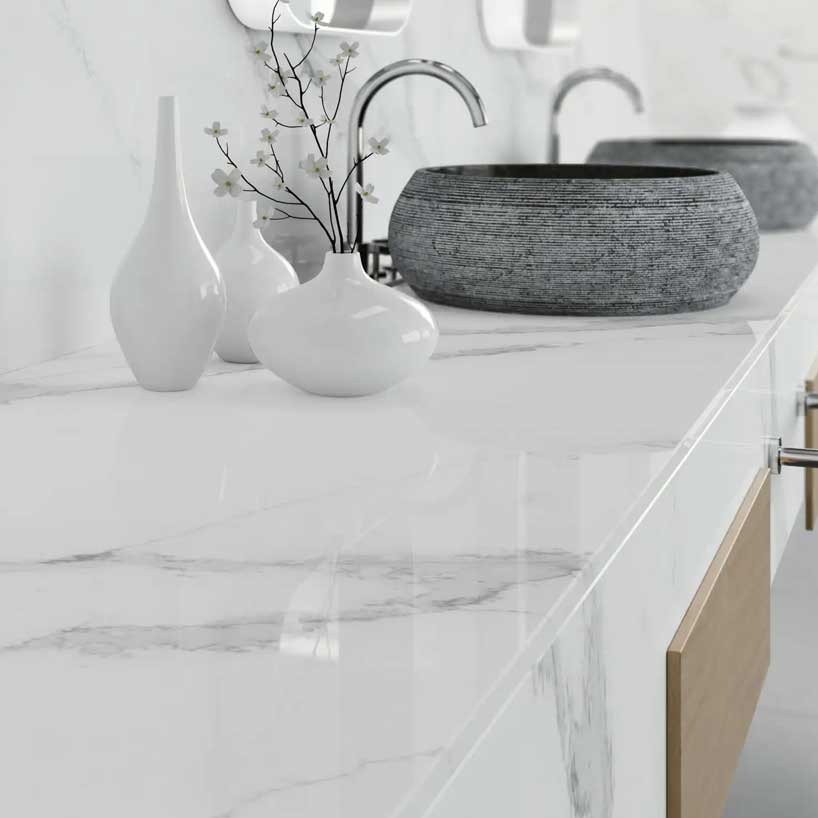
Calacatta is the look that half of Chicago’s kitchen remodels are chasing right now. That bright white field crossed by bold, dramatic veining, whether in soft gray or warm gold, is the single most requested countertop aesthetic we see walk through our Crestwood showroom. It reads as luxury the moment someone steps into the room, and it photographs beautifully, which is why designers and homeowners keep coming back to it.
But “Calacatta” is not one thing, and that is where most buyers get confused. You can get the Calacatta look in natural marble or in engineered quartz, and those two materials behave completely differently in a real kitchen. Pick the wrong one for how you actually live, and you will either spend years babying a surface or looking at a manufactured pattern you wish had more depth.
This is the complete guide, from a shop that stocks Calacatta slabs, cuts them, and installs them across Chicagoland. One spelling note before we start: the correct name is Calacatta, though many people search for it as “Calacutta” or “Calcutta.” They are all the same stone.

What Calacatta Actually Is
True Calacatta is a natural marble quarried in the Apuan Alps around Carrara, in the Tuscany region of Italy. Marble from this region has been cut and shipped worldwide since Roman times.
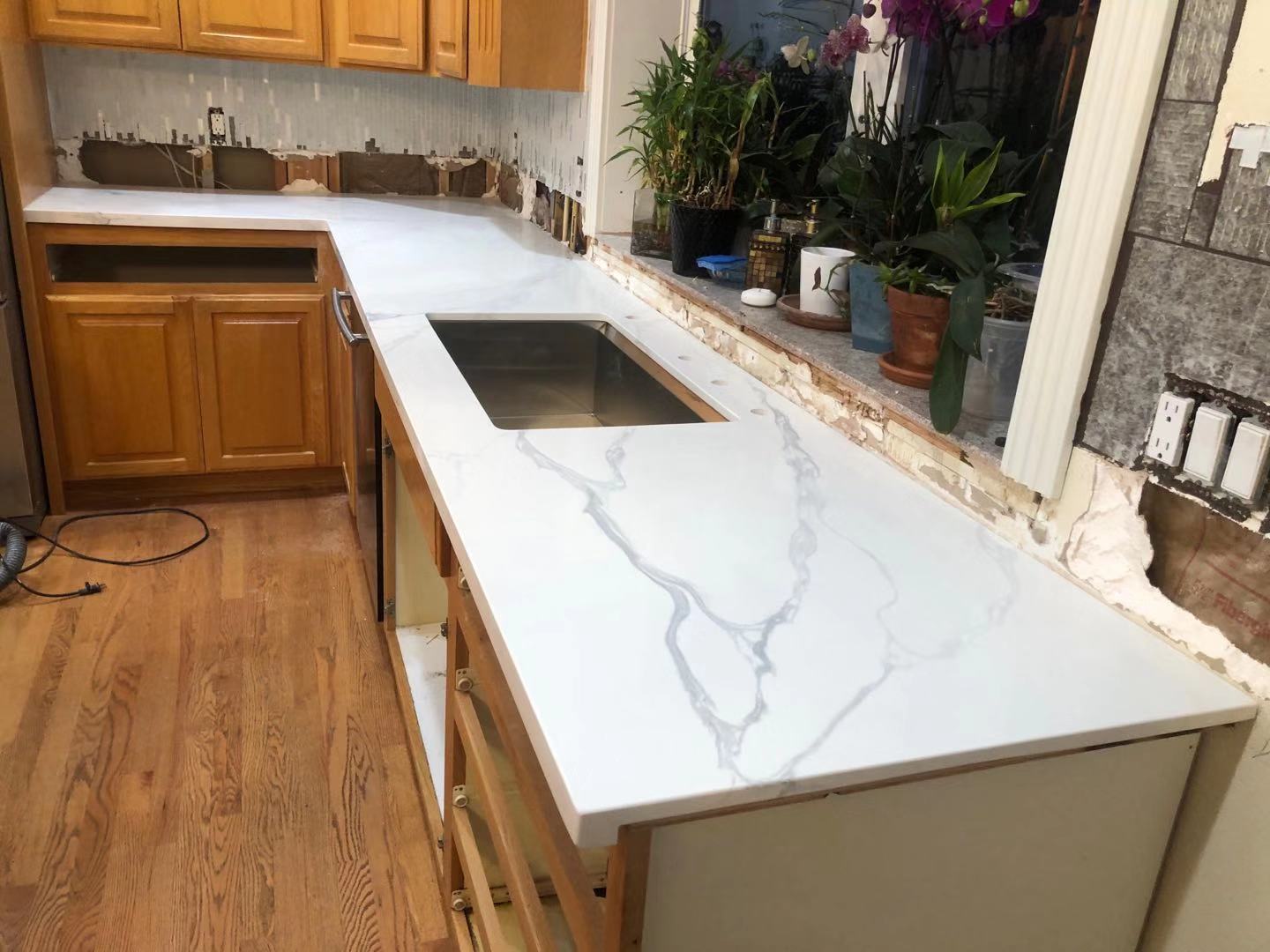
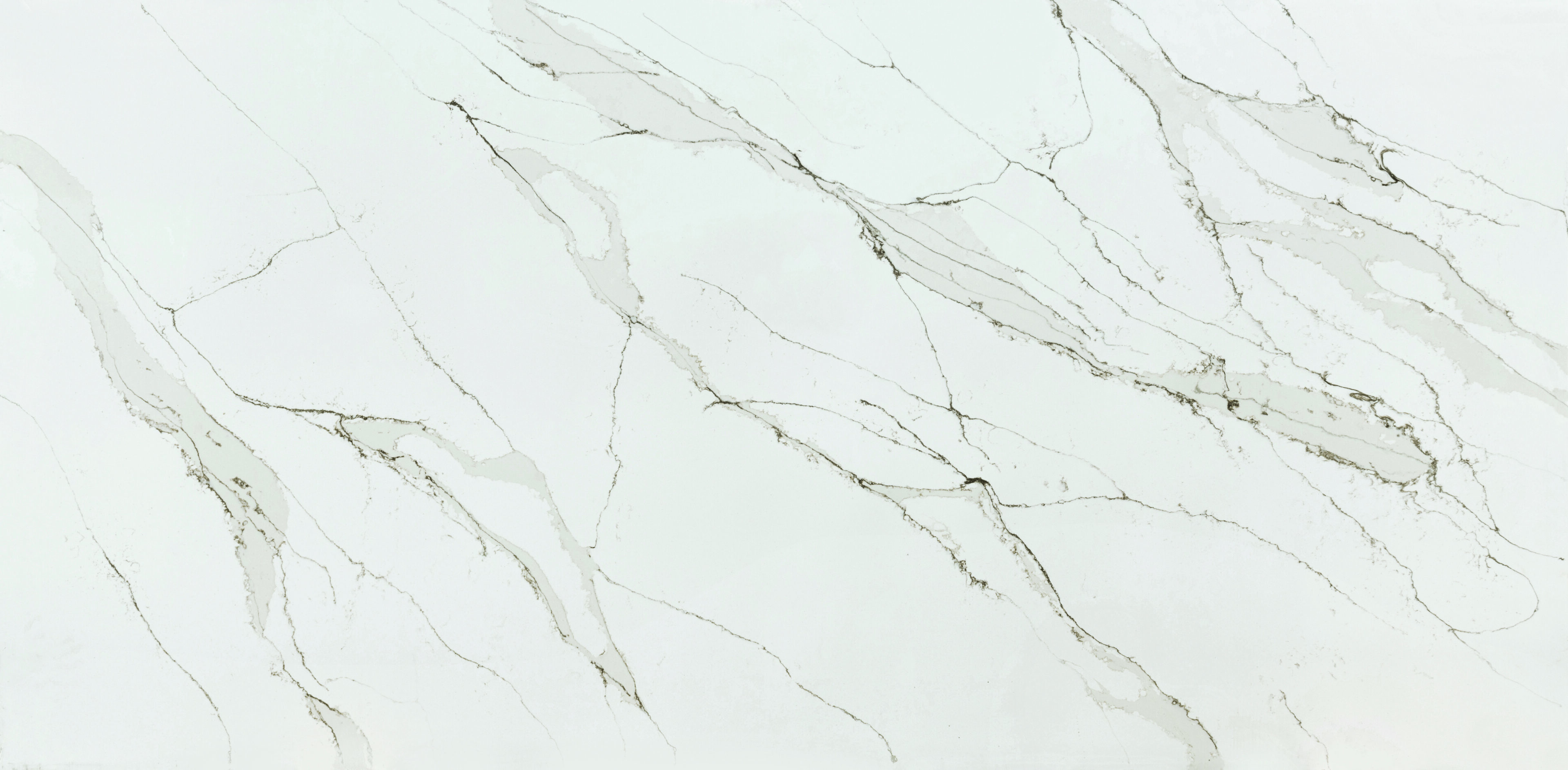
Here is the detail most people miss: Calacatta is technically part of the same broader Carrara marble family, quarried in the same mountains, but it is a distinct and rarer material. The difference comes down to appearance. Carrara marble has a softer, grayer field with fine, feathery gray veining. Calacatta has a whiter, brighter background with bolder, thicker, more defined veins that make a statement rather than a whisper, and those veins can run from deep gray through beige and into rich gold and brown.
That whiteness and that dramatic veining are exactly why Calacatta commands a premium. As a general rule, the whiter the field and the more striking the veining, the rarer and more expensive the slab. Only certain quarry areas produce true Calacatta, which is what separates it from more abundant Carrara.
One important caution for any Chicago buyer: the name gets used loosely in the trade. Because Calacatta is desirable, some suppliers label material “Calacatta style” or “Calacatta type” for stone that was quarried elsewhere and lacks the geological characteristics and value of authentic Italian Calacatta. When you are buying natural stone, quarry origin matters, and it is a fair question to ask. When you visit us, you can see the actual slab and we will tell you what it is.

The Big Decision: Calacatta Marble or Calacatta Quartz
This is the fork in the road, and it determines everything about cost, care, and how the surface ages.
Calacatta marble is the real, natural stone. It is composed almost entirely of calcium carbonate, which gives it a luminous, almost translucent quality that engineered products struggle to match. The white seems to glow softly and the veins appear to have depth inside the stone rather than sitting on the surface. Every slab is unique. It also sits low on the hardness scale, around a three out of ten, and it is porous, which means it stains and etches without proper care.
Calacatta quartz is an engineered surface, made from roughly 90 percent or more ground natural quartz bound with resins and pigments, with the Calacatta veining pattern designed in. Modern manufacturing, including digital printing and layered veining, reproduces the look convincingly. It is nonporous, never needs sealing, resists stains and scratches, and stays consistent slab to slab, which makes matching easy across a large kitchen.
The honest tradeoff:
Choose Calacatta marble if you want authentic, unrepeatable natural beauty and you either embrace the way marble ages or you are putting it in a low use application. Nothing engineered fully replicates the translucency and organic movement of the real stone.
Choose Calacatta quartz if you want the look with far less worry. A busy family kitchen, a rental, a household that will not baby a surface, or a commercial space is almost always better served by quartz. You give up a little depth and authenticity and you gain a surface that shrugs off daily life.
We cover the broader material tradeoffs in our quartz vs granite vs quartzite comparison, and marble specifically in our guide to marble countertops in Chicago.
Etching: The One Thing Marble Buyers Must Understand
If you are leaning toward Calacatta marble, this section is the most important one in the guide.
Marble is calcium carbonate, and acid dissolves it. Lemon, vinegar, wine, tomato, coffee, and many common household cleaners will lightly etch the polished surface where they touch, leaving a dull spot. This is not staining and it is not something sealer prevents. Sealer is a stain barrier, not an acid barrier. Nothing you apply to marble makes it etch proof, because the acid reacts with the stone itself.
There is a way to live with this beautifully, and it comes down to two choices:
Honed instead of polished. A honed, matte finish hides etching dramatically better than a glossy polished one, because an etch is a dull spot and a honed surface is already matte. For a Calacatta marble kitchen, honed is almost always the right call.
The right room. Put marble where acid rarely goes. We come back to this below.
We go deeper on etching, patina, and honed versus polished in our dedicated marble countertops guide. If a faint ring where a wine glass sat would bother you every time you saw it, that is your signal to choose Calacatta quartz instead.
Calacatta in the Kitchen
The kitchen is where Calacatta makes its biggest statement and where the marble versus quartz decision matters most.
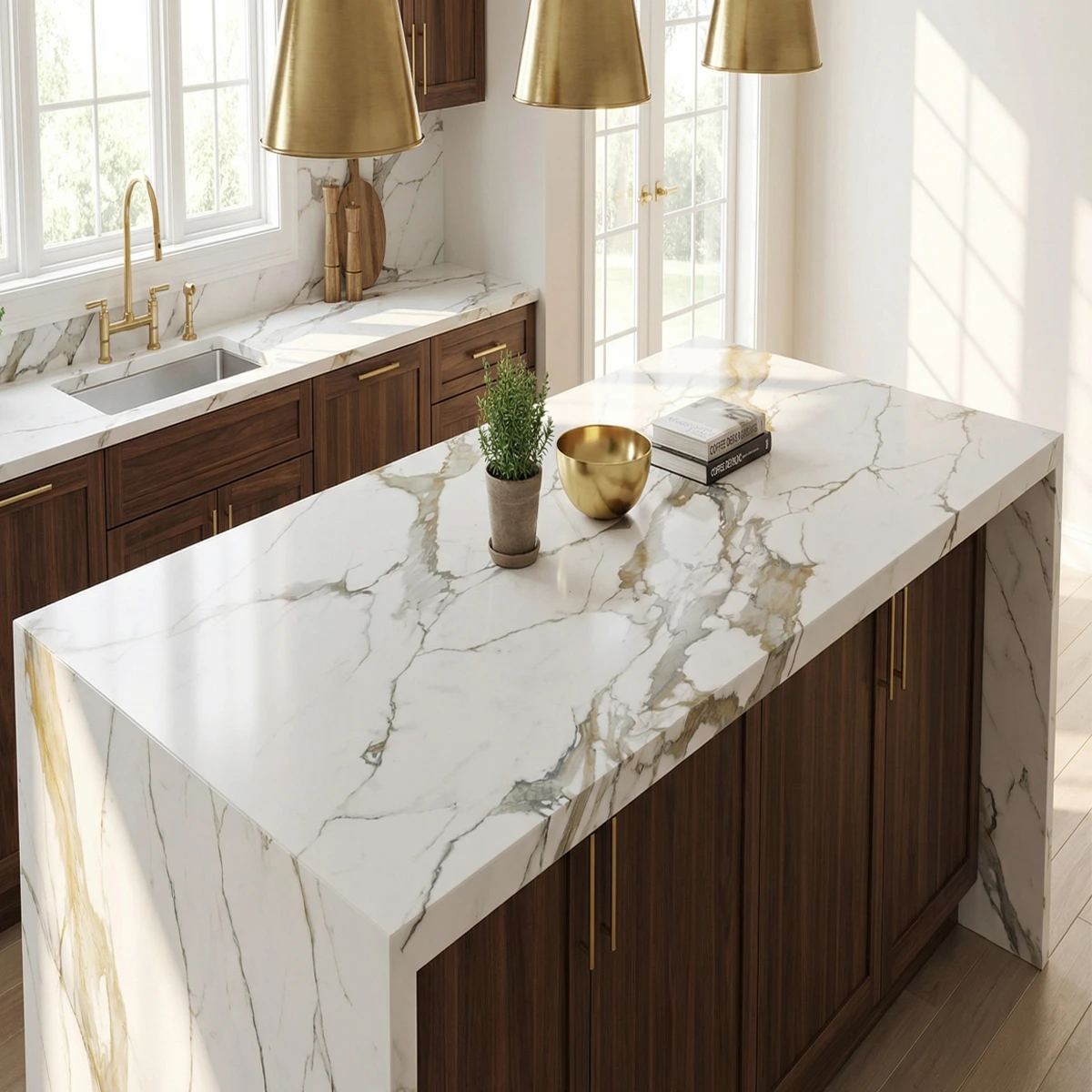
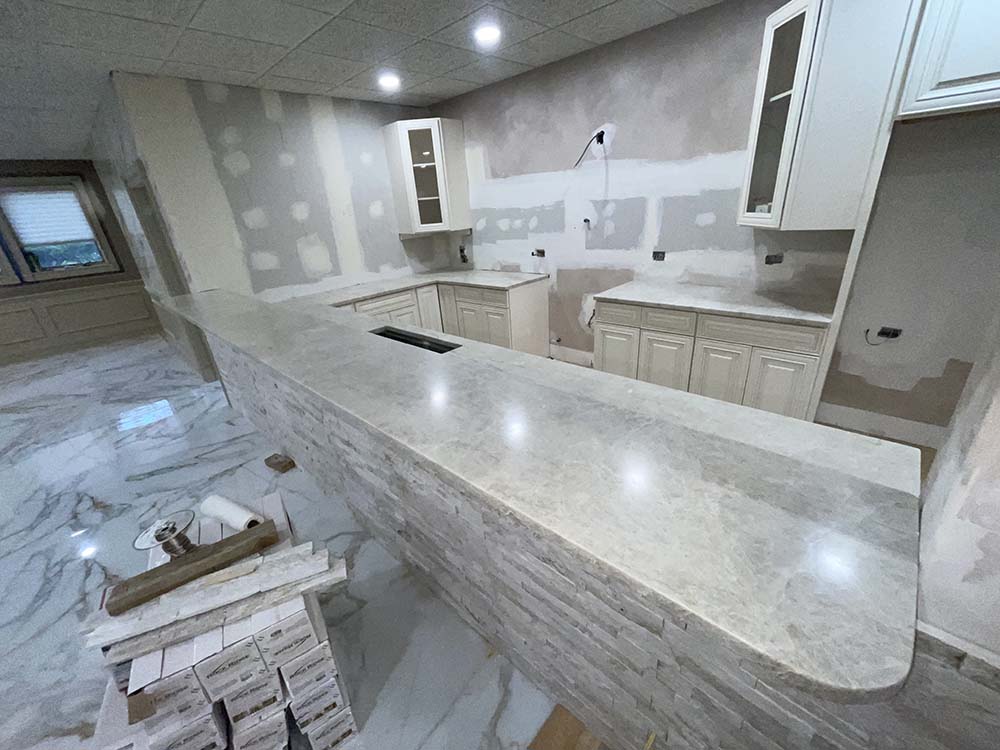
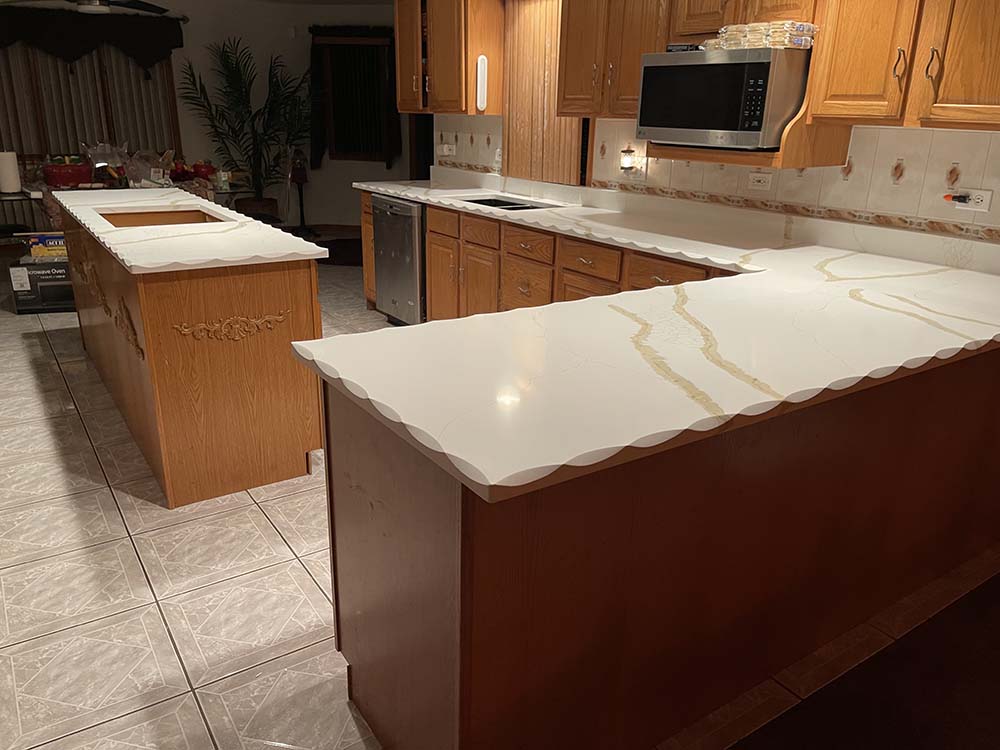
The showpiece island. This is the number one Calacatta request we get. A large island in Calacatta, with the veining laid out to flow across the surface, becomes the centerpiece of the whole room. For an island specifically, marble is more defensible than you might think, because islands often see less acidic prep than the perimeter around the stove and sink. Many Chicago homeowners put Calacatta quartz on the hardworking perimeter and splurge on a marble island, or do the whole kitchen in quartz for total peace of mind.
Waterfall edges. Calacatta veining running down a waterfall island panel is stunning, and it is a place where the pattern layout across the miter is a real craft decision. This is shop work, and how the vein turns the corner is something we plan on the actual slab.
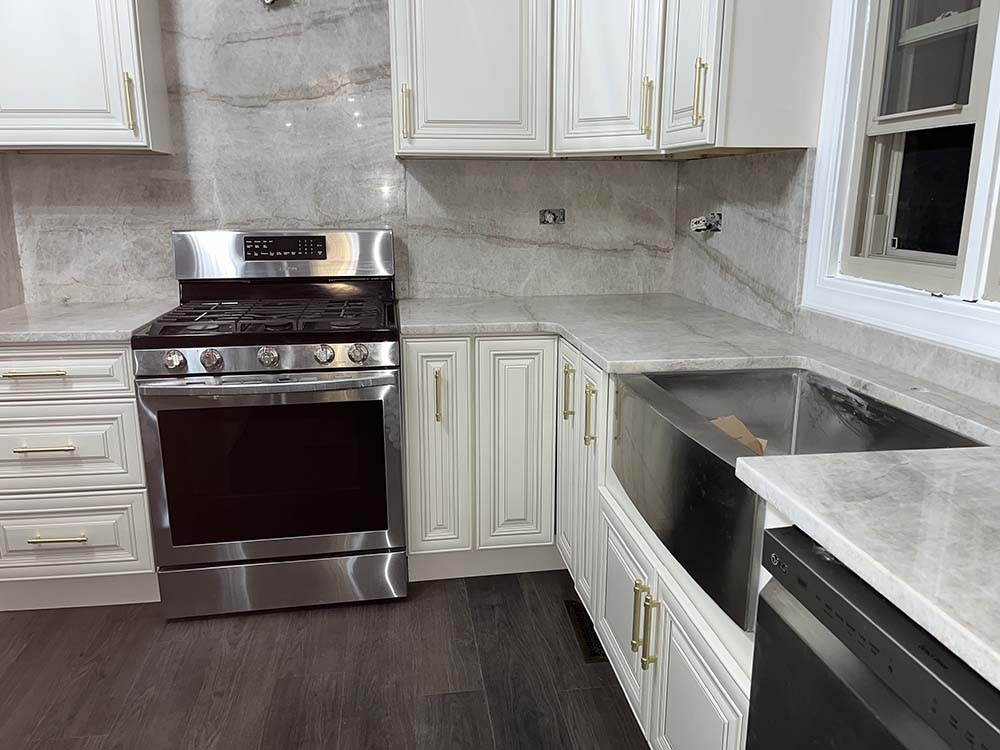
Full height backsplashes. A Calacatta slab backsplash running up to the hood is one of the most dramatic looks in kitchen design right now. Backsplashes are vertical, so they never see a cutting board or a wine glass, which makes even marble low risk here.
Perimeter counters. The hardest working surface in the house. If you cook daily with acidic ingredients, this is where quartz earns its keep.
Whichever way you go, see full slabs before you commit. Calacatta veining varies enormously piece to piece in natural marble, and where the vein lands on your island is a design decision, not luck. Our kitchen countertops page covers the application, and our kitchen countertop buying guide walks through the full selection process.
Calacatta in the Bathroom
If there is a single best place for Calacatta marble in a home, it is the bathroom.
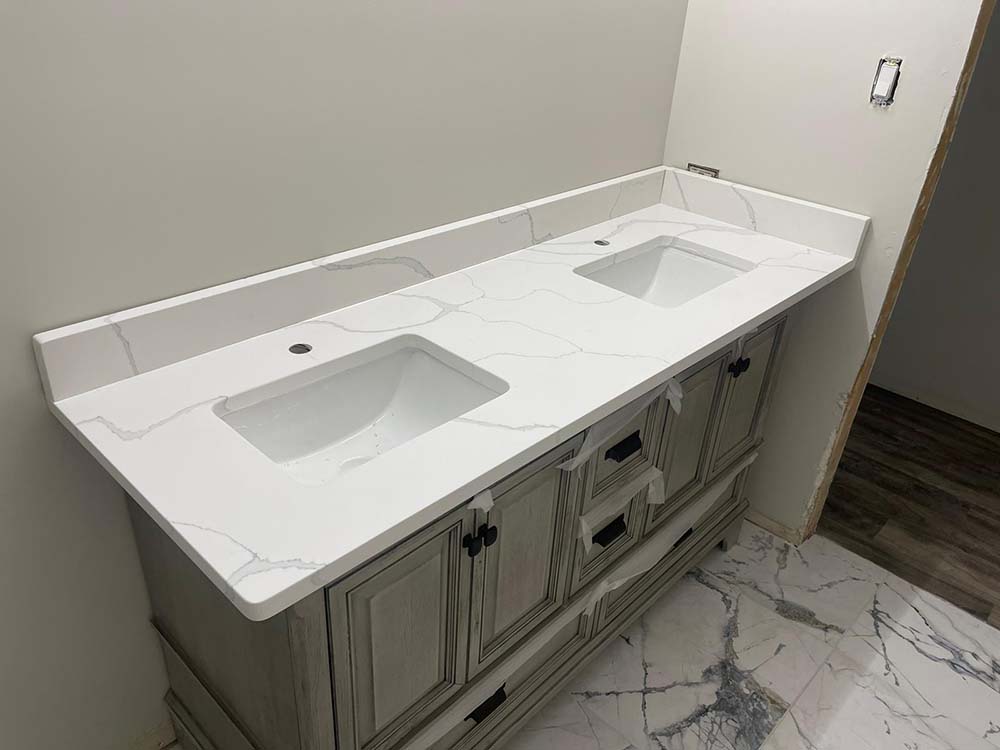
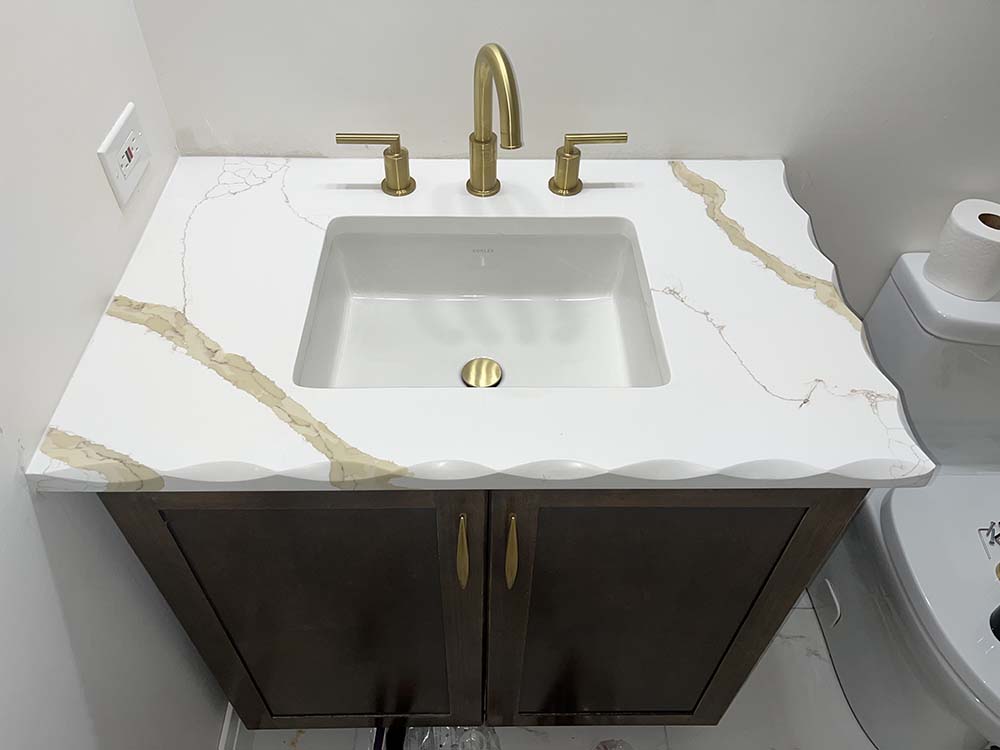
A vanity top sees almost no acid, very little heat, and light daily use. Calacatta marble here gives you the full luminous, luxurious look with a fraction of the worry a kitchen brings. The main thing to watch is cosmetics, since some products are acidic, and switching to a stone safe cleaner. For a powder room or a primary bath vanity, marble is a genuinely low risk, high reward choice.
Because a vanity is a small piece, it is also frequently a remnant opportunity, which can bring a premium Calacatta look into reach at a much lower material cost. A full slab kitchen might be out of budget while a Calacatta vanity from a remnant is very achievable.
Quartz Calacatta works beautifully in bathrooms too, particularly in a busy family bath or a rental, where the nonporous surface handles toothpaste, cosmetics, and constant wiping without a second thought. See our bathroom vanity tops page.
Calacatta in Restaurants, Cafes, and Commercial Spaces
Calacatta is a hospitality favorite, but the material choice shifts hard toward quartz in commercial settings, for good reasons.
Where Calacatta shines commercially: host stands, reception desks, retail display counters, back bars, feature walls, bathroom vanities, and pastry or coffee display counters. These are high visibility, lower contact surfaces where the look does the work.
Where marble struggles commercially: any bar top serving citrus and wine, and any direct food prep surface. A cocktail bar in polished Calacatta marble will etch fast under a nightly assault of lime, lemon, and acidic mixers. And for direct food contact, porous natural stone is generally not the right answer under food service sanitation expectations, which is why commercial kitchens lean on nonporous surfaces.
Calacatta quartz solves most of this. It delivers the sought after look with a nonporous, low maintenance surface that survives commercial cleaning products and heavy traffic. For a cafe counter, a bakery display, or a restaurant host stand, Calacatta quartz is frequently the ideal answer. We cover the full commercial picture, including food contact considerations and turnaround, in our guide to restaurant and cafe countertops in Chicago, and the scope on our commercial countertops and restaurant and cafe countertops pages.
One note for Chicago restaurant owners: we are fabricators, not your code authority. Confirm any direct food contact surface with your inspector and architect before committing to a material.
Veining, Layout, and Why Seeing the Slab Matters
With Calacatta more than almost any other stone, the slab selection is the design.
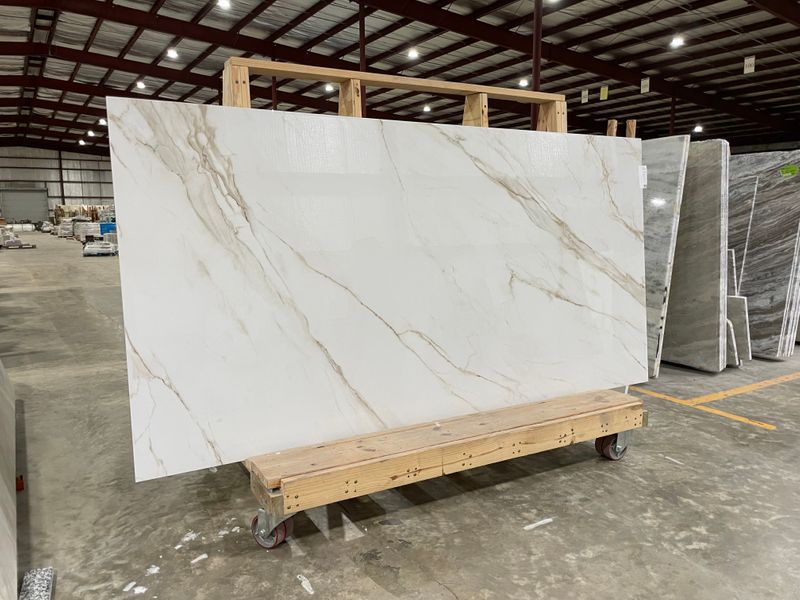
In natural Calacatta marble, no two slabs are alike. The direction the veining runs, how thick it is, and how the gray and gold move across the piece are unique to that slab, and a two inch sample tells you nothing. Where that dramatic vein crosses your island or turns your waterfall corner is a decision we make together, on the actual stone, before the saw runs.
Even in Calacatta quartz, which is far more consistent, the veined patterns have a direction, and on a large island or a run with seams, laying it out well is what separates a polished result from a disjointed one.
This is the heart of what a fabricator does that a reseller cannot. We template your space, lay your pieces out on the real slab in our Crestwood shop, plan where the veining flows and where any seams fall, then cut and install with our own crew. You can stand in front of your actual slab and see the plan. Our custom fabrication page covers the process, and because Calacatta slabs are large and dramatic, seam planning matters, which we explain in our post on countertop seam placement.


Cost and What Drives It
Calacatta sits in the upper tier of countertop pricing, and a few things move the number. Natural Calacatta marble costs more than Carrara because it is rarer, and the whiter and more dramatic the slab, the higher the price. Calacatta quartz varies by brand and by how convincingly the pattern is engineered, with premium veined lines costing more than basic ones. On top of the material, you are paying for fabrication, edge work, cutouts, and installation, which do not change based on how pretty the stone is.
If a full Calacatta kitchen is beyond budget, there are smart ways in: a marble island with quartz perimeter, a Calacatta vanity from a remnant, or Calacatta quartz throughout for a lower and more predictable number. Our countertop cost guide breaks down what goes into a quote, and every estimate we give is free, written, and no obligation.
Caring for Calacatta
Marble: use a stone safe, pH neutral cleaner, never vinegar or bleach. Wipe acidic spills immediately. Use cutting boards and coasters. Seal periodically for stain resistance. Choose honed to minimize visible etching. Embrace patina as part of the material’s character.
Quartz: mild soap and water. No sealing, ever. Keep hot pans on trivets, since the resin binder is heat sensitive, and avoid harsh chemicals.
See Calacatta in Person at Our Crestwood Showroom
You cannot choose Calacatta from a photo or a chip. The whole point of this stone is the veining, and veining only tells its story across a full slab.
We keep Calacatta marble and Calacatta quartz slabs in stock at our Crestwood showroom and yard, so you can walk the racks, compare marble against quartz side by side, and see full pieces end to end before you commit. Bring your cabinet door and a flooring sample and hold them against the stone. Because we stock, cut, and install in house, most projects start without waiting on a supplier order, and one team handles your job from template to final walkthrough.
We fabricate and install Calacatta countertops across Chicago, Orland Park, Naperville, Schaumburg, Oak Lawn, Tinley Park, Downers Grove, Aurora, Bolingbrook, and Joliet. If you are choosing between materials, see our quartz countertops and quartzite countertops pages, since Calacatta quartzite is another route to the same look with natural stone hardness.
Come See Calacatta, or Have Us Bring It to You
Whether it is a showpiece marble island, a low maintenance quartz kitchen, a Calacatta vanity, or a restaurant buildout, we will show you the real slabs and tell you honestly which version suits how you actually use the space.
Visit the showroom at 4711 135th St, Crestwood IL 60418, Monday through Saturday, 9:00 a.m. to 6:00 p.m. Call (708) 362-7674 or request a free estimate and we will bring Calacatta samples to your home or business and measure at no charge. Free consultation, free written estimate, no obligation.

Serving Chicago & Surrounding Areas
Get Your Free Kitchen Countertop Estimate
Fill out the form and our team will get back to you in next 24 hours.