
Written by Al Jory Marble Team
Updated September 7, 2026
Choosing between Countertop Edge Profiles may seem like a small part of a kitchen remodel, but the edge changes how the entire countertop looks, feels and functions. A clean eased edge can make a dramatic quartzite slab feel modern, an ogee can add traditional detail, and a mitered edge can make a kitchen island appear much thicker and more architectural.
The edge also affects fabrication, cleaning, comfort around seating areas and, in some cases, the overall cost of the countertop project.
If you are already comparing kitchen countertops, do not wait until the slab is ready to be cut before thinking about the edge. The profile should work with the countertop material, cabinet style, island design and the way the surface will actually be used.
Quick answer: The most common countertop edge profiles include eased, beveled, bullnose, half-bullnose, ogee and mitered edges. Eased edges are clean, versatile and easy to maintain; beveled edges add subtle definition; bullnose edges create a softer rounded appearance; ogee profiles suit more traditional designs; and mitered edges create the appearance of a thicker countertop. The best choice depends on your stone, kitchen style, island design, maintenance preferences and fabrication budget.
Countertop Edge Profiles: Why Does the Edge Matter?
The slab gets most of the attention.
That makes sense. Color and veining dominate the visual design.
But the edge is where your countertop physically meets the room.
It is what you see along:
- Kitchen islands
- Peninsula seating
- Sink runs
- Bathroom vanities
- Bar tops
- Waterfall transitions
- Exposed countertop ends
The profile can make the same slab feel completely different.
A dramatic natural stone with a simple edge may look contemporary and architectural.
The same material with an ornate ogee can feel much more traditional.
That means the right question is not:
“Which edge is the fanciest?”
It is:
“Which edge makes this particular countertop look right?”
Start With the Style of the Kitchen
Before comparing individual Countertop Edge Profiles, look at the kitchen as a whole.
Is it:
- Modern
- Transitional
- Traditional
- Minimalist
- Farmhouse-inspired
- Contemporary luxury
- Classic
- Commercial
The edge should support that design rather than fight against it.
Modern kitchens
Clean profiles generally work best.
Consider:
- Eased
- Slight bevel
- Mitered
Transitional kitchens
You have more flexibility.
Consider:
- Eased
- Beveled
- Half-bullnose
- Subtle decorative profiles
Traditional kitchens
More detailed edges can work beautifully.
Consider:
- Bullnose
- Ogee
- Decorative combinations
This does not mean an ogee cannot work in a modern home or an eased edge cannot work in a traditional kitchen.
It simply means the edge should feel intentional.
Eased Edge: The Clean, Versatile Choice
An eased edge is one of the most commonly selected countertop profiles.
The top corner is softened slightly rather than left completely sharp, while the overall shape remains clean and rectangular.
It works because it does not compete with the stone.
An eased edge is especially good for:
- Modern kitchens
- Transitional kitchens
- Quartz countertops
- Granite countertops
- Quartzite countertops
- Marble countertops
- Busy family kitchens
- Commercial surfaces
- Large islands
The edge allows veining and color to remain the main design feature.
That can be particularly valuable when you have invested in a visually dramatic slab.
Why homeowners like eased edges
They are:
- Clean-looking
- Comfortable to touch
- Easy to wipe
- Visually simple
- Compatible with nearly every countertop material
- Less likely to make a kitchen feel overly decorated
A simple edge does not mean a cheap-looking countertop.
In many high-end kitchens, restraint is exactly what makes the stone look expensive.
Beveled Edge: More Definition Without Becoming Ornate
A beveled edge introduces an angled cut along the top portion of the countertop.
It creates more visual definition than an eased edge without moving into a heavily decorative style.
Depending on the depth of the bevel, the effect can be subtle or pronounced.
A beveled edge works well when you want:
- A visible edge detail
- Clean geometry
- Transitional styling
- A slightly more formal appearance
- More interest than a standard eased profile
Bevels can look particularly attractive on stone with relatively quiet patterns because the edge itself becomes part of the design.
On highly dramatic stone, consider whether the extra geometry helps or competes with the veining.
Bullnose Edge: Soft and Rounded
A bullnose profile rounds the edge rather than leaving a squared appearance.
A full bullnose creates a rounded curve across much of the exposed edge.
This gives the countertop a softer appearance.
Bullnose edges can work well for:
- Traditional kitchens
- Family-oriented spaces
- Bathroom vanities
- Curved cabinetry
- Countertops where a softer edge is preferred
The rounded surface can also feel comfortable around areas where people frequently lean against the countertop.
One visual consideration is that a full bullnose can make the countertop appear slightly thinner because the edge curves away rather than presenting a strong vertical face.
That is not necessarily a disadvantage.
It simply creates a different visual effect.
Half-Bullnose Edge: Softer Without Losing the Countertop Face
A half-bullnose rounds the upper portion while leaving more of the lower vertical face visible.
This creates a compromise between:
- A square/eased appearance
- A completely rounded bullnose
It can work well when the homeowner wants a softer touch but does not want the countertop to look fully rounded.
Half-bullnose edges are often useful in:
- Transitional kitchens
- Traditional kitchens
- Bathroom vanities
- Family kitchens
- Natural-stone installations
It is a quieter detail than an ogee and a softer detail than an eased edge.
Ogee Edge: Traditional Detail and Visual Depth
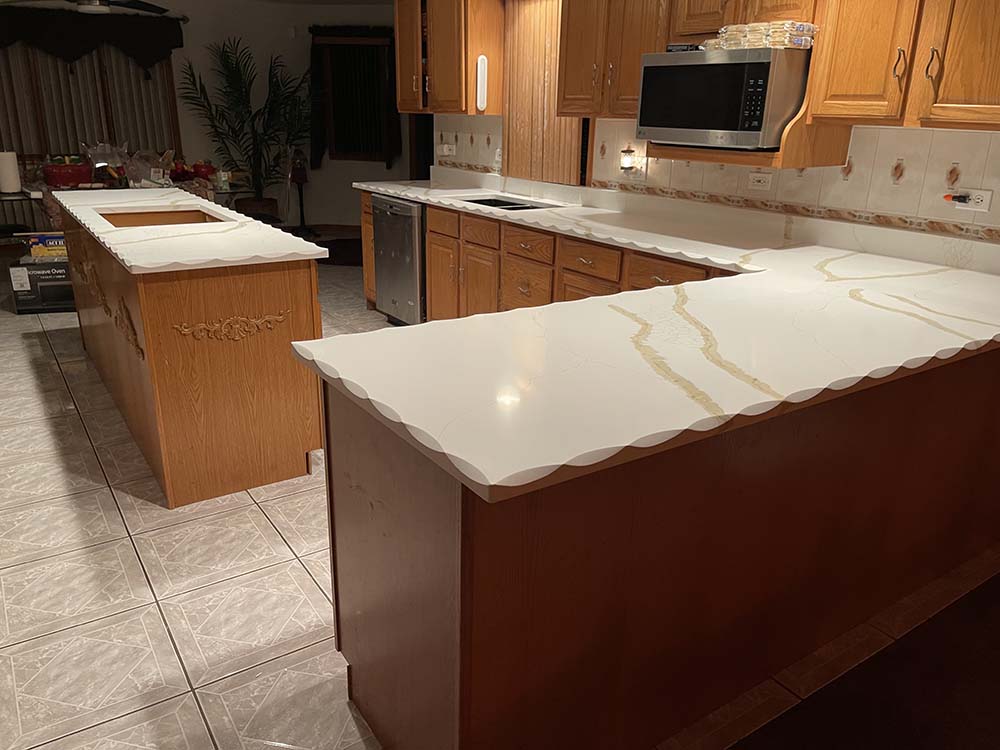
An ogee is more decorative.
Instead of one straight or rounded transition, the edge uses curves to create a more sculpted profile.
Ogee edges are commonly associated with:
- Traditional kitchens
- Classic cabinetry
- Detailed millwork
- Decorative islands
- Formal spaces
An ogee can add elegance when it matches the rest of the room.
But it is not automatically the “premium” choice.
A highly decorative edge placed next to ultra-modern flat-panel cabinets can feel disconnected.
Ogee works best when the room already contains detail
For example:
- Raised-panel cabinetry
- Traditional moldings
- Decorative hood surrounds
- Furniture-style islands
- Detailed hardware
In those kitchens, an ogee can reinforce the overall design language.
Mitered Edge: The Thick Countertop Look
A mitered edge is one of the most popular ways to create the appearance of a substantially thicker countertop.
Instead of requiring the entire slab to be unusually thick, the fabricator cuts and joins pieces so the vertical face creates the illusion of greater thickness.
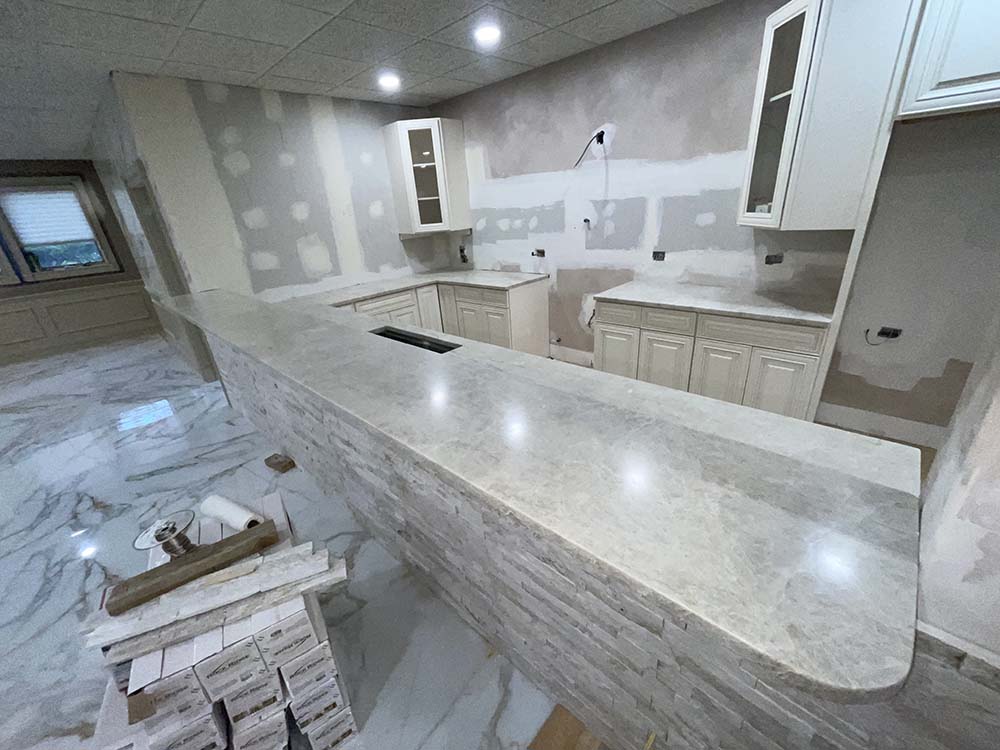
This is particularly popular on large kitchen islands.
Mitered edges work especially well for:
- Contemporary kitchens
- Large islands
- Waterfall designs
- Dramatic quartz
- Quartzite
- Premium statement surfaces
- Minimalist cabinetry
A thick mitered edge can make the island feel more architectural.
But it also requires more fabrication than a straightforward eased profile.
The pieces need to be cut accurately, aligned and finished so the transition looks deliberate.
For homeowners comparing the financial impact of design details, the Countertop Cost Guide explains why additional fabrication can affect the final quote.
Countertop Edge Profiles and Waterfall Islands Are Not Exactly the Same Thing
This causes confusion.
A mitered edge is an edge-fabrication technique.
A waterfall island is a design where countertop material continues vertically down one or both sides of the island.
Waterfall panels commonly use mitered transitions, which is why the terms sometimes get mixed together.
But they are not interchangeable.
You can have:
- A mitered thick-looking edge without a waterfall
- A waterfall panel with a carefully fabricated corner transition
- A standard countertop edge with no waterfall at all
The distinction matters when requesting a quote because a full waterfall requires considerably more material than simply changing the edge profile.
Countertop Edge Profiles for Kitchen Islands
Kitchen islands deserve extra attention because so much of the edge remains visible.
A perimeter countertop may have only one exposed front edge.
An island can be viewed from almost every direction.
That means the profile becomes part of the furniture-like appearance of the island.
For a modern statement island
Consider:
- Eased
- Mitered
For a transitional island
Consider:
- Eased
- Beveled
- Half-bullnose
For a traditional furniture-style island
Consider:
- Bullnose
- Ogee
- Decorative profile
Also think about seating.
People sitting at the island may rest their arms against the countertop edge regularly.
Comfort matters.
So does durability.
The most elaborate edge is not always the best edge for a heavily used breakfast island.
Countertop Edge Profiles for Quartz
Quartz countertops work with a wide variety of edge profiles.
Popular options include:
- Eased
- Beveled
- Bullnose
- Mitered
The pattern should influence the choice.
A simple solid or softly patterned quartz can handle a more noticeable edge.
A bold Calacatta-style quartz may benefit from a cleaner profile so the veining remains the star.
Mitered quartz islands
Mitered edges are particularly popular with dramatic quartz because they create a substantial island appearance while allowing the pattern to remain visually important.
When the design includes a waterfall, pattern alignment becomes even more important.
Countertop Edge Profiles for Granite
Granite countertops can accommodate both simple and decorative profiles.
Granite has enough visual depth to work with:
- Eased
- Beveled
- Bullnose
- Half-bullnose
- Ogee
The best choice depends heavily on the slab.
A granite with dramatic mineral movement may look better with a simpler edge.
A quieter granite paired with traditional cabinetry may support a decorative profile beautifully.
Because granite is natural stone, the edge also reveals the material itself.
That is part of its appeal.
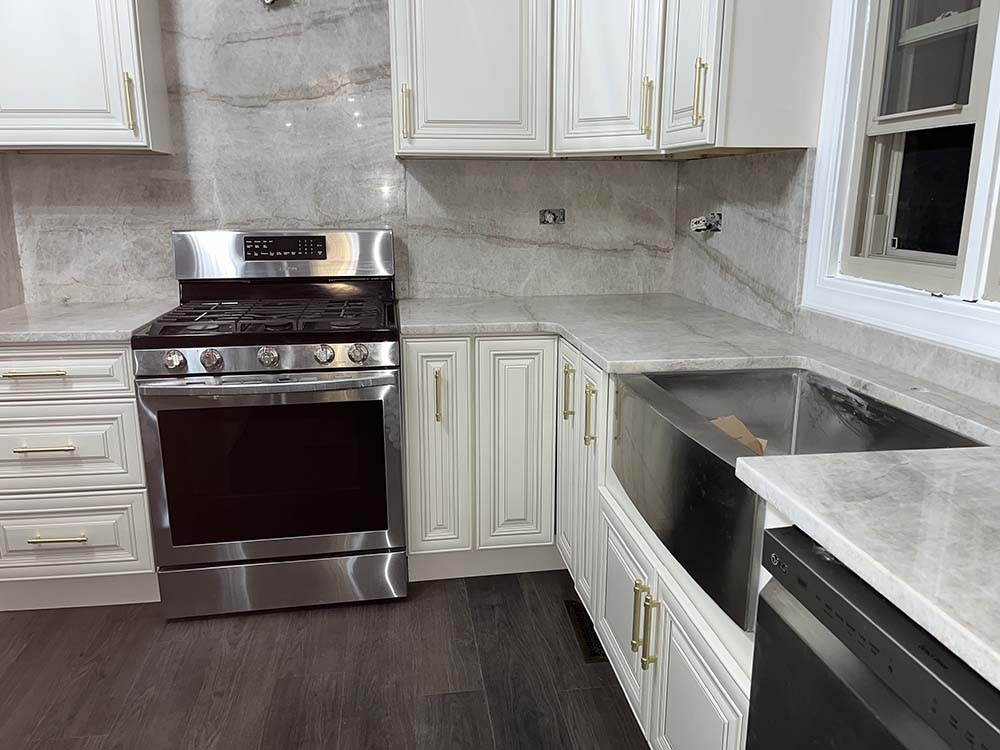
Countertop Edge Profiles for Quartzite
Quartzite countertops are often selected because the homeowner wants the natural movement to become a major design feature.
For that reason, cleaner profiles are frequently effective.
Consider:
- Eased
- Slight bevel
- Mitered
A dramatic quartzite island with sweeping veining usually does not need a complicated edge to look luxurious.
The stone is already doing the visual work.
Mitered edges can be especially impressive when a quartzite slab is used on a large statement island, but the fabrication should be planned carefully so the pattern looks intentional.
Countertop Edge Profiles for Marble
Marble countertops can work beautifully with both traditional and contemporary edges.
For a modern marble kitchen:
- Eased
- Beveled
- Mitered
For a traditional marble kitchen:
- Bullnose
- Ogee
- Decorative profiles
Marble has been used in architectural detailing for centuries, so sculpted edges naturally complement it.
However, marble is softer than granite or quartzite.
The edge is one of the areas most exposed to impact.
That makes both profile choice and professional fabrication important.
Does Countertop Thickness Affect the Edge?
Yes.
The thickness of the slab changes how an edge profile appears.
A decorative edge requires enough visible material for the shape to be readable.
A mitered edge creates an entirely different effect by making the countertop appear thicker than the slab itself.
When reviewing edge samples, make sure you understand how the profile will look on your actual material and thickness.
Do not assume a sample displayed in a showroom will look identical on a different slab.
Countertop Edge Profiles and Slab Veining
This is particularly important with natural stone and strongly patterned quartz.
A countertop edge does not exist separately from the slab pattern.
Veins can:
- Run into the edge
- Turn over a miter
- Continue onto a waterfall
- Disappear into an ornate profile
- Become more visible on a thick face
This is why slab layout and edge planning belong together.
Professional countertop fabrication includes more than cutting the countertop to size. Edge profiling, polishing and pattern planning affect what the finished surface actually looks like in the room.
Which Countertop Edge Is Easiest to Clean?
For homeowners who prioritize simple maintenance, a clean edge is usually the easiest choice.
An eased or lightly beveled profile has fewer decorative curves and transitions where dust, crumbs or residue can collect.
That makes these profiles particularly practical for:
- Busy kitchens
- Restaurants
- Bars
- Commercial surfaces
- Family islands
A decorative edge is not difficult to maintain, but it may require more attention along the detailed sections.
For commercial countertops, simple profiles are often preferred because surfaces need to be wiped repeatedly throughout the day.
Which Edge Is Best Around Children?
There is no universal child-safe countertop profile, and stone remains a hard surface regardless of the edge.
However, homeowners with active households sometimes prefer a profile that softens the exposed corner rather than leaving a sharper squared transition.
Possible options include:
- Eased
- Half-bullnose
- Bullnose
The overall kitchen layout matters just as much.
A protruding corner at a narrow walkway deserves more consideration than an edge along the back of an island seating area.
Discuss any high-traffic corners with the fabricator during measurement.
Countertop Edge Profiles for Bathroom Vanities
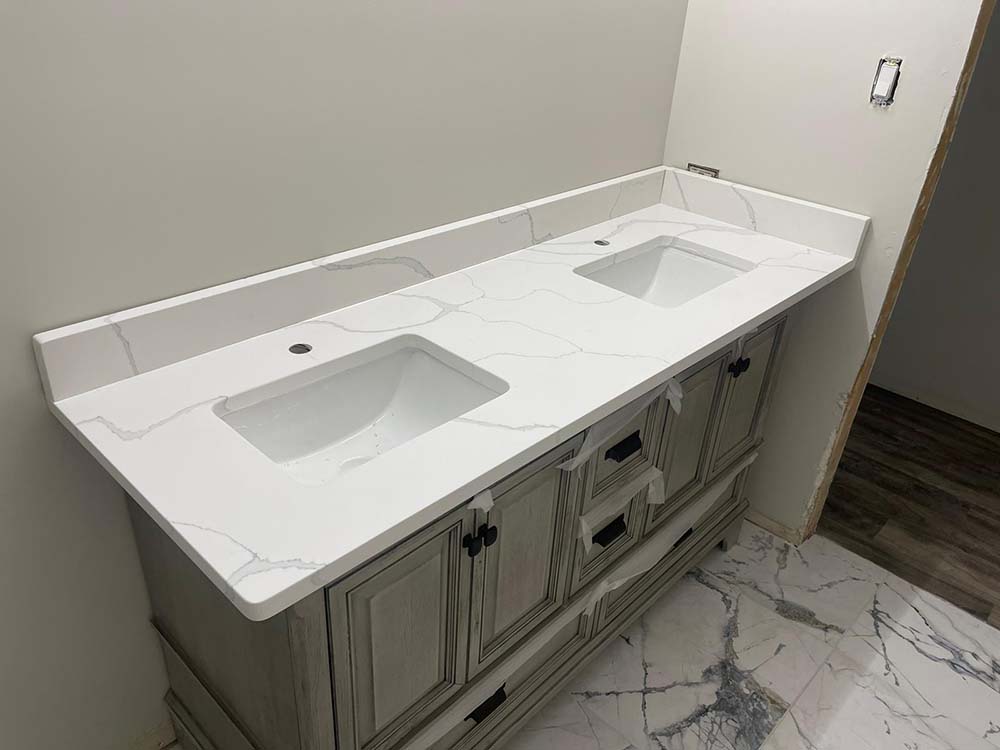
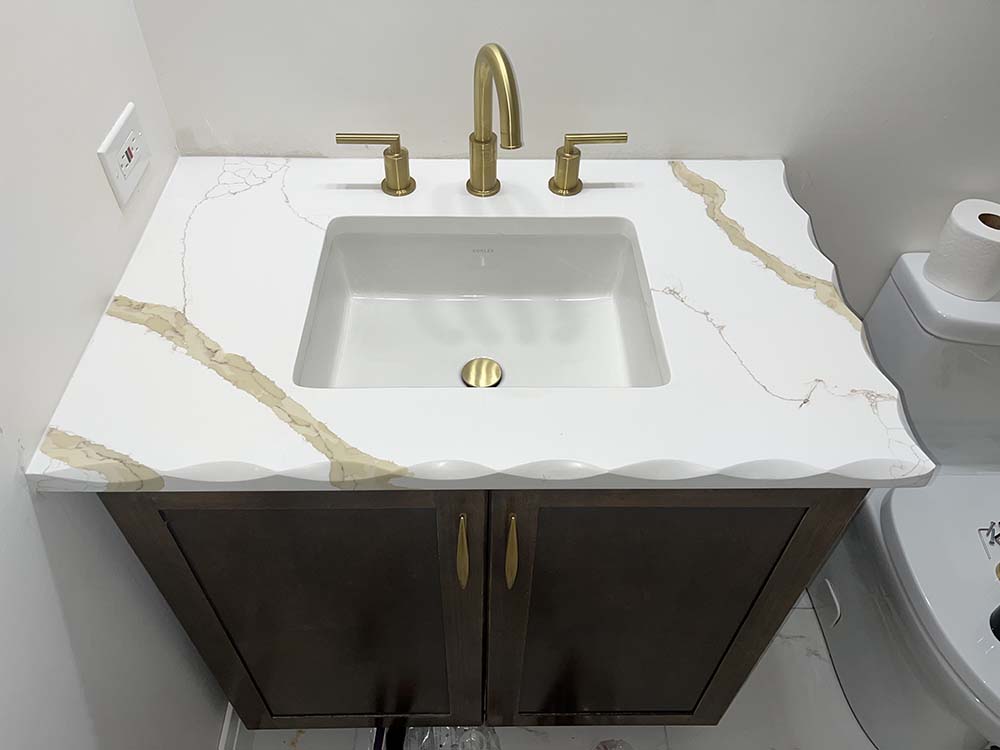
A bathroom vanity top gives homeowners more freedom to use decorative edges because the surface is typically smaller than a kitchen.
Popular vanity options can include:
- Eased
- Beveled
- Bullnose
- Ogee
A powder room is also a place where a premium remnant and a more detailed edge can make a small surface feel highly customized.
For smaller projects, countertop remnants may provide access to an interesting granite, quartz, quartzite or marble piece without requiring a full kitchen-sized slab purchase.
Does the Edge Profile Affect Countertop Cost?
It can.
The material is only one part of the countertop quote.
The edge also requires fabrication.
Generally, simpler profiles involve less fabrication than complex decorative or mitered designs.
Cost can be influenced by:
- Profile complexity
- Total exposed edge length
- Material
- Stone thickness
- Miter fabrication
- Hand finishing
- Polishing
- Special corners
If budget matters, ask the fabricator to show you the difference between a standard edge and the upgraded profile you are considering.
That is much more useful than assuming every edge is included in the same price.
The Countertop Cost Guide explains how fabrication choices combine with material, cutouts and installation to determine overall project cost.
Do All Edges Cost More Than an Eased Edge?
Not necessarily in exactly the same way, because each fabricator structures pricing differently.
But additional shaping generally means additional fabrication.
When requesting your written estimate, ask:
- Which edge is included?
- Which profiles are upgrades?
- How is upgraded edging priced?
- Does the island have more exposed edge than the perimeter?
- Does a miter require additional material?
- Is edge polishing included?
This is why a clear countertop quote matters.
A homeowner comparing two estimates should make sure both companies are pricing the same edge.
Countertop Edge Profiles and Sink Cutouts
The visible edge around an undermount sink is technically another finished stone edge.
It needs to be:
- Accurately cut
- Smoothed
- Finished
- Polished appropriately
This is another example of why fabrication quality matters beyond the front edge of the countertop.
The main front profile may be eased or ogee, while the sink opening has its own finished treatment.
Sink selection should therefore happen before fabrication.
How Corners Affect the Edge Profile
Corners deserve attention, particularly on islands and peninsulas.
The fabricator needs to consider how the profile transitions around:
- Outside corners
- Inside corners
- Curved ends
- Seating corners
- Waterfall transitions
An edge that looks simple on a straight sample can become more complex where two countertop runs meet.
This is one reason final countertop installation quality depends heavily on accurate templating and fabrication before the pieces arrive at the house.
Countertop Edge Profiles: Polished vs. Honed Stone
The surface finish can change the way the edge looks.
A polished stone reflects more light, which can make detailed edge contours more visible.
A honed surface creates a softer appearance.
When choosing an edge, evaluate the profile with the finish you actually intend to use.
For marble in particular, a polished ogee and a honed eased edge create very different design personalities even if the slab itself is identical.
Should the Island Edge Match the Perimeter Edge?
Usually, but it does not have to.
Using the same edge throughout creates consistency.
Using a different edge on the island can emphasize it as a focal point.
For example:
Perimeter: eased edge
Island: thick-looking mitered edge
This can work well because the island is intentionally designed as a different element.
The key is to make the difference obvious enough to look deliberate.
Small differences that are barely noticeable can sometimes look like a fabrication inconsistency rather than a design decision.
Should a Waterfall Island Have a Mitered Edge?
Waterfall islands commonly use mitered transitions because the goal is to make the horizontal and vertical surfaces appear to flow together.
But the exact construction should be determined by the fabricator based on:
- Material
- Pattern
- Slab thickness
- Island dimensions
- Cabinet design
The important part for the homeowner is to raise the waterfall question before slab layout begins.
Waterfalls consume additional material and require the horizontal and vertical pieces to be planned together.
Common Countertop Edge Profile Mistakes
Choosing an edge should be simple, but several mistakes can affect the finished design.
Choosing the edge before choosing the slab
The profile should complement the actual material.
Assuming decorative means expensive-looking
Sometimes a simple eased edge looks more refined.
Ignoring cabinet style
An ornate edge can conflict with minimalist cabinetry.
Forgetting about island seating
The edge is physically close to anyone sitting at the island.
Choosing from a tiny edge sample alone
Look at photographs of completed countertops too.
Forgetting to ask about cost
Do not assume every edge profile is included in the base estimate.
Adding a miter after material has been calculated
Mitered details may affect both fabrication and material planning.
Calling every waterfall a “waterfall edge”
A waterfall panel and an edge profile are related but different decisions.
Ignoring slab movement
The veining should still look intentional after the edge is fabricated.
Countertop Edge Profiles: A Simple Decision Guide
If you are still undecided, use this quick framework.
Choose an eased edge if:
- You want clean and timeless
- You have dramatic stone
- Easy maintenance matters
- Your kitchen is modern or transitional
- You do not want the edge to dominate the design
Choose a beveled edge if:
- You want subtle additional detail
- You like geometric lines
- You want more definition than an eased edge
Choose a bullnose or half-bullnose if:
- You prefer a softer profile
- Your kitchen leans traditional or transitional
- You like rounded details
Choose an ogee if:
- Your kitchen is traditionally styled
- Cabinetry has decorative detail
- You want the countertop edge itself to become a design feature
Choose a mitered edge if:
- You want a thick architectural appearance
- The island is a focal point
- You are considering waterfalls
- Your kitchen has a contemporary design
That eliminates most of the confusion.
Questions to Ask Before Choosing Your Countertop Edge
Before the slab is fabricated, ask:
- Which edge is included in my quote?
- Which edges cost more?
- Can I see physical edge samples?
- Which profile works best with my stone?
- Will this edge show the veining well?
- How will the edge look around corners?
- Is the island getting the same edge?
- How will the sink opening be finished?
- Does a miter require additional material?
- Will the profile work with my countertop thickness?
- Is this edge appropriate for a busy kitchen?
- How will it look with a honed or polished finish?
These are simple questions.
But they prevent the homeowner from making one of the most visible fabrication decisions at the last minute.
Countertop Edge Profiles FAQs
What is the most popular countertop edge profile?
An eased edge is one of the most versatile and commonly selected options because it works with modern, transitional and traditional kitchens without competing with the countertop material.
What is the easiest countertop edge to clean?
Simple profiles such as eased and lightly beveled edges are generally among the easiest to wipe because they contain fewer decorative curves.
What edge makes a countertop look thicker?
A mitered edge can create the appearance of a much thicker countertop by adding a vertical stone face at the perimeter.
Is a mitered edge the same as a waterfall edge?
No. A miter is a fabrication technique used to join pieces, while a waterfall design continues countertop material vertically down the side of an island.
Is an ogee edge outdated?
Not inherently. Ogee edges remain appropriate for traditional and highly detailed kitchens. They may feel less natural in minimalist contemporary designs.
Is bullnose good for a kitchen island?
It can be. A bullnose creates a softer rounded appearance and can work particularly well in traditional or family-oriented kitchens.
Which countertop edge looks most modern?
Eased and mitered profiles are commonly used in modern kitchens because of their clean geometry.
Which edge is best for quartz?
Quartz works with many profiles. Eased, beveled and mitered edges are especially common, but the best choice depends on the quartz pattern and kitchen design.
Which edge is best for quartzite?
Simple eased or mitered edges often allow dramatic quartzite veining to remain the main visual feature.
Which edge works best with marble?
Marble can support both clean modern profiles and more elaborate traditional profiles such as ogee. Choose based on the room rather than the material alone.
Does a countertop edge cost extra?
Some profiles may. Complex edges and mitered construction generally require additional fabrication. Ask which profile is included in your project estimate.
Can the island have a different edge than the perimeter counters?
Yes. A different island profile can help establish the island as a focal point when the contrast is intentional.
When should I choose the edge profile?
Choose it before fabrication begins. The fabricator needs the final profile decision before shaping and finishing the slab.
Can countertop edge profiles be changed after installation?
Changing the edge after fabrication and installation is generally much more difficult than selecting the correct profile before cutting. Make the decision during the planning stage.
Choose Countertop Edge Profiles Before Fabrication Begins
The edge may occupy only a few inches of the countertop, but it influences the appearance of the entire installation.
The most successful Countertop Edge Profiles are not necessarily the most complicated ones.
They are the profiles that fit:
- The slab
- The cabinets
- The island
- The architecture
- The household
- The project budget
For many modern kitchens, that may mean a clean eased edge.
For a dramatic island, it may mean a thick miter.
For a traditional kitchen, it could be an ogee or bullnose.
The important thing is to make the decision while the countertop is still being planned.
Once fabrication begins, the slab is being cut specifically for the edge you selected.
See Edge Profiles and Full Slabs at Al Jory Marble
Al Jory Marble fabricates quartz, granite, quartzite and marble countertops in its Crestwood shop for homes and businesses throughout Chicago and the surrounding suburbs.
Before selecting your edge, explore:
- Kitchen Countertop Buying Guide
- Countertop Cost Guide
- Kitchen Countertops
- Quartz Countertops
- Granite Countertops
- Quartzite Countertops
- Marble Countertops
- Calacatta Countertops
- Countertop Fabrication
- Countertop Installation
- Countertop Seam Placement Guide
- Countertop Remnants
- Bathroom Vanity Tops
- Commercial Countertops
- Project Gallery
- Customer Reviews
Ready to compare slabs, edge samples and fabrication options for your project?
Request a free countertop estimate or call (708) 362-7674.
Al Jory Marble Granite Quartz INC
4711 135th St
Crestwood, IL 60418
Phone: (708) 362-7674
Hours: Monday–Saturday, 9:00 a.m.–6:00 p.m.

Serving Chicago & Surrounding Areas
Get Your Free Kitchen Countertop Estimate
Fill out the form and our team will get back to you in next 24 hours.