
Written by Al Jory Marble Team
Published: September 16, 2026
Read Time: 18 minutes
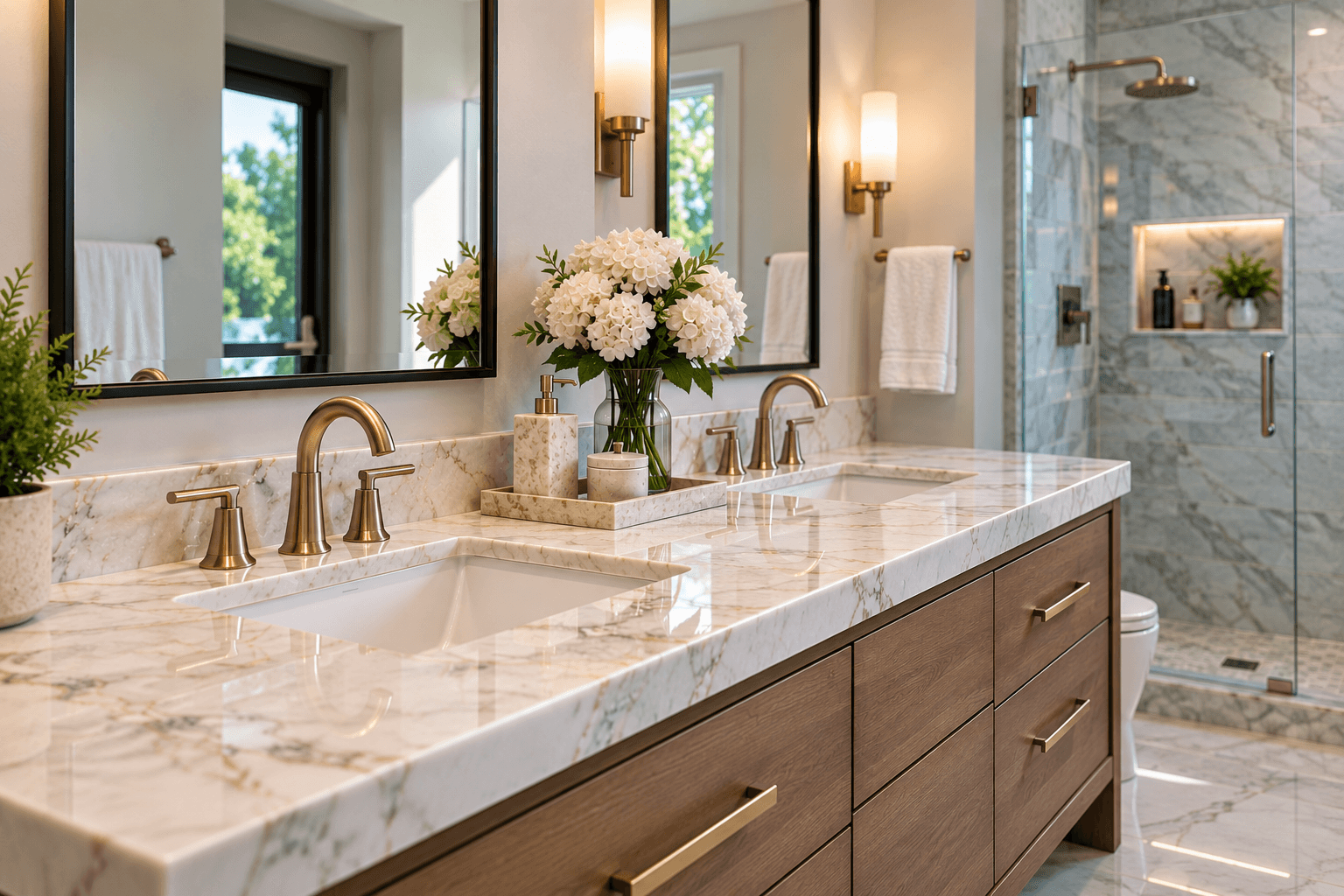
Bathroom vanity countertops require different planning than kitchen surfaces because bathrooms bring their own set of decisions: water around the sink, cosmetics and personal-care products, limited countertop depth, faucet-hole placement, sink cutouts, backsplash height, edge profiles, wall conditions, and the possibility of using a remnant instead of purchasing a full slab. The best vanity top should fit the cabinet accurately, work with the sink and faucet you select, handle the way the bathroom is used, and give the space the finished appearance you want without creating unnecessary maintenance.
Quick answer: Choose the vanity cabinet, sink and faucet before final countertop fabrication. Quartz is often selected for low maintenance, granite and quartzite provide natural variation and durability, and marble offers distinctive natural veining with more care requirements. Final measurements, sink cutouts, faucet drilling, edge profile and backsplash details should all be confirmed before the stone is cut.
Homeowners comparing stone surfaces for projects throughout the house can also explore Chicago kitchen countertops to see the materials and fabrication work available for kitchens, bathrooms and other applications.
Bathroom Vanity Countertops Need Different Planning Than Kitchen Counters
Kitchen countertop discussions usually revolve around food preparation, hot cookware, large islands, long runs and heavy cooking.
Bathrooms create a different environment.
The surface may regularly encounter:
- standing water;
- toothpaste;
- makeup;
- shaving products;
- lotions;
- perfume;
- hairspray;
- skincare products;
- soap;
- bathroom cleaners;
- hot styling tools.
Bathroom counters are also usually shallower than kitchen counters.
That leaves less space for the sink, faucet, backsplash and everyday items while still requiring enough stone around the cutouts for a clean finished appearance.
A vanity top therefore needs to be planned as a complete fabricated piece.
Material matters, but so do the sink, faucet, cabinet dimensions, edge and backsplash.
Start With the Vanity Cabinet
Stone may be the most visually exciting part of the project, but the cabinet underneath it establishes the dimensions.
Before final measurement, know:
- vanity width;
- vanity depth;
- final cabinet position;
- whether the vanity touches a side wall;
- whether fillers are being used;
- sink location;
- plumbing location;
- whether the vanity is freestanding or wall-mounted.
A cabinet sold as a 60-inch vanity does not necessarily mean the finished stone should simply be ordered as a 60-inch rectangle.
Walls are not always perfectly straight or square.
Fillers may change.
Finished wall materials may affect the final dimensions.
The safest approach is to fabricate around the actual installed conditions rather than relying only on a catalog measurement.
Choose the Sink Before the Stone Is Cut
This is one of the most important decisions in the project.
The sink determines a major portion of the fabrication.
Different sink styles require different openings and finishing.
Undermount Sink
An undermount sink sits beneath the stone.
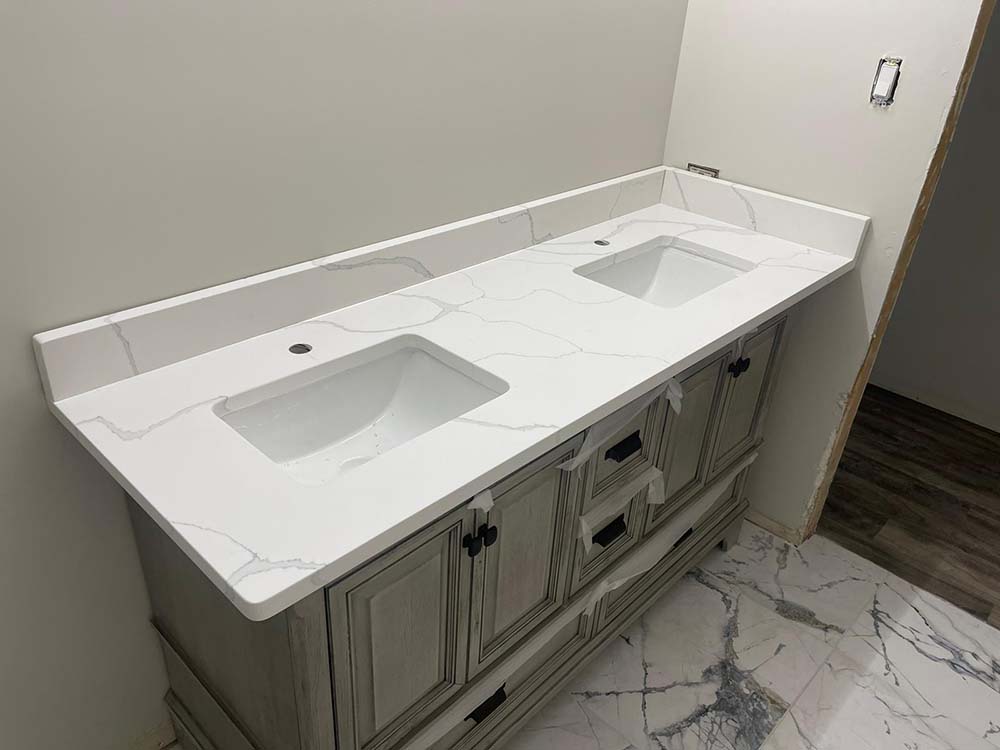
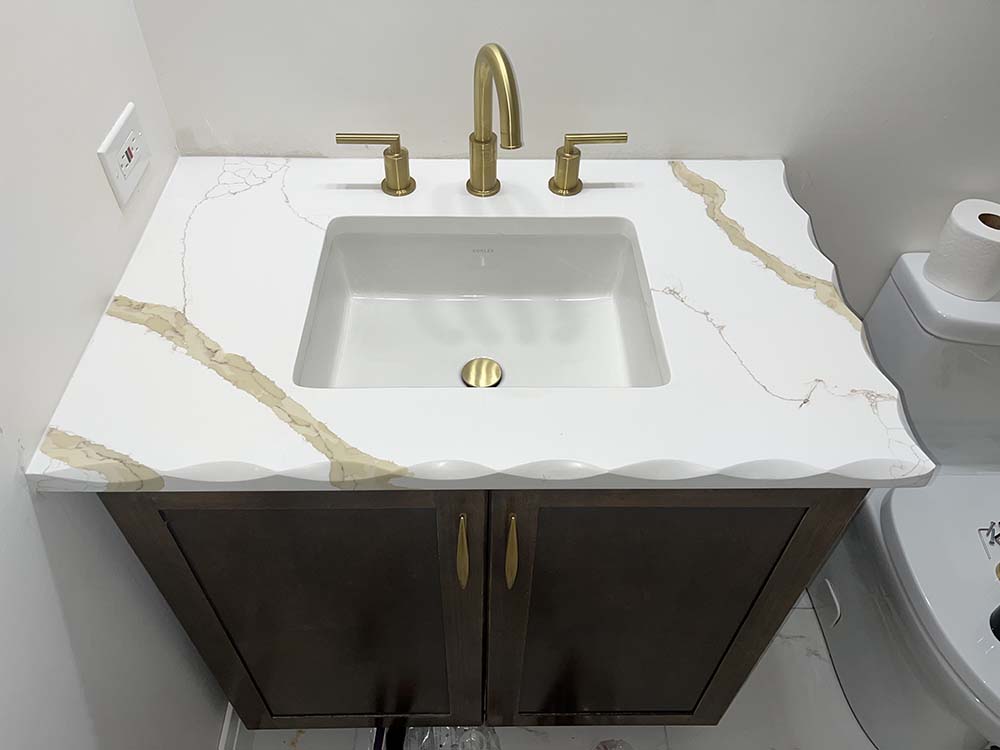
The countertop opening remains visible, so that opening needs to be accurately cut, finished and polished.
Undermount sinks create a clean transition from countertop to bowl because there is no raised sink rim sitting on the surface.
Drop-In Sink
A drop-in sink rests inside the opening with a visible rim above the countertop.
The sink covers the cut edge.
This can work well in many bathrooms, but it creates a different visual result from an undermount sink.
Vessel Sink
A vessel sink sits primarily above the countertop.
That changes several decisions at once:
- sink opening;
- faucet position;
- faucet height;
- countertop drilling;
- total vanity height.
The finished height deserves particular attention because the bowl itself adds height above the countertop.
Specialty Sinks
Certain custom or specialty sinks require their own templates and installation details.
The safest rule is simple:
Have the actual sink model confirmed before fabrication begins.
The fabricator should not have to guess from a general description.
Understand the Sink Reveal
With an undermount sink, you may hear the terms:
- positive reveal;
- flush reveal;
- negative reveal.
These describe the relationship between the stone opening and the sink beneath it.
Positive Reveal
A small amount of the sink rim remains visible.
Flush Reveal
The stone opening and sink edge align closely.
Negative Reveal
The countertop slightly overlaps the edge of the sink.
The right option depends on the sink, fabrication requirements, appearance and homeowner preference.
It is a small detail, but it is something you will see every day.
Confirm the Faucet Before the Holes Are Drilled
Bathroom faucets can require very different drilling patterns.
Common configurations include:
- single-hole faucet;
- centerset faucet;
- widespread three-hole faucet;
- wall-mounted faucet;
- separate accessories.
Accessories may add additional holes.
Once stone has been drilled, those holes cannot simply be moved.
Before fabrication, confirm the actual faucet model and the manufacturer’s hole-spacing requirements.
This is particularly important on shallow vanity tops because the sink, faucet and backsplash all compete for limited space behind the bowl.
Single and Double Vanities Need Different Planning
A compact powder-room vanity and a long double vanity are not simply the same countertop at different widths.
A double vanity adds additional decisions.
Sink Spacing
Two sinks should feel balanced across the vanity while leaving useful counter space between them.
Faucet Placement
Each faucet needs to align correctly with its sink and backsplash.
Cabinet Storage
Sink locations affect drawers, plumbing and storage below.
Stone Pattern
With natural stone, both sink cutouts may remove portions of the slab pattern.
If the stone contains dramatic veining, slab layout should be considered before cutting.
Overall Length
A long vanity may require different fabrication and handling considerations than a small single vanity.
These decisions are much easier to resolve before the slab reaches the cutting stage.
Choosing the Right Vanity Countertop Material
There is no single countertop material that works best for every bathroom.
Consider:
- maintenance expectations;
- appearance;
- daily usage;
- natural versus engineered material;
- budget;
- desired pattern;
- bathroom type.
Quartz Vanity Tops
Quartz is often chosen for bathrooms because it is nonporous and generally easy to maintain.
Available designs range from:
- subtle white;
- warm neutrals;
- solid colors;
- marble-inspired patterns;
- dramatic veining.
Quartz can make sense for:
- family bathrooms;
- children’s bathrooms;
- frequently used primary bathrooms;
- homeowners who want minimal routine maintenance.
Because the pattern is engineered, appearance is also more predictable than natural stone.
Homeowners interested in this material can learn more about quartz countertops in Chicago before comparing slabs and colors.
Granite Vanity Tops
Granite is natural stone, which means every slab can vary.
A granite vanity may contain:
- mineral deposits;
- movement;
- subtle color changes;
- dramatic patterns.
Granite is durable and can work very well in shared bathrooms and other high-use spaces.
Some granite benefits from sealing to help resist staining.
The care requirements should be based on the actual stone rather than assuming every granite behaves exactly the same.
Quartzite Vanity Tops
Quartzite is natural stone.
It should not be confused with engineered quartz.
Certain quartzites offer marble-like movement with strong durability, making them appealing to homeowners who want natural variation without choosing marble.
Because it is natural, the actual slab matters.
Color, veining and movement can change substantially across the surface.
Marble Vanity Tops
Marble remains one of the most distinctive bathroom materials.
Its natural veining can work especially well in:
- primary bathrooms;
- powder rooms;
- classic interiors;
- luxury contemporary bathrooms;
- traditional homes.
But homeowners should understand the material.
Marble is calcium based, which means acidic substances can affect the finish and create etching.
Some cosmetics, cleaners and personal-care products may contain ingredients that deserve caution around natural marble.
The Natural Stone Institute stone-care guidance recommends using cleaning methods appropriate for natural stone and avoiding damaging acidic cleaners on sensitive materials.
Marble can still be an excellent bathroom material.
It simply needs an owner who understands how natural stone behaves.
Powder Rooms Give You More Freedom
A powder room can be a great place to use a visually dramatic material.
The vanity is often smaller and may receive less intensive use than the primary family bathroom.
That can create an opportunity for:
- dramatic marble;
- expressive quartzite;
- bold granite;
- unusual quartz;
- specialty edge details.
A smaller vanity may also require significantly less material than a large kitchen project.
That opens another possibility:
a remnant.
Primary Bathrooms Need to Handle Daily Life
The primary bathroom may be used every morning and every evening.
Two people may use the vanity simultaneously.
Cosmetics may sit on the surface.
Water may remain around the sink.
Hot hair tools may be used nearby.
That makes daily behavior just as important as appearance.
Ask yourself:
- Do products frequently remain on the counter?
- Do you wipe standing water quickly?
- Are styling tools used every day?
- Do you want almost no maintenance?
- Do you enjoy the changing character of natural stone?
- Will two people need usable counter space simultaneously?
The countertop should fit your routine.
A material that makes you nervous every morning is probably not the right material, even if it looked beautiful in the showroom.
Children’s Bathrooms Need Practical Surfaces
A child’s bathroom is often a good place to prioritize:
- simple cleaning;
- durability;
- stain resistance;
- low maintenance.
That does not mean the countertop has to look plain.
Modern quartz can provide substantial visual depth while remaining practical.
Natural stone can work too, but household habits and maintenance expectations should be considered realistically.
The goal is a countertop that can be used comfortably rather than protected constantly.
Countertop Depth Matters More Than You May Expect
Bathroom vanity cabinets are usually shallower than kitchen base cabinets.
That means there is less depth available for:
- sink bowl;
- faucet;
- backsplash;
- soap;
- cosmetics;
- trays;
- daily personal items.
An oversized sink can leave surprisingly little useful counter space.
Before choosing the sink, think about what normally sits on the vanity.
A bowl that looks impressive in a showroom may feel oversized once it is installed in a compact bathroom.
The sink should fit the countertop.
The countertop should not become whatever space remains around the sink.
Remnants Can Be Excellent for Bathroom Vanities
Vanity tops are one of the strongest applications for stone remnants.
A remnant is a usable portion of slab remaining after a larger fabrication project.
Because bathroom vanities are often relatively compact, one piece may provide enough material for:
- powder-room vanity;
- single vanity;
- smaller double vanity;
- countertop and backsplash;
- additional bathroom pieces.
This may allow a homeowner to use a premium stone without purchasing material for a much larger project.
Al Jory Marble’s guide to countertop remnants in Chicagoland explains how remnants can work for vanities, bar tops and other smaller surfaces.
Do Not Choose a Remnant Based Only on Price
The piece still has to work physically.
It needs:
- enough width;
- enough depth;
- enough usable stone around previous cuts;
- appropriate pattern placement;
- sufficient material for the backsplash if needed.
If the remnant is almost large enough, it is not large enough.
Fabrication requires real usable dimensions.
Plan the Backsplash Before Fabrication
The backsplash can change both the appearance and material requirements of the vanity.
Several approaches are possible.
Short Stone Backsplash
A strip of matching material behind the vanity creates a traditional finished transition.
Full-Height Stone
The countertop material continues higher on the wall.
It may extend:
- behind the faucet;
- behind the mirror;
- between mirrors;
- to a shelf;
- to another architectural stopping point.
This can create a much stronger stone feature.
Tile
Tile provides opportunities for:
- texture;
- contrast;
- pattern;
- color.
Painted or Finished Wall
Some contemporary vanities use no traditional stone backsplash.
The wall finish, sink configuration and water exposure need to be considered carefully if this approach is used.
The important point is to decide before stone quantities and fabrication are finalized.
Full-Height Stone Can Turn a Small Vanity Into a Statement
Bathrooms are excellent locations for full-height stone because the area behind the vanity is often relatively compact.
A dramatic slab may transition from:
countertop
→ backsplash
→ wall feature.
With veined natural stone or strongly patterned engineered material, thoughtful layout can make the pieces feel visually connected.
Where possible, consider where important veins will appear before cutting.
A premium stone deserves more planning than simply cutting the next available rectangle from the slab.
We will cover full-height stone backsplashes in a separate guide so this article remains focused specifically on vanity planning.
Edge Profiles Change the Appearance of the Vanity
The edge may occupy only a small portion of the countertop, but it affects the entire finished look.
Common profiles include:
Eased Edge
Clean, simple and highly versatile.
Works well with contemporary, transitional and traditional bathrooms.
Beveled Edge
Adds a defined angle and slightly more visual detail.
Bullnose
Creates a softer rounded edge.
Ogee
More decorative and typically associated with traditional interiors.
Mitered Edge
Creates the appearance of a substantially thicker stone surface.
This can look especially strong with:
- floating vanities;
- modern cabinetry;
- statement slabs.
The countertop edge profiles guide explains eased, beveled, bullnose, ogee and mitered edges in greater detail.
Match the Edge to the Vanity Cabinet
A dramatic edge does not automatically create a more expensive-looking bathroom.
The edge should relate to:
- cabinet style;
- cabinet scale;
- hardware;
- sink;
- stone pattern;
- room architecture.
A simple floating vanity may look strongest with an eased or mitered edge.
A traditional furniture-style vanity may support a more decorative profile.
The countertop and cabinet should look as though they were designed together.
Floating Vanities Require Coordination
A floating vanity creates a lighter visual appearance because the cabinet does not extend to the floor.
The countertop is still real stone or engineered material with real weight.
The system therefore needs appropriate support.
That may involve coordination among:
- wall framing;
- vanity attachment;
- countertop;
- sink;
- plumbing.
The support plan should be resolved before installation rather than after a heavy stone top arrives.
Natural Stone Pattern Placement Still Matters on a Vanity
Vein layout is not only a concern for huge kitchen islands.
It matters on a bathroom vanity too.
Imagine a marble remnant containing one dramatic vein.
If the sink opening removes most of it, the finished top may lose the feature that made the piece attractive in the first place.
Instead, look at how the stone could be positioned around:
- sink opening;
- faucet;
- backsplash;
- front edge;
- exposed side.
A small surface can still benefit from careful slab planning.
Side Splashes Should Be Intentional
When a vanity touches a side wall, many homeowners automatically add a short side splash.
That can be practical, but it is not the only design option.
Depending on the room, alternatives may include:
- stone side splash;
- tile continuing around the wall;
- full-height stone;
- finished wall with no side splash.
The right choice depends on water exposure and the overall design.
Do not add a side splash automatically just because previous bathrooms had one.
Plan the Mirror and Stone Together
The mirror can affect how the backsplash looks.
Consider:
- one large mirror;
- two individual mirrors;
- medicine cabinet;
- sconces;
- full-height stone;
- short backsplash.
If stone will continue behind the mirrors or lighting, electrical boxes and mounting points need to be considered early.
It is much easier to coordinate these elements during planning than after the stone is installed.
Wall-Mounted Faucets Change the Countertop Details
A wall-mounted faucet eliminates traditional faucet holes in the stone.
That can create a particularly clean vanity surface.
But the planning moves into the wall.
The plumbing has to align with:
- sink centerline;
- countertop height;
- sink height;
- faucet reach;
- backsplash thickness.
A wall-mounted faucet should therefore be selected early enough for plumbing and stone planning to work together.
Hot Styling Tools Need Protection Too
Bathrooms commonly contain:
- hair straighteners;
- curling irons;
- hot brushes;
- other heated tools.
Avoid treating the countertop as a permanent resting place for extremely hot equipment.
Quartz contains resin components that can be affected by excessive heat.
Natural stone has different heat characteristics, but reasonable protection is still worthwhile.
A small heat-resistant pad costs very little and avoids unnecessary risk.
Cosmetics and Bathroom Products Can Affect Countertops
Bathrooms expose surfaces to chemicals that are rarely present on kitchen countertops.
Examples may include:
- nail-polish remover;
- perfume;
- hair dye;
- skincare acids;
- strong cleaning products.
For natural stone, especially marble, acidic products deserve additional caution.
For engineered materials, follow the manufacturer’s cleaning recommendations.
Regardless of material:
- wipe spills promptly;
- avoid harsh cleaners unless approved;
- do not allow strong chemicals to sit on the surface.
Good maintenance usually comes down to simple habits rather than complicated routines.
Polished or Honed?
Finish changes how stone looks.
Polished Finish
A polished surface reflects more light and usually emphasizes color and veining strongly.
Honed Finish
A honed surface creates a softer, more matte appearance.
This can look especially elegant with natural stone.
Finish may also change how fingerprints, water marks and surface changes are perceived.
Because this decision deserves more depth, our separate finish guide can cover polished, honed and leathered surfaces without forcing that discussion into a general vanity article.
Coordinate the Countertop With the Entire Bathroom
Do not choose the vanity surface in isolation.
Bring the countertop sample together with:
- cabinet finish;
- floor tile;
- shower tile;
- wall paint;
- faucet;
- hardware.
Pay particular attention to undertones.
Two materials can both be described as white while looking completely different beside each other.
One may lean warm.
Another may appear cooler or gray.
The same issue occurs with creams, greiges, woods and metal finishes.
Materials should be evaluated together.
Bathroom Lighting Can Change How Stone Looks
Stone can appear different under:
- daylight;
- vanity lighting;
- recessed lighting;
- warm lamps;
- cool lamps.
A polished surface reflects more light.
A honed surface generally appears softer.
Warm light can strengthen beige and gold movement.
Cooler light can make white and gray stone appear sharper.
Whenever practical, look at a sample inside the actual bathroom before making the final decision.
Does the Vanity Counter Need to Match the Shower?
No.
The bathroom should feel coordinated, but every surface does not need to be identical.
For example:
- marble vanity with simple porcelain shower tile;
- quartz vanity with natural-stone accent tile;
- quartzite vanity with neutral large-format porcelain.
Repeating exactly the same pattern everywhere can sometimes make the room feel flat.
A better objective is to create a relationship among the materials.
Think Beyond the Vanity When Calculating Stone
A bathroom project may use countertop material for more than the vanity.
Additional pieces can include:
- backsplash;
- side splash;
- shower curb;
- shower threshold;
- niche shelf;
- bench;
- window sill.
If the stone is being fabricated already, ask whether the same slab or remnant can provide additional bathroom pieces.
This can improve visual continuity and make better use of the material.
What Changes the Price of a Vanity Top?
Two vanity tops with similar dimensions can still have different finished prices.
Factors can include:
- stone material;
- full slab versus remnant;
- one sink versus two;
- sink cutout type;
- faucet drilling;
- backsplash;
- side splash;
- edge profile;
- thickness;
- installation access.
A small powder-room vanity with one simple cutout is not the same fabrication project as a long double vanity with two undermount sinks, a decorative edge and full-height stone behind it.
Compare the full fabrication scope rather than looking only at square footage.
Final Measurement Should Reflect the Real Space
Whenever the construction sequence allows it, final stone measurements should be based on finished or properly established site conditions.
Walls may not be perfectly straight.
Cabinet position can vary slightly from an early drawing.
A filler may be added.
Wall finishes can change dimensions.
Small differences matter when stone has to fit between walls or align closely with cabinetry.
Stone fabrication rewards accurate measurements.
What Should Be Final Before Fabrication?
Before cutting begins, confirm the applicable items:
- vanity dimensions;
- final vanity position;
- sink model;
- number of sinks;
- sink placement;
- faucet model;
- faucet-hole pattern;
- edge profile;
- backsplash;
- side splash;
- stone material;
- surface finish;
- major vein orientation.
That does not mean the entire bathroom has to be finished.
It means the decisions that determine how the stone is cut should no longer be temporary placeholders.
Bathroom Vanity Countertops: A Simple Selection Order
A good sequence can prevent later conflicts.
Start with the vanity cabinet.
Confirm its dimensions and final position.
Choose the sink.
The sink determines the cutout and can affect usable counter space.
Choose the faucet.
Confirm hole requirements and positioning.
Select the countertop material.
Compare appearance, maintenance and daily usage.
Choose the finish and edge.
These details change the character of the stone.
Decide on the backsplash.
Short stone, full-height stone, tile or another wall treatment.
Review the stone layout.
This matters particularly with natural stone or dramatic veining.
By the time fabrication begins, the project should be based on actual selections rather than assumptions.
FAQs About Bathroom Vanity Countertops
What is the easiest bathroom vanity material to maintain?
Quartz is often chosen when low routine maintenance is the priority because it is nonporous and generally does not require sealing. Natural stone can also perform very well when cared for according to the particular material.
Is marble suitable for a bathroom vanity?
Yes. Marble can create a distinctive natural-stone vanity, particularly in primary bathrooms and powder rooms. Homeowners should understand that acidic products can etch marble and that the stone may develop patina over time.
Can I use a countertop remnant for a bathroom vanity?
Yes. Vanities are one of the most practical uses for remnants because many require far less material than a full kitchen. The remnant still has to provide enough usable stone for the countertop, sink opening and any backsplash pieces.
Should I choose the sink before ordering the vanity top?
Yes. The actual sink model determines the cutout dimensions and can affect sink placement, faucet location and usable countertop space.
Can the backsplash be made from the same stone?
Yes. Matching stone can be fabricated as a short backsplash or used in a larger full-height application depending on the design and available material.
Does a double vanity always need a seam?
No. Whether a seam is required depends on the total dimensions, slab size, material, fabrication considerations and installation access.
Which edge profile works well on a vanity?
Eased edges are versatile and work with many styles. Beveled, bullnose, ogee and mitered edges create different visual effects. Cabinet style, stone type and desired thickness should guide the decision.
Does natural stone in a bathroom need sealing?
Some natural stones benefit from an impregnating sealer. Requirements vary by material, so care should be based on the actual stone rather than following one generic sealing schedule for every surface.
Choose the Vanity as One Fabricated System
The best bathroom vanity countertops are not selected by color alone.
The cabinet establishes the dimensions.
The sink determines the opening.
The faucet determines the drilling.
The edge influences the appearance.
The backsplash changes the material requirements.
The stone pattern determines where important veins should fall.
And the way the bathroom is used determines whether the surface is comfortable to live with every day.
Treating all of those pieces as one fabrication plan produces a better result than choosing the countertop independently at the end of the project.
Al Jory Marble fabricates stone surfaces in its Crestwood shop for projects throughout Chicago and the surrounding suburbs. Homeowners planning a new vanity can explore custom bathroom vanity tops for quartz, granite, quartzite and marble fabrication, sink cutouts, faucet drilling and installation.
Al Jory Marble
Phone: (708) 362-7674
Address: 4711 135th St, Crestwood, IL 60418
Email: aljorymarble9446@gmail.com
Hours: Mon – Sat: 9:00 am – 6:00 pm

Serving Chicago & Surrounding Areas
Get Your Free Kitchen Countertop Estimate
Fill out the form and our team will get back to you in next 24 hours.