
Written by Al Jory Marble Team
Published: September 16, 2026
Read Time: 18 minutes
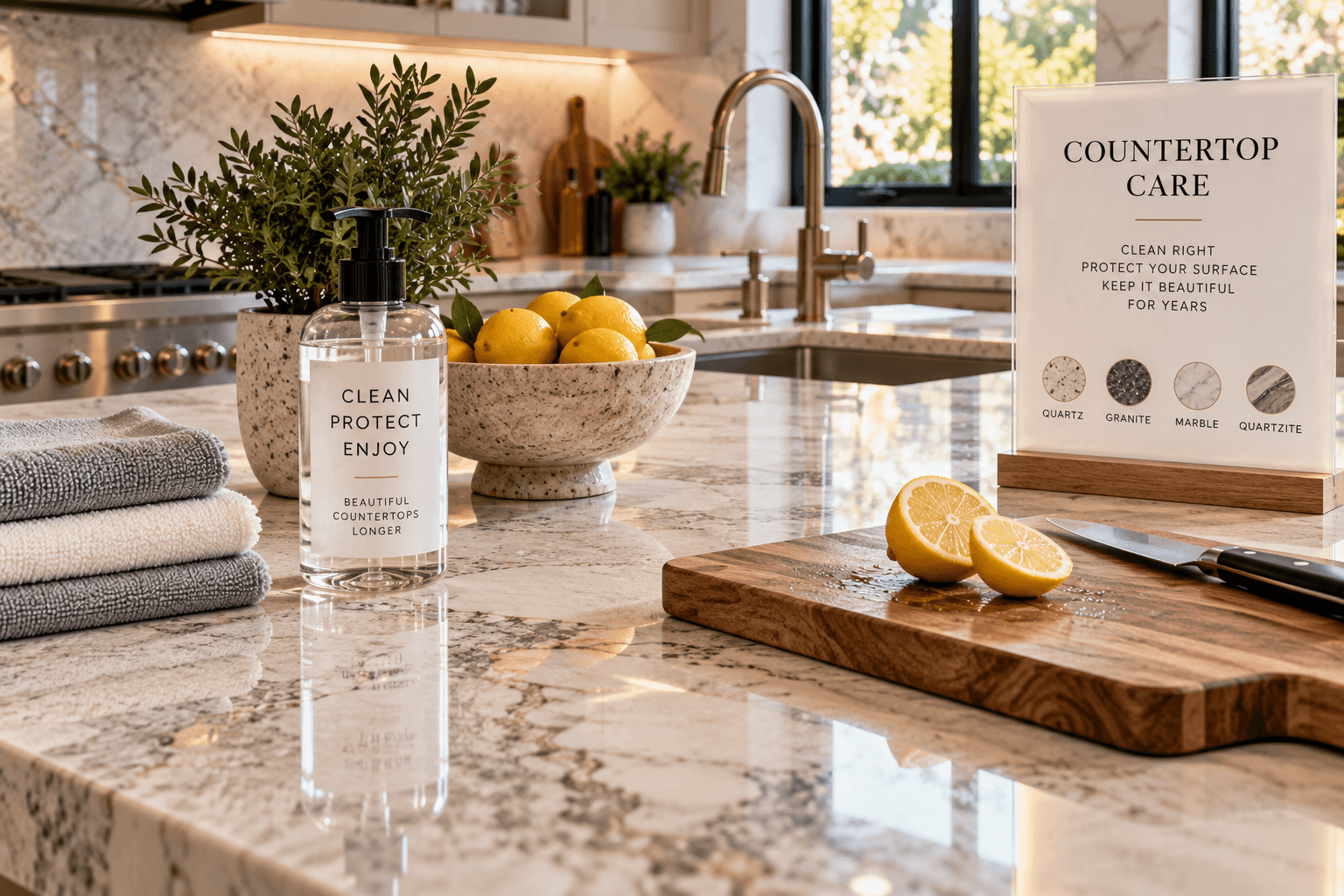
Countertop care becomes much easier once you stop treating quartz, granite, marble and quartzite as though they all behave the same way. Quartz does not need sealing but should be protected from concentrated heat. Granite and quartzite are natural stone and may benefit from sealing depending on the actual slab. Marble needs more awareness around acids because lemon, vinegar, wine and certain cleaners can dull the surface through etching. The best routine is not complicated: know what material you own, clean spills promptly, use gentle products, and avoid trying random household chemicals when something goes wrong.
Quick answer: For everyday cleaning, use warm water, a soft cloth and a mild cleaner appropriate for the surface. Avoid acidic or abrasive cleaners on natural stone, use trivets around high heat, and do not assume every natural stone needs to be sealed on the same schedule. Quartz does not require sealing. Marble needs special care around acidic spills because sealing helps with staining but does not prevent etching.
The First Rule: Know What Countertop You Actually Have
This sounds obvious.
It is not.
Homeowners regularly confuse:
- quartz with quartzite;
- marble-look quartz with real marble;
- granite with quartzite;
- polished natural stone with engineered stone.
The names matter because the care instructions are different.
Quartz
Engineered material made with quartz minerals, resins and pigments.
Generally:
- nonporous;
- no sealing;
- stain resistant;
- sensitive to excessive direct heat.
Granite
Natural stone.
Generally:
- highly durable;
- strong heat resistance;
- some varieties may benefit from sealing;
- care depends on the exact stone.
Marble
Natural calcium-based stone.
Generally:
- softer than granite or quartzite;
- sensitive to acidic substances;
- can etch;
- may benefit from sealing against staining.
Quartzite
Natural stone.
Generally:
- hard;
- heat resistant;
- typically more resistant to scratching and etching than marble;
- may benefit from sealing depending on absorption.
If you are unsure what you have, identify the material before experimenting with cleaners.
The wrong cleaner can create a bigger problem than the original spill.
The Five-Minute Countertop Routine
You do not need an elaborate cleaning system.
For most everyday use, a simple routine is enough.
After Cooking
Remove crumbs and loose debris.
Wipe the surface with:
- warm water;
- mild dish soap or an approved countertop cleaner;
- soft microfiber cloth.
Then dry the surface if streaks or water marks bother you.
After a Spill
Blot it.
Do not spread it across a larger area unnecessarily.
Then clean with the appropriate mild solution.
At the End of the Day
Check around:
- sink;
- coffee machine;
- stove;
- beverage area.
Those are where moisture, oils and residue most often collect.
This takes minutes.
It is far easier than trying to remove a problem after it has sat overnight.
Quartz: Keep It Simple
Quartz is popular partly because routine maintenance is straightforward.
Because the material is nonporous, it does not require periodic sealing.
For everyday cleanup:
- warm water;
- mild soap;
- soft cloth;
will handle most normal kitchen use.
Al Jory Marble’s quartz countertops page also recommends mild cleaning and avoiding harsh chemicals.
What quartz does not like
Quartz is durable, but it is not indestructible.
Avoid:
- extremely hot cookware directly on the surface;
- harsh solvents;
- highly abrasive scrubbers;
- aggressive chemicals;
- prolonged exposure to strong cleaners not approved by the manufacturer.
The International Surface Fabricators Association notes that engineered quartz does not require sealing and recommends routine cleaning with mild detergent while avoiding highly aggressive chemical cleaners that can affect the finish.
Use a trivet
This is one of the easiest habits to maintain.
Quartz contains resin.
A heavy pan directly from a hot burner may expose the surface to temperatures well above ordinary kitchen use.
The trivet protects the surface without changing how you cook.
Granite: Durable Does Not Mean Maintenance-Free
Granite is one of the most durable natural countertop materials.
That does not mean every granite slab behaves identically.
Different stones have different:
- mineral structures;
- absorption rates;
- finishes.
Some granite benefits from an impregnating sealer.
Some very dense granite may require less intervention.
That is why blanket advice like:
“Seal granite every six months.”
or:
“Granite never needs sealing.”
is too simplistic.
The Natural Stone Institute notes that many granites are already highly moisture resistant and that sealing can provide additional stain resistance in appropriate cases rather than serving as a universal requirement for every slab.
If you are selecting natural stone, review granite countertops and ask about the actual slab rather than relying on generic internet schedules.
Marble: Learn the Difference Between a Stain and an Etch
This is probably the single most important marble-care concept.
A stain and an etch are not the same thing.
A stain goes into the stone
Oil, wine or another substance may absorb and darken an area.
Sealer can help slow absorption.
An etch changes the surface
Acid reacts with calcium-based stone.
The result may look like:
- dull patch;
- pale ring;
- loss of polish;
- cloudy mark.
Common causes include:
- lemon;
- vinegar;
- wine;
- tomato;
- certain cleaners.
A sealer does not make marble immune to etching.
That misunderstanding leads to a lot of disappointed homeowners.
If you choose marble, choose it because you like real marble—including the way it changes with use.
Al Jory Marble’s marble countertops page explains why honed marble is often worth considering in working kitchens where visible etching is a concern.
Quartzite: Natural Stone With Its Own Care Requirements
Quartzite is commonly chosen by homeowners who love marble-like movement but want a harder natural stone.
It performs very well in kitchens.
But it is still natural stone.
Depending on the slab, periodic sealing may be appropriate.
Routine care should remain simple:
- wipe spills;
- use mild soap;
- avoid harsh chemicals;
- use suitable stone-safe products.
Do not confuse quartzite with quartz.
Quartzite is quarried.
Quartz is manufactured.
That distinction changes everything from sealing to heat behavior.
Homeowners comparing natural slabs can use Al Jory Marble’s quartzite countertops page for material-specific guidance.
The Cleaner Cabinet: What You Actually Need
Most countertop care does not require ten bottles.
For many homes, the useful list is remarkably short:
Soft microfiber cloths
For routine wiping and drying.
Mild dish soap
Useful for everyday cleaning when appropriate.
pH-neutral stone cleaner
Useful for natural stone.
Paper towels or absorbent cloth
For immediately blotting spills.
Trivets
For hot cookware.
Cutting boards
For food preparation.
That covers far more everyday care than most specialty products.
The Products I Would Keep Away From Natural Stone
Natural stone deserves special caution around chemistry.
The Natural Stone Institute specifically warns that cleaners containing acids such as lemon or vinegar may etch calcium-based stones and that abrasive cleaners can scratch some stone surfaces.
That means I would avoid experimenting with:
- vinegar cleaner;
- lemon-based cleaner;
- toilet-bowl cleaner;
- acidic bathroom spray;
- abrasive powder;
- rough scouring pads;
- unknown rust remover.
That last one is especially important.
Some rust-removal products contain aggressive acids that can damage even silicate-based stones.
Do not assume:
“If it removes rust, it will remove this countertop mark.”
Different chemistry creates different risks.
Vinegar Is Not a Universal Natural Cleaner
Vinegar gets recommended for almost everything online.
Natural stone is where that advice can become a problem.
On marble, vinegar can etch the surface.
That can turn a cleaning attempt into permanent-looking dullness.
For granite and quartzite, acidic cleaners are still generally unnecessary.
There is little reason to use aggressive acid when mild soap or a stone-safe neutral cleaner already works for routine maintenance.
Natural does not automatically mean safe for stone.
Bleach Deserves Caution Too
Strong chemicals should not be your default countertop cleaner.
Quartz manufacturers may restrict concentrated bleach or certain high-alkaline products.
Natural stone can also react poorly to inappropriate chemicals.
If you believe the countertop needs disinfection beyond ordinary cleaning, use a product specifically approved for that surface.
Do not create a homemade chemical experiment.
And never mix cleaning chemicals.
In particular, bleach and ammonia should never be mixed because the combination creates toxic gases.
Hot Pans: The Rule Depends on the Material
Heat questions come up constantly.
Quartz
Use a trivet.
Granite
Granite has strong heat resistance, but trivets remain a good habit because thermal shock and localized extreme heat are unnecessary risks.
Quartzite
Also highly heat resistant.
Again, a trivet is inexpensive protection.
Marble
Natural marble tolerates heat better than engineered quartz, but protecting the surface still makes sense.
There is almost no downside to using a trivet.
The habit costs nothing once it becomes automatic.
Knives and Cutting Boards
Just because a stone is harder than your knife does not mean you should cut directly on it.
Cutting directly on countertops can:
- dull knives;
- mark certain surfaces;
- increase wear on the finish;
- create unnecessary risk near edges.
Use a cutting board.
This is one of those cases where protecting both the countertop and the knife takes the same action.
Wine, Coffee and Oil: What to Do First
When a spill happens, speed helps.
Wine
Blot quickly.
Then clean with the appropriate mild solution.
Coffee
Wipe rather than allowing it to dry into a ring.
Oil
Oil deserves particular attention on porous natural stone because it can darken areas if absorbed.
Do not panic.
Do not immediately reach for harsh chemicals.
Start with proper cleaning.
If a true stain remains in natural stone, professional stain-removal methods may be needed.
The Natural Stone Institute provides separate guidance for identifying and removing organic, oil-based and metallic stains rather than treating every discoloration the same way.
Water Around the Sink Is a Different Problem
Sink areas see more repeated moisture than almost any other section of the counter.
Look around:
- faucet base;
- soap dispenser;
- backsplash;
- sink edge.
Water can leave mineral deposits when it evaporates.
In Chicagoland, hard-water residue can become especially noticeable on dark or highly polished surfaces.
Al Jory Marble already has a dedicated hard water spots on countertops guide, so we do not need to repeat that entire topic here.
The important everyday habit is simple:
wipe around the sink before mineral buildup becomes thick.
Preventing a deposit is easier than removing one.
Sealing: Stop Following a Calendar Blindly
This is another area where generic advice causes confusion.
You may hear:
- every six months;
- once a year;
- every two years.
Those schedules ignore the actual stone.
The need for sealer can depend on:
- stone type;
- absorption;
- finish;
- existing treatment;
- product used;
- level of use.
The Natural Stone Institute describes impregnating sealers as products that improve resistance to staining rather than making stone completely stain-proof.
That distinction matters.
Sealer buys you reaction time.
It does not turn marble or granite into plastic.
A Simple Water Test Can Give You Useful Information
For some natural stone, homeowners use a simple water test as an indication of absorption.
Place a few drops of water on a clean area.
Observe.
If the stone darkens relatively quickly where the water sits, it may indicate greater absorption.
If water beads and the surface remains unchanged, the existing protection may still be effective.
This is only a practical indicator.
If you are unsure what the stone needs, ask the fabricator rather than repeatedly adding sealer.
Too much product can create its own appearance problems.
More Sealer Is Not Better
This is worth emphasizing.
A sealer is not a coat of armor.
Impregnating sealers are designed to enter pores and reduce liquid absorption.
Applying unnecessary layers does not automatically produce more protection.
Follow the product instructions and the recommendation for the specific stone.
The goal is appropriate treatment.
Not maximum chemical buildup.
Countertop Finish Changes What You Notice
Finish affects maintenance visually.
A polished dark granite can show:
- fingerprints;
- streaks;
- dried water.
A honed finish may hide some of those marks better.
A leathered surface breaks up reflection even further.
Marble presents another example.
A polished marble surface makes an etch stand out because the damaged area loses shine.
On honed marble, the contrast may be less obvious because the entire surface already has a lower sheen.
Our countertop finishes guide explains how polished, honed and leathered finishes affect reflection, texture and everyday appearance.
Do Not Assume Matte Means Maintenance-Free
Honed and leathered surfaces can hide certain visual marks.
That does not make them immune to:
- stains;
- oils;
- spills;
- dirt.
Texture can also change the way a cloth moves across the surface.
A leathered slab may need slightly more attention during wiping simply because the surface is not perfectly flat.
Choose finish based on appearance and lifestyle.
Not because someone told you matte stone never looks dirty.
What About Chips?
Chips often happen at vulnerable locations.
Common areas include:
- sink edge;
- dishwasher area;
- outside corners;
- heavily used island edges.
A chip does not automatically mean the entire countertop needs replacement.
Depending on:
- material;
- chip size;
- location;
- color;
professional repair may be possible.
Do not fill a valuable natural-stone countertop with random hardware-store glue before asking a stone professional.
A poor DIY repair can be more visible than the original damage.
What About Scratches?
Again, first identify the material.
A mark that appears to be a scratch may actually be:
- metal transfer;
- residue;
- etching;
- true surface damage.
Do not immediately sand or scrub the area.
That can enlarge the problem.
Polished stone in particular requires care because aggressive abrasion can alter the finish around the mark.
If normal cleaning does not resolve it, have the surface evaluated.
What About Etching?
If the countertop is marble or another acid-sensitive stone and a dull ring suddenly appears after:
- lemon;
- wine;
- vinegar;
you may be looking at an etch.
Cleaning does not remove an etch because the issue is not sitting on the stone.
The finish itself has changed.
Professional refinishing or repolishing may improve the area depending on:
- stone;
- finish;
- severity.
Do not keep applying stronger cleaners.
The cleaner is not the solution to a chemical surface reaction.
What About Staining?
A real stain usually represents something absorbed into the material.
Natural-stone stain treatment depends on what caused it.
Oil is different from wine.
Rust is different from coffee.
That is why the correct first question is:
What created the mark?
not:
What is the strongest cleaner in the cabinet?
Professional stone-care guidance uses different treatment methods for different stain categories.
Countertop Care After Installation
The first few weeks are a good time to establish habits.
Know:
- what material was installed;
- what finish it has;
- whether it received sealer;
- what cleaner is recommended;
- what to avoid.
Save that information.
A year later, you should not have to guess whether the countertop is:
quartz
or quartzite.
Keep the material name and care instructions with your other home records.
A Practical Care Routine by Frequency
You do not need to schedule countertop maintenance like vehicle service.
But thinking in three simple time frames helps.
Daily
- wipe spills;
- clear crumbs;
- clean with mild approved products;
- dry visible water where necessary.
Occasionally
- inspect sink area;
- check high-use edges;
- clean behind small appliances;
- look for buildup around faucet and backsplash.
When Needed
- test natural stone for absorption;
- reseal if the material and existing treatment call for it;
- address chips or damage before they worsen;
- have difficult stains or etching evaluated.
That is enough for most homes.
Care Around Small Appliances
Coffee makers, air fryers, mixers and toaster ovens create little countertop micro-environments.
Look beneath them occasionally.
You may find:
- crumbs;
- moisture;
- coffee residue;
- heat buildup.
An appliance sitting in the same spot for months can hide spills that would have been easy to wipe on day one.
Move items periodically and clean underneath.
Coffee Stations Need Extra Attention
Coffee areas combine:
- water;
- heat;
- coffee;
- milk;
- syrups.
That makes them high-maintenance zones even when the rest of the counter remains spotless.
A tray can help contain drips.
It also makes cleaning easier because the equipment can remain organized while the area underneath stays protected.
Simple solutions usually work best.
Bar Areas Have Their Own Risks
Wet bars and beverage stations regularly encounter:
- wine;
- citrus;
- liquor;
- ice;
- coffee.
If marble is used there, understand the etching risk.
If natural stone is used, clean spills promptly.
Our wet bar countertops guide covers material selection for these secondary surfaces in more detail.
This is a natural example of the new guide cluster supporting itself without repeating the same information.
Outdoor Countertops Need a Different Maintenance Mindset
Exterior surfaces face:
- rain;
- pollen;
- dust;
- temperature change;
- UV exposure.
Their care should match both the stone and the outdoor installation.
Do not automatically use the same product you keep under the indoor sink.
And if the countertop is natural stone, confirm whether its sealing and cleaning recommendations change because of exterior exposure.
Our new outdoor kitchen countertops guide covers exterior material selection separately.
Do Not Let Cleaning Products Sit Overnight
Even products considered safe for a countertop should generally be used as directed.
More contact time is not automatically more cleaning power.
Wipe.
Rinse if appropriate.
Dry.
Do not spray a chemical across the entire counter and leave it until morning because the label says “stone safe.”
Follow directions.
The Best Countertop Care Starts Before Installation
This is where buying and maintenance connect.
If you hate maintenance, that should influence the material selection.
Choose quartz if you want:
- no sealing;
- predictable routine care.
Choose granite or quartzite if you want:
- natural stone;
- strong durability;
- and are comfortable with appropriate stone care.
Choose marble if:
- you specifically want real marble;
- understand etching;
- appreciate natural patina.
There is no prize for choosing the highest-maintenance material.
The right surface is the one you will enjoy living with.
Questions to Ask When Your Countertops Are Installed
Before the installer leaves, ask:
What exact material did I purchase?
What finish is this?
Was it sealed?
What cleaner do you recommend?
Should this stone be resealed?
How will I know when it needs it?
What should I never use on it?
Those answers are more useful than a generic online cleaning article because they apply to your actual slab.
When to Stop DIY Cleaning and Call Someone
There is a point where more scrubbing becomes counterproductive.
Get professional advice when you have:
- deep natural-stone stain;
- visible etching across a large area;
- chip near sink edge;
- crack;
- damaged seam;
- major loss of polish;
- unidentified mark that does not respond to normal cleaning.
The goal should be to identify the problem before trying increasingly aggressive products.
Stone can often be repaired or refinished.
But an incorrect DIY treatment can make professional restoration harder.
FAQs About Countertop Care
What is the safest everyday countertop cleaner?
Warm water and mild dish soap are suitable for many countertop materials. Natural stone can also be cleaned with a pH-neutral stone cleaner. Always follow the material or manufacturer’s recommendations.
Does quartz need to be sealed?
No. Engineered quartz is nonporous and does not require sealing.
Does granite need to be sealed every year?
Not necessarily. Sealing requirements vary by the particular granite, absorption rate, existing treatment and product used. Some granites benefit from sealing, while dense stones may need it far less often.
Why does marble get dull spots?
Acidic substances can react with calcium-based marble and alter its finish. This is called etching. It is different from a stain.
Does sealing prevent marble etching?
No. Sealer helps reduce liquid absorption and staining. It does not stop the chemical reaction between acid and marble.
Can vinegar be used on granite or marble?
Vinegar is not recommended for natural stone. Acidic cleaners can damage calcium-based materials such as marble, and mild neutral products are generally safer for routine stone care.
Can I put hot pans on quartz?
Use a trivet. Engineered quartz contains resin binders that can be affected by concentrated heat.
What should I do if my countertop develops a stain?
Identify the material and likely cause of the stain before treating it. Different stains require different methods, and difficult natural-stone stains are often better handled with stone-specific guidance or professional help.
Homeowners choosing new Chicago kitchen countertops should ask about care before the slab is fabricated—not after installation—because the material and finish determine what normal maintenance will actually look like.
Make Care Match the Material
Good countertop care should not feel complicated.
The confusion usually comes from trying to apply one set of rules to completely different surfaces.
Quartz is engineered.
Granite is natural stone.
Marble reacts to acids.
Quartzite is not quartz.
Once those differences are understood, the routine becomes much simpler:
clean gently,
wipe spills,
protect against unnecessary heat,
seal only when appropriate,
and do not attack an unfamiliar mark with the strongest chemical you can find.
A countertop is meant to be used.
The purpose of care is not to make homeowners afraid of the surface.
It is to keep the material performing the way it was designed to perform for years.
Al Jory Marble fabricates and installs quartz, granite, marble and quartzite surfaces from its Crestwood shop for homes and businesses throughout Chicago and the surrounding suburbs. Homeowners who are unsure what material best matches the amount of maintenance they want can request a free countertop estimate and compare full slabs before fabrication.
Al Jory Marble
Phone: (708) 362-7674
Address: 4711 135th St, Crestwood, IL 60418
Email: aljorymarble9446@gmail.com
Hours: Mon – Sat: 9:00 am – 6:00 pm





Serving Chicago & Surrounding Areas
Get Your Free Kitchen Countertop Estimate
Fill out the form and our team will get back to you in next 24 hours.