
Written by the Al Jory Marble team — fabricators and installers of quartz, granite, marble and quartzite, working out of our Crestwood, Illinois slab yard and showroom. Updated September 18, 2026.
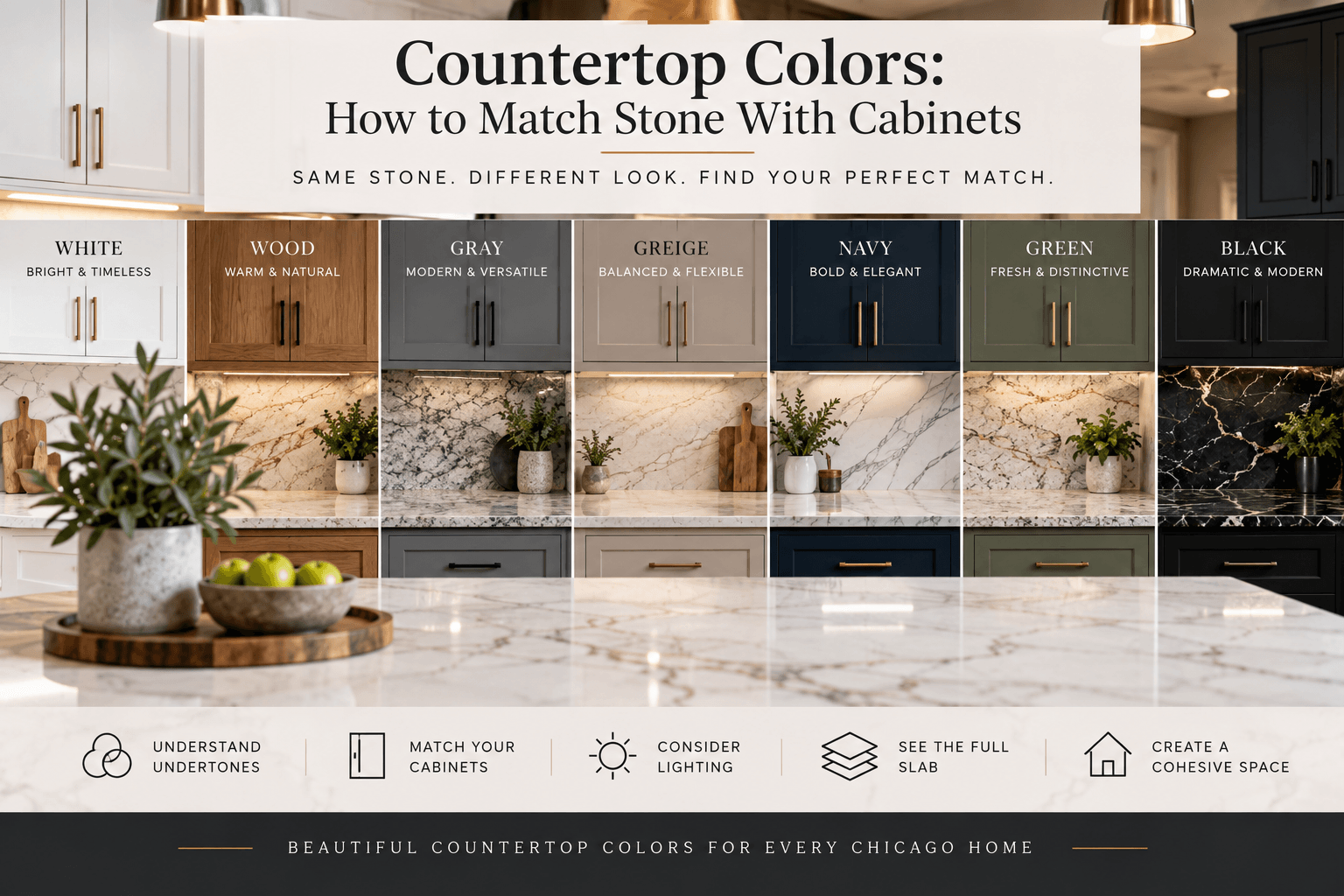
Quick answer: Match undertones, not color names. Warm cabinets (wood, cream, greige) sit best with warm whites, creams, taupe and gold or brown veining. Cool cabinets (blue-gray, charcoal, bright white) sit best with crisp whites and gray or silver veining. White cabinets are flexible, but two different whites can clash, so compare them side by side. Bring a cabinet door and a flooring sample to the slab yard, and view the full slab before fabrication, since a four-inch sample never shows what a slab does across an island. Call (708) 362-7674 or request a free estimate.
Matching Countertops to Cabinets: Undertones, Color Pairings by Cabinet Finish, Pattern and Scale, Lighting, Finish, and What to Bring to the Slab Yard
Bring your cabinet door to our Crestwood showroom. Compare full slabs of quartz, granite, marble and quartzite against your actual finishes, under real light, before anything is cut.
📞 (708) 362-7674 · 💻 Free estimate · 📍 4711 W 135th St, Crestwood, IL 60418 · Mon–Sat 9–6
Start With Undertone, Not Color
“White” is not one color. A slab sold as white can read blue-white, warm cream, pale gray or ivory with gold veining, and a cabinet sold as white can lean yellow, gray, blue or cream. Put two incompatible whites side by side and one of them suddenly looks dirty. The same happens with grays: a cool blue-gray countertop beside warm greige cabinetry makes the cabinets look muddy.
So the useful question is never “do I want white countertops?” It’s “which white works with these cabinets?”
When you look at a slab, ignore the product name and ask four things:
- Is the background warm or cool? Creamy and ivory, or crisp and blue-white?
- What color is the veining? Gray, taupe, brown, gold or black changes everything.
- What happens beside wood? Many stones pull warmer next to oak or walnut.
- What happens beside painted cabinets? The same slab can read cooler against a painted finish.
Two materials named “Arctic White” and “Alabaster” can both be called white and produce completely different kitchens.
Pairings by Cabinet Finish
| Cabinet finish | Usually works with | Watch out for |
|---|---|---|
| Bright white | Crisp white quartz, white-and-gray marble, cooler quartzite, black or charcoal granite, high-contrast stone | Creamy stone can look dingy against a true white |
| Warm white / cream | Creamy quartzite, warm marble-look quartz, beige movement, gold veining, taupe stone | An icy countertop exaggerates the yellow in the cabinets |
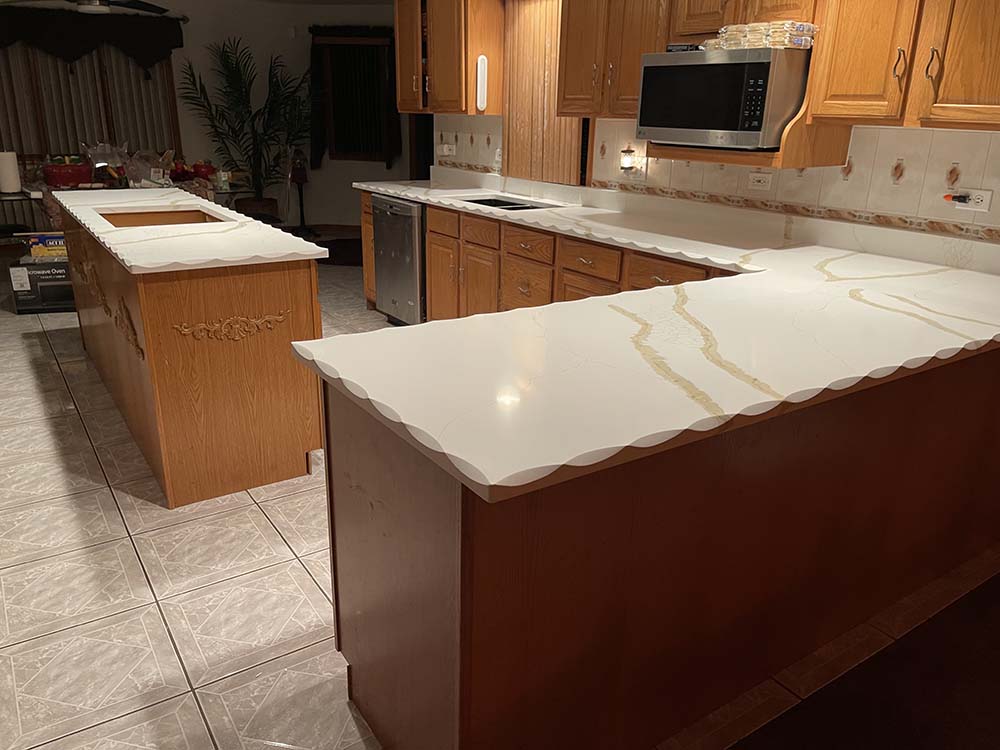
| White oak | Warm white quartz, soft beige quartzite, creamy natural stone, restrained marble-look, warm gray granite | Matching the wood tone too closely flattens the room |
| Walnut and darker woods | Cream quartzite, white marble, warm white quartz, pale granite for contrast; dark stone for a moodier room | Dark cabinets plus dark counters need strong lighting and lighter walls |
| Cool gray / blue-gray | Crisp white, cool gray veining, charcoal, silver movement | Strong gold movement can feel disconnected |
| Greige | Cream quartzite, warm quartz, restrained marble, beige granite, taupe movement | Very cool stone makes greige look muddy |
| Navy | White quartz, pale marble, light quartzite, white or gray granite; warm veining to tie in brass and wood | Don’t hunt for blue in the stone just because the cabinets are blue |
| Sage and olive green | Warm white, cream, quiet quartzite, subtle marble-look | A second strong color competes with the cabinets |
| Deep forest green | Strong white contrast, pale quartzite, warmer natural stone | Busy veining fights the cabinet color |
| Black / charcoal | Light stone for sharp contrast, or dark granite for a monolithic look | A dark lower half needs a bright room and good lighting |
| Two-tone (white perimeter, wood island) | One warm white that’s light enough for the painted cabinets and warm enough for the wood, or two coordinated materials | The more finishes you add, the more deliberate the relationships need to be |
Color and Pattern Are Two Separate Decisions
A white granite with dense mineral speckle and a white quartzite with broad sweeping veins might both be called “light countertops,” and they produce entirely different rooms. Choose the color family first, then decide how much movement the kitchen can carry.
For material-by-material detail, see our guides to quartz, granite, marble, quartzite and Calacatta countertops.
Pattern determines how busy the room feels, how visible the seams are, how much the slab layout matters, and how the surface behaves on a large island.
- Dramatic stone needs breathing room. If the island is the focal point, simplify the cabinet doors, the backsplash, the hardware and the flooring pattern. A veined quartzite island doesn’t need four competitors.
- Quiet stone makes cabinetry the star. If the cabinets already have strong grain, decorative panels or bold color, a restrained surface lets that detail stay visible.
Scale: What the Island Does to a Slab
This is where samples mislead people most. A small chip may show a white background with a little gray veining. The full slab can hold diagonal movement, gold sections, heavy mineral deposits and real color transitions across eight feet.
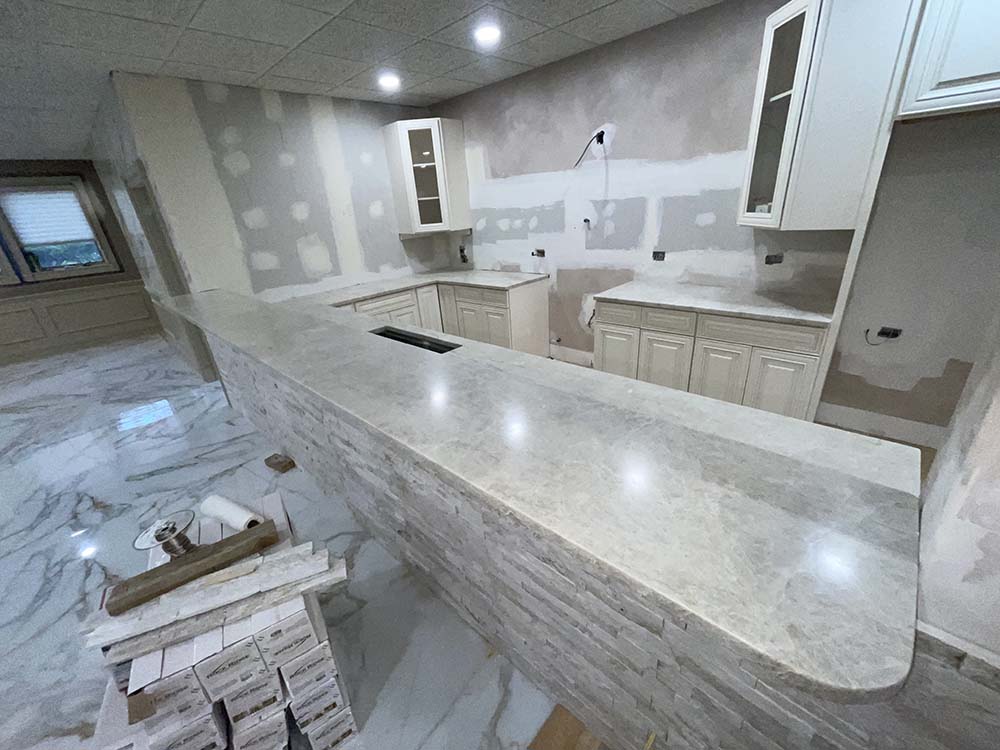
In a large island, the stone finally has room to show its whole pattern. That’s excellent when the slab is beautiful, and overwhelming when it’s more active than you expected.
In a small kitchen, most of the slab gets cut into narrow perimeter runs. Big sweeping veins get chopped into fragments and lose the effect you paid for. Quieter or more consistent movement often looks better in a compact room. That’s not a rule against dark or dramatic stone in small kitchens, just a reason to see the layout before you commit.
Vein Direction Is a Fabrication Decision
Choosing the color is only half of slab selection. With directional stone, the movement has to be laid out deliberately: veins running the length of the island, flowing toward the room, or connecting visually to the perimeter pieces.
We mark slab layout before cutting and show you which areas become the island, the perimeter, the backsplash and the exposed ends. A beautiful slab loses much of its effect when it’s cut without considering the finished room. We handle that at every stage of fabrication and installation. More on that in our slab selection, templating and cutting guide.
Lighting Changes the Color You Chose
A slab has no single appearance. It shifts under daylight, warm LEDs, cool LEDs and evening light.
- Warm gold movement intensifies under evening light and warm bulbs
- Cool gray veining reads bluer beside a north-facing window
- Under-cabinet lighting hits the perimeter differently than pendants hit the island
- A stone that looked neutral in a showroom can feel warmer once installed
Take samples home when you can, and look at them in the actual kitchen at morning, afternoon and night.
Finish Is Part of the Color Decision
| Finish | What it does to the color |
|---|---|
| Polished | Deeper color, stronger reflection, more pronounced contrast in the veining |
| Honed | Softer, lighter, more muted; shows fingerprints and marks more readily on dark stone |
| Leathered | Texture that breaks up reflection and mutes the surface without lightening it |
Don’t approve the stone and leave the finish for later. The same slab in polished and honed can look like two different materials.
Don’t Forget the Floor
A cabinet door and a slab can look perfect together and still fail once the floor joins them. Warm oak floors plus warm wood cabinets plus a warm beige countertop can leave a kitchen with no depth at all. A patterned stone or tile floor may already be carrying the room’s visual interest, which argues for a quieter countertop.
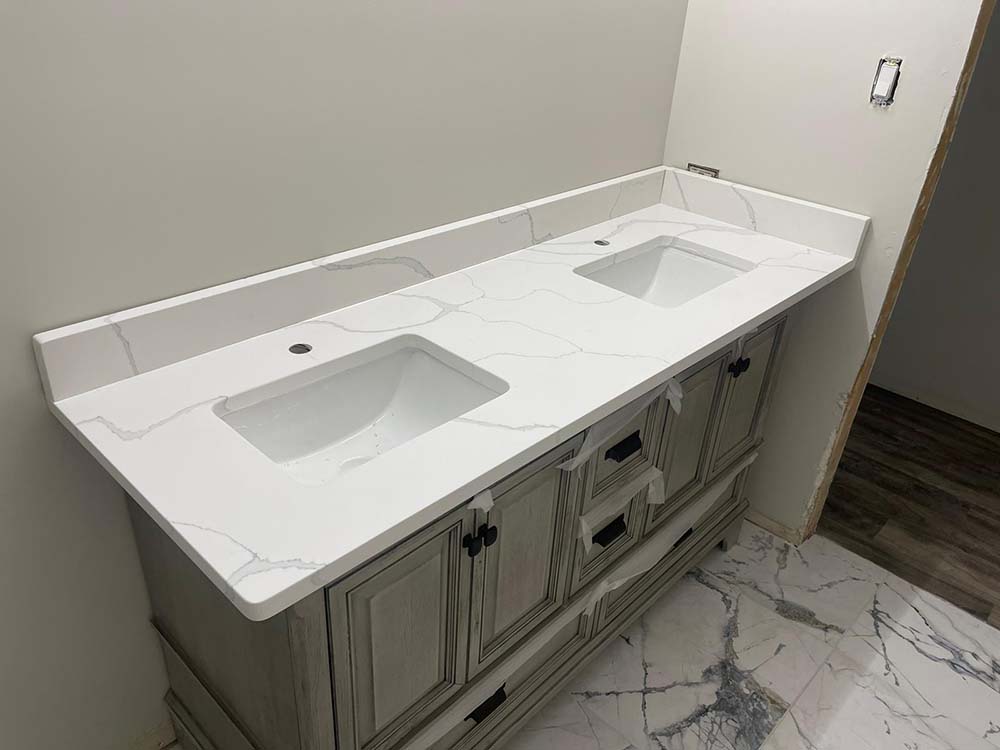
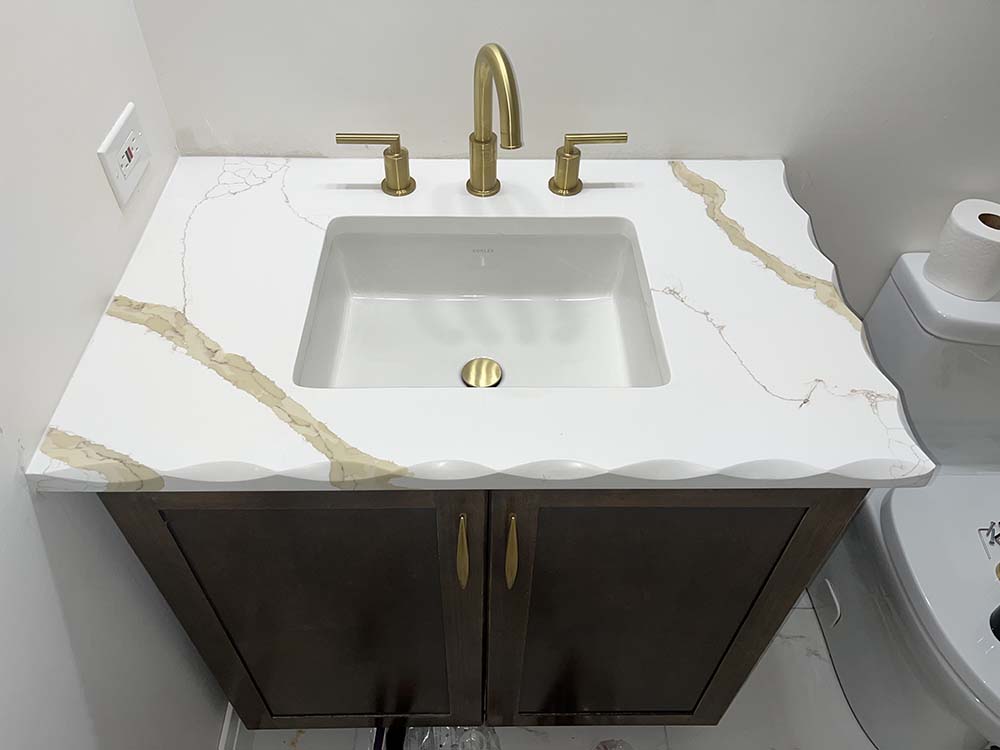
Judge the combination as cabinet + counter + floor + backsplash, not as two samples held together. The same logic applies beyond the kitchen: see kitchen countertops, bathroom vanity tops and commercial countertops.
Choose the Countertop Before the Backsplash
The countertop covers more visual space and is far harder to change later, so it makes the better anchor. Once the slab is chosen, the backsplash can repeat one of its tones, disappear quietly, add texture, or create deliberate contrast.
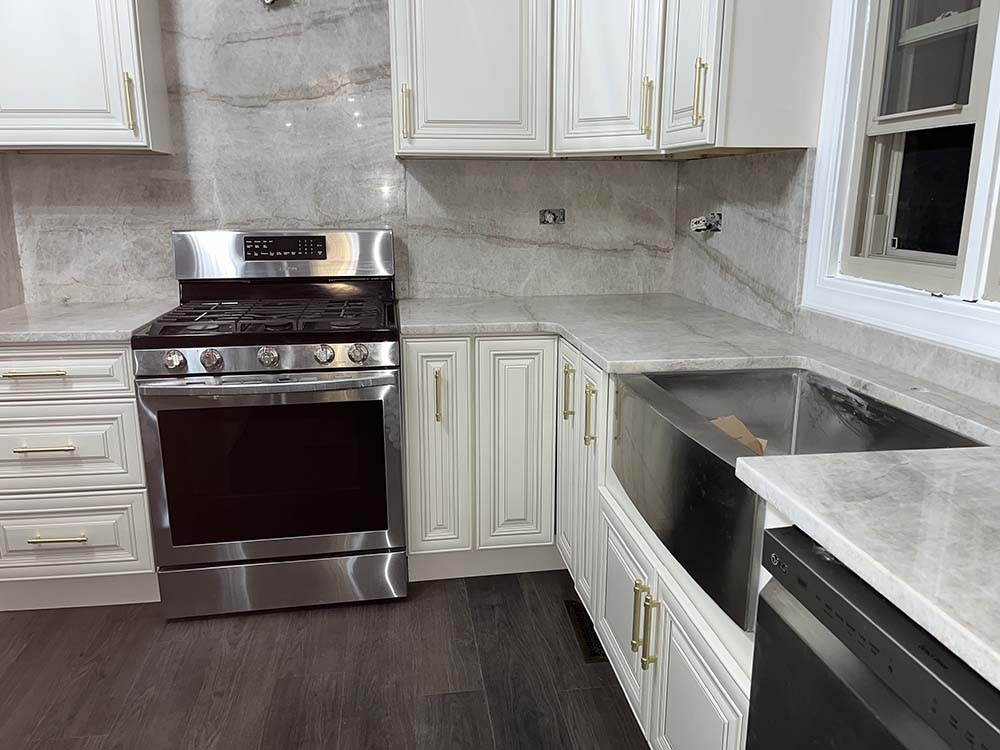
If the stone continues up the wall as a full-height backsplash, color matters even more, because the material occupies much more of the room. Slab layout, veining, outlet locations and wall dimensions all need to be coordinated before fabrication.
Aim for Relationship and Contrast, Not Matching
Cabinets, countertop, floor and backsplash all in the same beige sounds coordinated and usually produces a flat room. Good combinations rely on relationship, contrast and repetition: the countertop repeats a warm tone from the wood without being the same color, and that gap is what creates dimension.
The same applies to a contrasting island. A dramatic quartzite island against a quiet perimeter works beautifully, as long as the two share something — an undertone, a vein color, a level of warmth. Contrast should look deliberate rather than accidental.
Replacing Countertops in an Existing Kitchen
A full remodel lets every finish change together. A countertop replacement is a different exercise: the cabinets, flooring, appliances and paint are staying, and the new stone has to become the bridge between materials that were chosen years apart, possibly by someone else.
That makes physical samples essential, because the room has already made most of its decisions. Bring the cabinet door and a flooring sample, and expect to rule out slabs that would be perfect in a different kitchen. See countertop replacement.
Quartz vs. Natural Stone, in Terms of Color
Engineered quartz is manufactured, so the color and pattern are consistent and predictable. That helps when you want a controlled background, repeatable veining, or the same material across a kitchen, a bar and two bathrooms. Even so, dramatic quartz patterns repeat, and a small chip won’t show how often that repeat appears across a long island.
Granite, marble and quartzite vary naturally. A sample cannot show vein direction, mineral concentration, broad color transitions or the features unique to your slab. For natural stone, full-slab viewing isn’t a nicety, it’s how you avoid surprises. Compare the materials in our quartz vs granite vs quartzite guide.
Online Photos Are for Shortlisting, Not Deciding
Galleries are excellent for discovering what you like. A monitor cannot reproduce undertone, surface depth, mineral texture or finish, and phone cameras adjust brightness, warmth and contrast automatically. Use photographs to build a shortlist and to remember the room; use real slabs and real samples to make the decision.
What to Bring to the Slab Yard
| Bring | Why |
|---|---|
| A cabinet door or finish sample | The single most important item, and far more reliable than a photo |
| A flooring sample | Essential if the floor is staying |
| Hardware finish | Brass, nickel, black and bronze each pull different tones out of stone |
| Backsplash sample | If it’s already chosen |
| Photos of the whole room | Windows, adjoining spaces and existing finishes, for context |
| Rough dimensions | So we can tell you how many slabs the job needs |
Then step back. A countertop is experienced from several feet away, across a whole room. Don’t judge a kitchen from six inches off the slab.
Four Questions Before You Reserve a Slab
- Does the background undertone work with the cabinet finish?
- Do any vein colors conflict with the flooring or other fixed materials?
- Is the pattern too active, or too quiet, for this cabinetry?
- Will I still like this surface when it covers the whole island rather than a sample?
Those four eliminate most bad combinations before anyone writes a deposit.
A Simple Starting Point
| If your cabinets are… | Start by comparing… |
|---|---|
| Warm (wood, cream, greige) | Cream, warm white, taupe, beige, gold or brown movement |
| Cool (blue-gray, charcoal, bright white) | Crisp white, cool gray, charcoal, silver movement |
| Neutral white | Almost anything — then decide whether the room needs warmth, contrast, drama or restraint |
That’s a starting point, not an answer. The room decides.
See Slabs at Our Crestwood Showroom
Al Jory Marble fabricates and installs quartz, granite, marble and quartzite from our Crestwood location for homes across Chicago and the suburbs, including Chicago, Orland Park, Tinley Park, Naperville, Oak Lawn, Downers Grove, Schaumburg, Bolingbrook, Aurora and Joliet.
Bring your cabinet and flooring samples, compare full slabs under real light, and request a free estimate once the material and dimensions are settled. For budgeting, see our countertop cost guide.
Visiting the Crestwood Slab Yard
Al Jory Marble
📍 4711 W 135th St, Crestwood, IL 60418
📞 (708) 362-7674
🕔 Monday–Saturday, 9:00 a.m.–6:00 p.m. · Closed Sunday
🚗 Get directions
We’re on 135th Street in Crestwood, a few minutes from I-294 and the Cicero Avenue corridor, which puts us within a short drive of most of the south and southwest suburbs:
| From | Approximate drive |
|---|---|
| Oak Lawn, Palos Heights, Orland Park | 10–20 minutes |
| Tinley Park, Oak Forest, Alsip, Evergreen Park | 10–20 minutes |
| Downtown Chicago and the South Side | 25–45 minutes |
| Downers Grove, Bolingbrook, Joliet | 30–45 minutes |
| Naperville, Aurora, Schaumburg | 40–60 minutes |
Walk-ins are welcome during business hours, though calling ahead means we can pull slabs in your color range before you arrive.
FAQs About Countertop Colors
Where is Al Jory Marble located?
At 4711 W 135th St, Crestwood, IL 60418, with a slab yard and showroom open Monday through Saturday, 9:00 a.m. to 6:00 p.m.
What areas do you serve?
Chicago and the surrounding suburbs, including Orland Park, Tinley Park, Naperville, Oak Lawn, Downers Grove, Schaumburg, Bolingbrook, Aurora and Joliet.
Do I need an appointment to view slabs?
No, walk-ins are welcome during business hours. Calling ahead at (708) 362-7674 lets us pull slabs in your color range before you arrive.
What countertop color works best with white cabinets?
White cabinetry pairs with cream, white, gray, black and strongly veined stone. The key is comparing undertones so the cabinet white and the countertop white don’t conflict.
What countertop colors look good with wood cabinets?
Warm white, cream, beige, taupe and many quartzites pair naturally with wood. The right choice depends on whether the wood leans gold, red, brown or gray.
Should countertops be lighter or darker than cabinets?
Either works. Light stone creates contrast against dark cabinetry; darker counters ground lighter cabinets. Room size, lighting and flooring should decide it.
What countertop works with navy cabinets?
Light quartz, marble, quartzite and lighter granite create strong contrast. Warm veining also ties navy cabinets to brass fixtures and wood details.
Do gray cabinets need gray countertops?
No. Warm greige cabinets often look better with cream quartzite, while cooler gray cabinetry suits crisp white or cool-veined stone.
Should the backsplash match the countertop?
They should coordinate, not match. A quieter backsplash lets a dramatic countertop stay the focal point.
Can the island use a different stone than the perimeter?
Yes, and it’s a common way to create a focal point. The two surfaces should still share an undertone, a vein color or a level of warmth.
Why does stone look different after installation?
Daylight, artificial light, cabinet color, flooring, paint and the surface finish all change how stone reads. That’s why samples should be judged in the actual room.
Does the finish change the color?
Yes. Polished deepens color and contrast, honed looks softer and lighter, and leathered adds texture that mutes reflection.
How many slabs will my kitchen need?
It depends on the layout, the island size and the slab dimensions. Send us your measurements and we’ll tell you before you shop.
Can I see the full slab before it’s cut?
Yes, and you should, especially with granite, marble and quartzite. We’ll walk the slab with you and mark the layout before fabrication.
Do you help with color selection?
Yes. Bring your cabinet door and flooring sample to the Crestwood showroom and we’ll narrow the options with you.
Choose the Stone Beside the Materials That Matter
A slab that’s beautiful on its own is only half a decision. The better question is whether it makes the rest of the kitchen look better — beside the cabinetry, the flooring, the hardware, the backsplash and the light in that particular room.
Request a free countertop estimate · (708) 362-7674 · 4711 W 135th St, Crestwood, IL 60418 · Mon–Sat 9:00 a.m.–6:00 p.m.
Related: kitchen countertop buying guide · countertop cost guide · quartz vs granite vs quartzite · slab selection and templating · gallery


Serving Chicago & Surrounding Areas
Get Your Free Kitchen Countertop Estimate
Fill out the form and our team will get back to you in next 24 hours.