Written by Al Jory Marble Team
Published: September 16, 2026
Read Time: 16 minutes
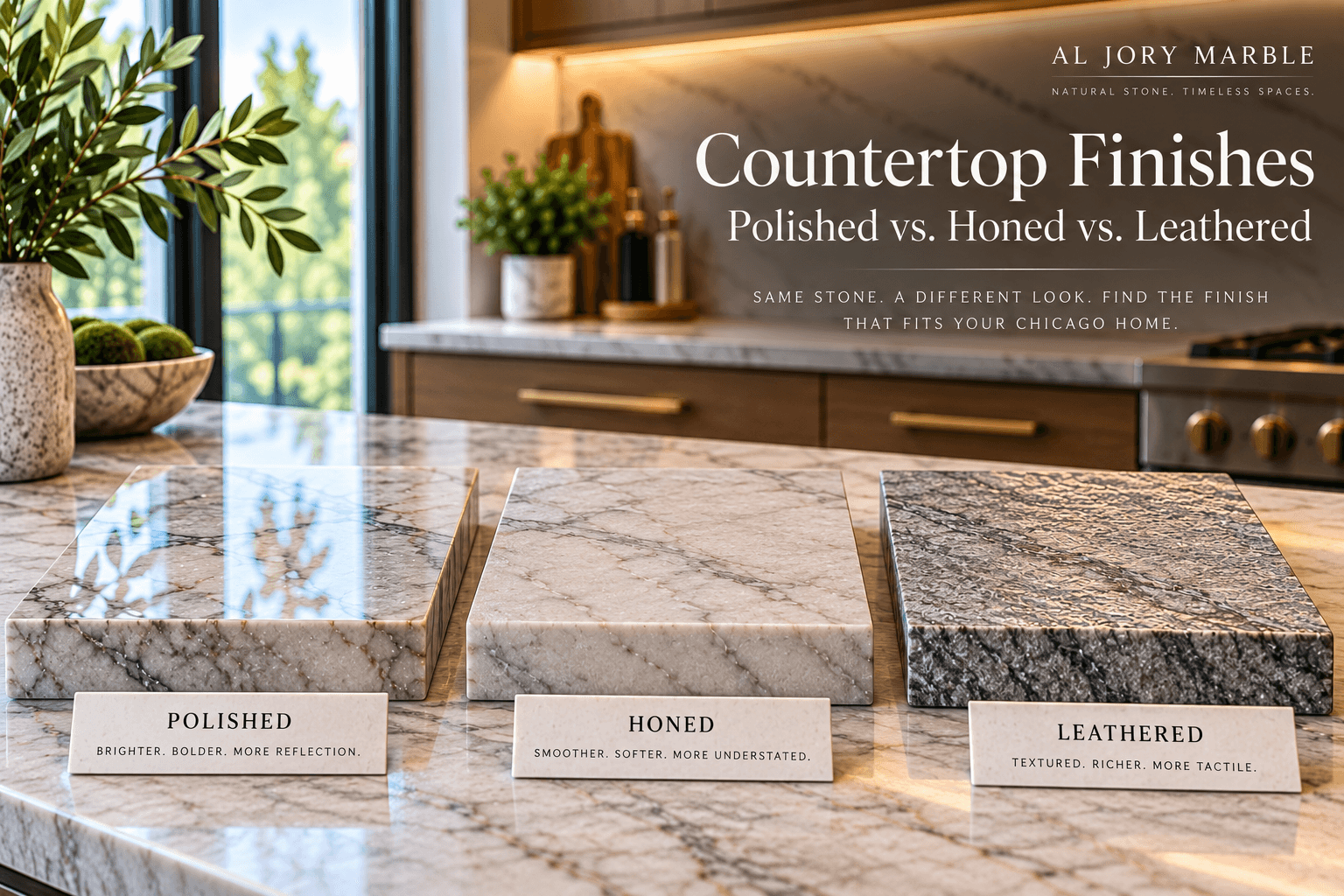
Countertop finishes can make the exact same slab look like three completely different materials. A polished finish reflects light and brings out color and veining. A honed finish removes the high gloss and gives the stone a softer, matte appearance. A leathered finish adds subtle texture and depth while reducing the mirror-like reflection associated with polished stone. The right choice depends on the stone itself, how much light enters the room, how the countertop will be used, and whether you prefer a crisp glossy surface or a quieter, more tactile finish.
Quick answer: Choose polished stone when you want maximum color depth, shine and strong vein definition. Choose honed when you prefer a smooth matte look and want fingerprints or light surface changes to be less noticeable. Choose leathered when you want visible texture, a softer sheen and a surface with more tactile character. Not every stone responds to each finish in the same way, so compare the actual material before fabrication.
Homeowners selecting slabs for Chicago kitchen countertops should look at finish samples alongside the actual stone whenever possible. Changing the finish changes how light, color, texture and movement are perceived even when the slab itself has not changed.
How Countertop Finishes Change the Same Stone
The finish is the final surface treatment applied to the face of the stone.
It does not change whether the material is:
- granite;
- marble;
- quartzite;
- another natural stone.
But it changes how the material looks and feels.
Think of the finish as the final lens through which you see the slab.
The same dark granite may appear:
deep and reflective when polished
soft and muted when honed
rich and tactile when leathered
The mineral structure is the same.
What changes is the surface.
This is why choosing a slab without discussing the finish can leave an important part of the design unresolved.
What Is a Polished Countertop Finish?
A polished finish is smooth, reflective and glossy.
During fabrication, progressively finer abrasives are used until the surface develops a high level of sheen.
Polishing usually intensifies:
- color;
- veining;
- mineral depth;
- contrast.
Natural Stone Institute technical guidance describes polished stone as having a high-gloss, mirror-like appearance that intensifies the color and pattern of natural stone.
What polished stone looks like
Imagine a slab of dark granite.
When polished, the darker background may become deeper and more saturated.
Metallic mineral deposits may catch the light.
White quartzite can appear more luminous.
Marble veining can become sharper and more dramatic.
This is one reason polished surfaces are commonly seen in showrooms: they create immediate visual impact.
Why Homeowners Choose Polished Stone
Polished stone works especially well when the goal is:
- a crisp finished appearance;
- strong vein definition;
- deeper color;
- reflected light;
- traditional elegance;
- high visual contrast.
Polished material can look particularly strong in rooms with controlled lighting because light travels across the surface and emphasizes the slab.
Polished stone can help darker kitchens feel more reflective
A glossy surface reflects more light than a matte one.
That does not mean the countertop will make a dark kitchen bright by itself.
But reflected light can add visual energy to the room.
This can work especially well with:
- dark cabinets;
- dramatic granite;
- richly colored quartzite;
- marble with pronounced veining.
What Does Polished Stone Show More Easily?
A highly reflective surface can make certain things easier to see.
Depending on the color and stone, that may include:
- fingerprints;
- dried water;
- smudges;
- streaks;
- etching on acid-sensitive materials.
Dark polished stone can be particularly revealing.
Think of a polished black granite countertop.
The dark surface and strong reflection can show fingerprints much more clearly than a textured finish on the same material.
That does not make polished stone impractical.
It simply means visual maintenance may be more noticeable.
Polished Marble Requires Realistic Expectations
Polished marble can be spectacular.
The high sheen emphasizes:
- luminosity;
- veining;
- color contrast.
But marble is calcium-based.
Acidic substances can react with the surface and produce etching.
On a glossy polished surface, the etched area can appear as a dull patch because the shine has been altered.
That is why some homeowners who love marble but worry about visible etching choose a honed finish instead.
Homeowners considering natural marble can review marble countertops in Chicago for more information about slab selection, fabrication and care.
What Is a Honed Countertop Finish?
A honed finish is smooth but less reflective.
The stone is ground and finished to a lower sheen rather than being taken all the way to a high polish.
The Natural Stone Institute describes honed stone as having a non-reflective, satin-like finish produced by stopping the finishing process before a full polish is achieved.
The surface should still feel finished.
It is not unfinished stone.
It simply has much less gloss.
What Does Honed Stone Look Like?
Honed stone generally appears:
- softer;
- calmer;
- less reflective;
- more understated.
Color can also look slightly different.
A polished black stone may appear very deep and almost glass-like.
The honed version may look more charcoal.
A polished marble may look luminous.
The honed version can look softer and almost powdery.
Neither appearance is inherently better.
They create different design personalities.
Why Honed Countertops Have Become Popular
Honed finishes fit particularly well with current kitchens that use:
- natural wood;
- warm neutral colors;
- matte cabinetry;
- plaster-style hoods;
- understated hardware;
- organic materials.
A glossy countertop creates contrast against those finishes.
A honed surface blends more quietly.
That can make the stone feel less formal and more architectural.
Honed Marble Is Worth Serious Consideration
Marble is one of the materials where the choice between polished and honed matters most.
Acid can still etch honed marble.
Honing does not make marble chemically resistant.
What changes is visibility.
Because the entire surface already has a lower sheen, an etched area may blend more naturally than it would on a highly polished slab.
This is why homeowners who love real marble but expect the kitchen to be used heavily often consider honed marble.
The stone still behaves like marble.
The finish simply changes how some everyday wear is perceived.
Does Honed Stone Show Fingerprints Less?
Often, yes.
Because a honed surface reflects less light, fingerprints and smudges may be less visually obvious than on a dark polished surface.
But the exact result depends on:
- stone color;
- mineral structure;
- lighting;
- cleaning;
- surface treatment.
Do not choose a finish from a verbal description alone.
Look at an actual sample.
Touch it.
Hold it near your cabinet material.
Move it under different light.
What Is a Leathered Countertop Finish?
A leathered finish introduces texture.
The stone typically begins with a relatively smooth surface and is then worked with abrasive brushes that interact with the harder and softer minerals differently.
The result may have:
- gentle texture;
- subtle relief;
- reduced reflection;
- soft sheen.
The Natural Stone Institute notes that terms such as brushed, antique and leathered are not completely standardized across the stone industry, and the finished appearance can vary depending on both the process and the mineral composition of the stone.
That is an important point.
One leathered stone may feel almost smooth.
Another may have clearly noticeable texture.
Leathered Stone Is Particularly Effective on Dark Granite
Dark granite is one of the materials where leathering can produce a dramatic transformation.
A polished black or charcoal granite may feel:
- formal;
- glossy;
- sharp.
The leathered version may feel:
- softer;
- richer;
- more tactile;
- more organic.
Certain mineral patterns become more noticeable because the surface no longer reflects light evenly.
Al Jory Marble’s Black Pearl granite information, for example, identifies polished and leathered as popular finish options and describes leathering as especially effective for reducing the visibility of fingerprints and water marks.
Leathered Does Not Mean Rough
A properly finished leathered countertop should not feel like unfinished rock.
The surface is textured, but it remains intentional and usable.
How pronounced that texture becomes depends on:
- stone composition;
- brushing process;
- desired finish;
- original slab.
This is another reason full-size finish samples are valuable.
A tiny photograph online does not communicate texture well.
Polished vs. Honed vs. Leathered: Start With Light
One of the easiest ways to choose among countertop finishes is to think about how much light reaches the room.
Bright kitchens
A kitchen with large windows and strong natural light may support any of the three finishes.
A polished surface will reflect more of that light.
A honed or leathered surface will absorb it visually and feel quieter.
Darker kitchens
A polished finish can add reflectivity.
But a honed finish may also work beautifully if the goal is a moody, sophisticated appearance.
Do not assume:
dark room = polished
bright room = matte
Design is more nuanced than that.
The important point is to see the stone in lighting similar to the finished room.
Think About Cabinet Finish Too
The countertop and cabinetry should not be selected independently.
Imagine:
matte walnut cabinetry
- honed Taj Mahal quartzite.
The two surfaces may feel soft and cohesive.
Now imagine:
high-gloss cabinetry
- highly polished stone.
That creates a very different level of reflection.
Neither is automatically wrong.
But the room needs balance.
If every surface reflects strongly, the kitchen can feel busy.
If everything is extremely matte, the room can feel visually flat.
Countertop finish can help balance the other materials.
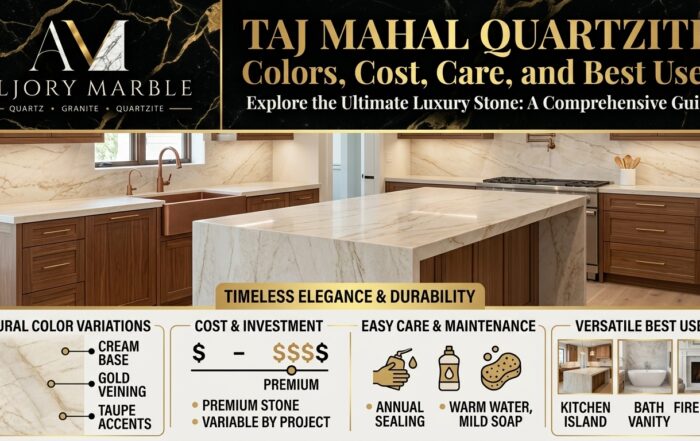
What Finish Works Well With Taj Mahal Quartzite?
Taj Mahal quartzite is a good example because it can look dramatically different depending on finish.
Polished Taj Mahal
Polishing emphasizes:
- cream background;
- taupe veining;
- gold movement;
- depth.
Honed Taj Mahal
Honing creates a softer, quieter version of the stone.
The overall look becomes less reflective and more understated.
Brushed or Leathered Taj Mahal
A textured finish adds surface character.
The stone feels more tactile and can appear slightly more casual.
Al Jory Marble already offers polished, honed and leathered finishes on quartzite fabrication, making this a decision homeowners can compare during slab selection.
Those researching the material itself can also review quartzite countertops separately rather than turning this finish guide into another quartzite article.
Granite Can Change Dramatically With Finish
Granite is highly varied.
That means there is no universal rule about which finish looks best.
Some granites become extremely dramatic when polished.
Others gain character when leathered.
Dark granites often respond beautifully to texture.
Highly patterned granites may become visually calmer when the gloss is reduced.
When selecting granite, ask to compare the same or similar stone in multiple finishes if samples are available.
The finish should be evaluated on the actual material—not as an abstract preference.
Marble: Polished or Honed?
This is one of the most common finish decisions.
Choose polished marble when you want:
- maximum shine;
- dramatic veining;
- reflected light;
- a more formal appearance.
Consider honed marble when you prefer:
- matte surface;
- softer aesthetic;
- less obvious etching contrast;
- quieter visual character.
Again, honed marble can still etch.
The finish does not change the underlying mineral composition.
It changes how the surface looks before and after normal use.
What About Quartz?
Engineered quartz is different from natural stone.
Most quartz surfaces are manufactured with a specific factory finish.
That may be:
- polished;
- matte;
- textured.
Homeowners should choose from finishes approved and offered by the manufacturer rather than assuming a fabricator can simply convert any quartz slab from polished to honed or leathered the way natural stone can be mechanically refinished.
This distinction is important.
With natural stone, finish can often be part of the fabrication conversation.
With engineered quartz, the finish is commonly part of the product itself.
Always follow the manufacturer’s specifications.
Countertop Finishes and Fingerprints
If fingerprints bother you, finish matters.
Dark polished surfaces often show touch marks most clearly.
A honed finish can reduce strong reflection.
Leathered surfaces can hide marks even more effectively on some stones because the texture breaks up reflected light.
This can be especially useful on:
- islands;
- bar areas;
- dark countertops;
- heavily touched surfaces.
But do not choose solely on fingerprints.
Cleaning habits, color and lighting matter too.
Countertop Finishes and Water Spots
Water spotting is another practical consideration.
A dark polished countertop can sometimes show dried water more clearly because the mineral deposit contrasts against the glossy surface.
Honed and leathered finishes may make those marks less obvious visually.
That does not mean water spots disappear.
They simply may not catch the eye as quickly.
Regular cleaning remains important regardless of finish.
How Finish Affects Veining
Polishing usually creates the strongest vein contrast.
If a slab contains dramatic movement, polished finishing can emphasize it.
Honing can soften that contrast.
Leathering can add another layer because the physical texture interacts with the mineral pattern.
This matters especially on:
- quartzite;
- granite;
- marble.
If the slab itself is the main design feature, decide whether you want to amplify the pattern or soften it.
Does a Leathered Finish Hide Scratches?
Textured finishes can make certain light surface marks less noticeable because reflections are broken up.
But leathering does not make stone scratch-proof.
Likewise, honing does not make stone immune to damage.
The material still determines the underlying performance.
Finish changes appearance.
Material determines much of the physical behavior.
Keep those decisions separate.
The Finish Should Match the Edge Profile
The countertop surface and edge meet each other.
That means they should be considered together.
A polished ogee edge can create a highly traditional, formal appearance.
A honed eased edge feels much quieter.
A leathered surface with a simple eased edge may emphasize the natural stone rather than the edge detail.
For homeowners still deciding, the countertop edge profiles guide explains how eased, beveled, bullnose, ogee and mitered edges change the final appearance.
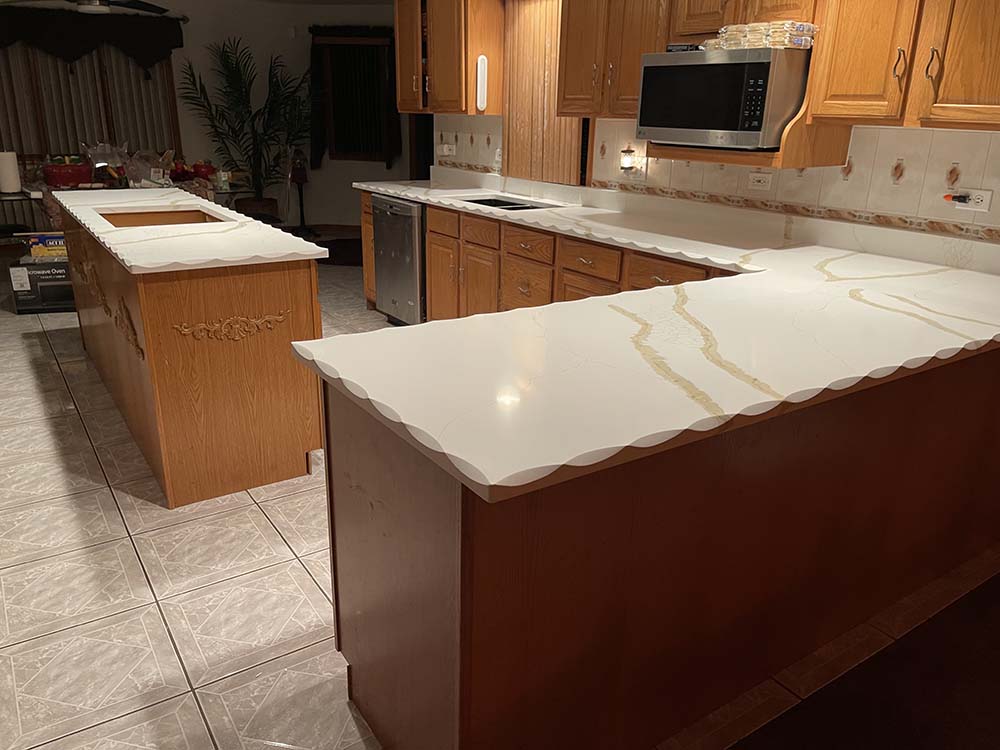
Can the Island Have a Different Finish?
Yes, but do it intentionally.
For example:
- polished perimeter + leathered granite island;
- honed marble island + another material on the perimeter;
- leathered dark stone feature island + lighter polished surface elsewhere.
Mixing finishes can create hierarchy.
But subtle accidental-looking differences can feel inconsistent.
If the island is different, make the difference clear enough to look deliberate.
Finish Samples Should Be Viewed in Person
Photography cannot fully show:
- gloss level;
- texture;
- tactile feel;
- subtle relief.
This is particularly true for leathered material.
A photo may make honed and leathered stone look nearly identical.
Touch them and the difference becomes obvious.
Whenever possible, evaluate:
- polished sample;
- honed sample;
- leathered sample;
in person.
Al Jory’s countertop slab selection, templating and cutting guide explains why full slabs and physical samples provide information that small photographs cannot.
Look at the Finish Next to Your Cabinet Door
Bring the actual cabinet finish when possible.
A phone photograph is not the same.
Put the cabinet next to the stone.
Then step back.
Check the combination in:
- daylight;
- warmer artificial light;
- cooler artificial light if relevant.
Polished stone may reflect the cabinet color.
Honed stone may appear warmer or softer.
Leathered stone can make natural wood feel especially tactile.
The interaction matters more than either material by itself.
Finish Can Change the Perceived Color
A single stone can look surprisingly different across multiple finishes.
Polishing often deepens colors.
Honing can make them appear lighter or more muted.
Leathering may deepen some mineral colors while reducing overall reflectivity.
This can affect a design where exact undertones matter.
A stone that looks perfect polished may become too muted when honed.
Another stone may become much more sophisticated.
Never assume.
Compare.
Does the Finish Change Sealing Requirements?
Finish can influence how a natural stone surface behaves, but sealing requirements depend on the actual stone.
Some natural stones benefit from an impregnating sealer.
Others are dense enough that the need may be limited.
A sealer does not make natural stone completely stain-proof.
The Natural Stone Institute explains that impregnating sealers improve stain resistance rather than creating total stain immunity.
Follow recommendations for the specific stone and finish instead of using a one-size-fits-all schedule.
Cleaning Polished, Honed and Leathered Stone
Start with the same basic principle:
use cleaning products appropriate for natural stone.
For routine care:
- wipe spills promptly;
- use mild soap or stone-safe cleaner;
- avoid unnecessary abrasives;
- avoid acidic cleaners on acid-sensitive stone;
- dry the surface when needed.
The Natural Stone Institute recommends neutral cleaners, stone soap or mild dishwashing detergent for natural-stone surfaces and cautions that acidic cleaners can damage calcium-based stones.
Leathered surfaces may need slightly different cleaning attention
Texture creates small variations in the surface.
Depending on how pronounced the leathering is, wiping technique may feel different than on a completely smooth polished top.
That is not necessarily difficult.
It is simply different.
What Finish Works Best for a Busy Family Kitchen?
There is no universal answer.
Consider a household with:
- children;
- heavy island use;
- constant fingerprints;
- lots of entertaining.
A honed or leathered natural stone may visually hide everyday touch marks better.
But a polished surface may be easier for that particular homeowner to wipe clean because it is extremely smooth.
Lifestyle matters.
Do not select a finish only because it is currently popular.
What Finish Works Best for a Statement Island?
If the stone itself is the star, polished can create maximum visual drama.
But leathered can make an island feel equally special in a completely different way.
Imagine a dark leathered granite island beside warm wood cabinetry.
The surface becomes tactile rather than reflective.
Now imagine dramatic polished quartzite.
The movement becomes the focal point.
Both can work.
The question is what kind of statement you want.
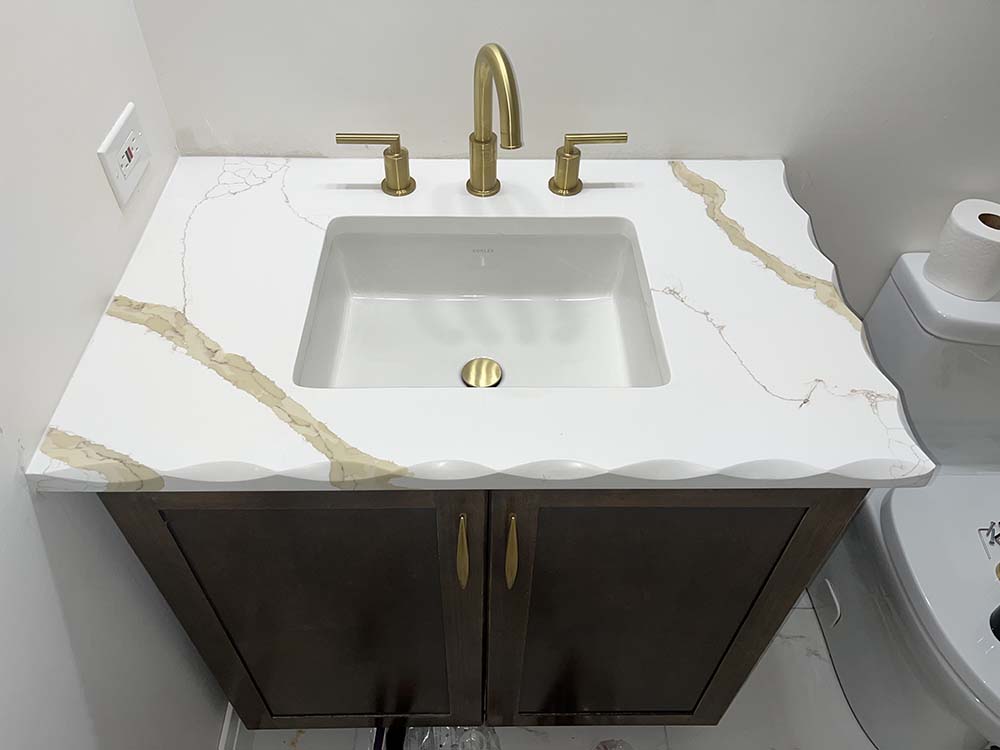
What Finish Works Best in a Bathroom?
Bathrooms can support several directions.
Polished stone can:
- reflect vanity lighting;
- feel crisp;
- highlight veining.
Honed stone can:
- feel softer;
- create a spa-like appearance;
- reduce intense reflection.
Leathered stone can create texture, although suitability depends on the specific stone and application.
For vanity tops, consider cosmetics, cleaners, water and the expected level of maintenance along with appearance.
Countertop Finishes Should Be Chosen Before Final Fabrication
Do not wait until the countertop is nearly ready to ask:
“Can we make it honed instead?”
Finishing is part of the fabrication process.
The fabricator needs to know the desired surface before the job reaches its final stages.
That is especially important when the finish affects:
- edge appearance;
- slab selection;
- seam appearance;
- fabrication sequence.
Al Jory Marble’s countertop fabrication services include cutting, edge profiling, polishing and finishing in its Crestwood fabrication shop.
What Should You Compare Before Choosing?
Place your options side by side.
Look at:
Reflection
How much light do you want bouncing from the surface?
Color depth
Do you prefer bold saturation or softer tones?
Veining
Should the pattern feel dramatic or understated?
Texture
Do you want completely smooth or tactile?
Fingerprints
How much do visible touch marks bother you?
Stone type
Does that particular stone respond well to the chosen finish?
Room style
Is the kitchen formal, transitional, organic, contemporary or rustic?
Maintenance expectations
What will everyday cleaning feel like?
Those questions lead to a better decision than simply asking which finish is most popular.
FAQs About Countertop Finishes
What is the most common countertop finish?
Polished remains one of the most common natural-stone finishes because it emphasizes color, veining and reflectivity. Honed and leathered finishes are increasingly selected when homeowners want a softer or more textured appearance.
Is honed stone harder to clean than polished stone?
Not necessarily, but the experience can differ by stone. Polished surfaces are extremely smooth, while honed finishes have less sheen. Proper cleaning products and regular maintenance matter more than assuming one finish is universally difficult.
Does honed marble still etch?
Yes. Honing does not change marble’s mineral composition. Acid can still etch it. The difference is that etching may be less visually obvious against an already matte surface.
Is leathered granite good for kitchens?
It can be an excellent kitchen finish, particularly on dark or strongly patterned granite. Leathering adds texture and can reduce how noticeable fingerprints and water marks appear.
Can any stone be leathered?
Not every stone produces the same leathered result. Mineral structure and hardness influence the final texture. The specific slab should be evaluated before choosing the finish.
Can quartz countertops be honed or leathered?
Some engineered quartz products are sold in matte or textured factory finishes. Homeowners should select manufacturer-approved finishes rather than assume engineered quartz can be refinished like natural stone.
Does polished stone need less sealing?
Not necessarily. Sealing requirements depend primarily on the actual natural stone and its absorption characteristics. Finish may influence behavior, but the material itself should guide the recommendation.
Which finish shows fingerprints the least?
Leathered and honed finishes often make fingerprints less noticeable than dark polished surfaces because they reflect less light. Color and stone pattern also influence visibility.
Choose the Finish on the Actual Stone
The biggest mistake with countertop finishes is choosing one in theory.
“Polished” does not look identical on every stone.
Neither does “honed.”
And leathered finishes can vary substantially in texture.
See the slab.
See finish samples.
Touch them.
Put them next to the cabinet material.
Look at them under light similar to your home.
Then decide.
A finish should not be an afterthought.
It is part of what turns a raw slab into the surface you will actually see and use every day.
Al Jory Marble fabricates marble, granite, quartzite and engineered stone surfaces for homes and businesses throughout Chicago and the surrounding suburbs, with slab selection, templating, cutting, finishing and installation coordinated from its Crestwood shop.
Al Jory Marble
Phone: (708) 362-7674
Address: 4711 135th St, Crestwood, IL 60418
Email: aljorymarble9446@gmail.com
Hours: Mon – Sat: 9:00 am – 6:00 pm


Serving Chicago & Surrounding Areas
Get Your Free Kitchen Countertop Estimate
Fill out the form and our team will get back to you in next 24 hours.