
Written by Al Jory Marble Team
Published: September 16, 2026
Read Time: 18 minutes
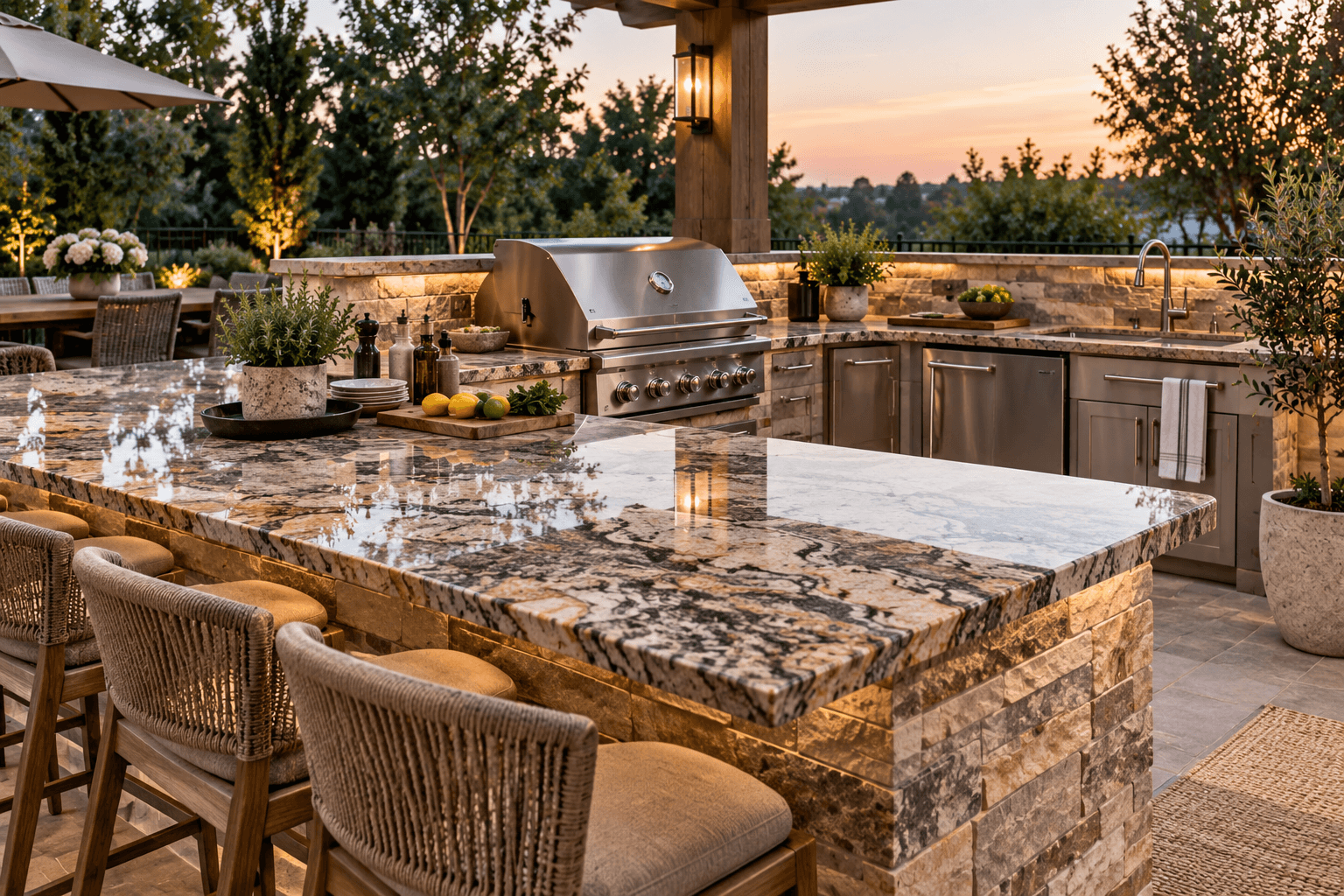
Outdoor kitchen countertops in Chicago have to survive conditions an indoor surface never sees. Summer sun can heat a dark slab for hours, rain reaches exposed seams and edges, winter brings repeated freezing and thawing, and the countertop may sit directly beside a grill that generates concentrated heat. That changes the material conversation. A surface that performs beautifully inside a climate-controlled kitchen is not automatically the right choice for an outdoor cooking area. Granite and properly selected quartzite are often strong candidates, while engineered quartz requires much more caution because many products are intended for indoor use rather than constant UV exposure.
Quick answer: For an outdoor kitchen in Chicagoland, start with natural stone that is suitable for exterior exposure—commonly granite or an appropriate quartzite—and build the installation for weather from the beginning. The cabinet structure, support, adhesives, seams, grill openings and drainage all matter. Do not assume an indoor quartz product can be moved outdoors; verify the exact manufacturer’s exterior-use guidance before choosing engineered material.
Homeowners who already work with Chicago kitchen countertops indoors will recognize many of the same fabrication decisions outside, but exterior stone adds weather, moisture, sunlight and seasonal movement to the equation.
The Chicago Weather Test
Picture the countertop in July.
The grill is running.
Direct afternoon sun is hitting the island.
Cold drinks are sweating on the stone.
Someone spills barbecue sauce beside the prep area.
Now picture that same countertop in January.
No one is cooking.
The stone is cold.
Snow melts against an edge.
Temperatures drop again overnight.
That is the real outdoor-countertop test.
The surface needs to work through both scenes.
Outdoor material selection should therefore consider:
- sunlight;
- heat;
- moisture;
- freezing and thawing;
- staining;
- support;
- installation materials;
- maintenance.
A countertop should not be chosen only because it looks good beside the grill in a summer showroom display.
It needs to make sense for the entire year.
Granite Is Usually the First Natural Stone to Compare
Granite has a long history of exterior use.
That matters.
It is not simply a kitchen material that happens to be placed outdoors.
The Natural Stone Institute describes granite as a stone with strong weathering durability that has historically been used in exterior architectural applications.
For an outdoor kitchen, granite offers several useful characteristics:
- strong durability;
- natural heat resistance;
- resistance to everyday abrasion;
- many available colors;
- polished, honed and leathered finishes;
- natural variation.
But “granite” is still a broad category.
One slab can look completely different from another.
Some are nearly uniform.
Some contain dramatic minerals and movement.
The actual stone should still be inspected before fabrication.
Homeowners comparing natural stone can review Al Jory Marble’s granite countertops and slabs before narrowing the selection.
Dark Granite Creates a Strong Outdoor Look
Outdoor kitchens can support darker surfaces particularly well.
A dark granite may coordinate beautifully with:
- stainless grill equipment;
- black appliances;
- cedar or composite cabinetry;
- stone veneer;
- brick;
- concrete patios.
Leathered black granite can be especially attractive outside because the lower-reflection texture feels natural in an exterior environment.
It also does not visually depend on the perfectly controlled lighting of an indoor kitchen.
Sunlight moves across the surface throughout the day.
Texture can make that change in light part of the design.
But Dark Stone Gets Hot in Direct Sun
This is an everyday-use issue more than an aesthetic one.
Dark surfaces absorb more solar heat.
On a sunny summer afternoon, the stone can become uncomfortable to touch.
That is worth thinking about if the counter will be used for:
- children’s seating;
- serving;
- bare hands;
- food preparation.
Shade can make a major difference.
A covered outdoor kitchen will behave differently from an island exposed to full western sun.
Before choosing a very dark slab, look at where the kitchen sits relative to the house, roof and afternoon sun.
Quartzite Can Be Exceptional Outdoors
Quartzite is another natural-stone category worth serious consideration.
The Natural Stone Institute describes quartzite as having exceptional strength, density and hardness in suitable varieties, with weathering durability that allows broad dimension-stone applications.
That combination makes the right quartzite attractive for exterior countertop projects.
Visually, quartzite can also provide something granite sometimes does not:
large flowing veins.
Warm creams.
Soft gold.
Gray movement.
More marble-like patterns.
That can create an outdoor kitchen that feels directly connected to a high-end indoor space.
Homeowners considering the material can review quartzite countertops and slabs separately.
Not Every Stone Sold as Quartzite Behaves Identically
This is important.
Stone names in the market do not always tell you everything about performance.
Different slabs may vary in:
- mineral composition;
- porosity;
- absorption;
- finish;
- fabrication characteristics.
Do not buy an exterior slab only because the label contains the word “quartzite.”
Ask about the actual material.
See it in person.
Understand its characteristics.
Outdoor exposure makes correct stone identification more important, not less.
Why Engineered Quartz Needs Caution Outdoors
This is where outdoor and indoor recommendations split.
Engineered quartz contains mineral content combined with resin binders and pigments.
Many standard quartz products are designed primarily for indoor environments.
Constant UV exposure can affect some products over time.
MSI, for example, states in its quartz countertop guidance that its standard quartz is not recommended for outdoor use because of conditions including UV exposure, moisture and temperature changes.
That does not mean every product manufactured by every company has identical exterior limitations.
It means you should never assume.
If someone proposes engineered quartz outside, ask for the manufacturer and exact product documentation confirming that the material is approved for the intended exterior installation.
“Quartz works great in kitchens” is not enough.
Natural Quartzite and Engineered Quartz Are Not the Same Thing
This distinction becomes especially important outdoors.
Quartzite is natural stone.
Quartz countertops are manufactured surfaces.
The similar names cause constant confusion.
They behave differently.
A homeowner may hear:
“Quartz is not recommended outdoors.”
Then assume the same restriction automatically applies to quartzite.
It does not.
The materials are fundamentally different.
That is why countertop buying should be based on the exact material rather than a similar-sounding name.
What About Marble Outdoors?
Marble has been used on exterior architecture for centuries.
But that does not automatically make every marble slab the ideal Chicago outdoor-kitchen counter.
An outdoor cooking surface introduces:
- food acids;
- wine;
- grease;
- weather;
- freeze-thaw exposure.
Marble can etch from acidic substances such as citrus and vinegar even indoors.
Outside, the homeowner also has to be comfortable with natural weathering and changes in appearance.
For some projects, that patina is desirable.
For others, granite or an appropriate quartzite may be the more practical choice.
A marble outdoor counter should therefore be a deliberate material decision—not simply an extension of an indoor marble kitchen.
Outdoor Kitchen Countertops Need Exterior Construction Underneath
This is where many online countertop articles become too superficial.
They talk about stone.
Then stop.
But the stone has to sit on something.
The Natural Stone Institute’s outdoor-kitchen guidance specifically notes that exterior installations face:
- extreme temperature changes;
- UV exposure;
- varying moisture levels.
It also calls for substrates or auxiliary framing appropriate for exterior use and installation products suitable for outdoor conditions.
That means the countertop should not simply be installed using whatever approach would normally be used inside a kitchen.
The entire assembly matters.
Build for January, Not Just July
Outdoor kitchens are usually designed during warm weather.
That can create a blind spot.
The space feels like:
grill
- patio
- cold drinks
- summer dinners.
But the structure remains outside all winter.
Think about:
- snow;
- water;
- freeze-thaw cycles;
- seasonal movement.
Outdoor construction needs to account for those conditions even when the kitchen itself is rarely used in winter.
The stone is not seasonal.
It stays there.
Moisture Needs Somewhere to Go
Outdoor kitchens should not be built in a way that traps water.
Water can come from:
- rain;
- melting snow;
- cleaning;
- sink use;
- ice.
Horizontal stone surfaces should work with the overall outdoor structure rather than creating areas where water repeatedly collects.
The cabinetry, substrate and adjoining patio conditions matter too.
If the outdoor kitchen is covered, exposure may be significantly reduced.
If it is completely exposed, drainage becomes even more important.
The Grill Zone Is Its Own Fabrication Problem
A grill cutout is not simply a large rectangle in the countertop.
The grill manufacturer typically specifies the dimensions and installation conditions for the equipment.
Those specifications affect:
- countertop opening;
- surrounding support;
- combustible-material clearances;
- ventilation;
- appliance position.
Use the actual grill model.
Do not say:
“We are probably buying a 36-inch grill.”
Different 36-inch appliances can have different installation requirements.
The fabricator needs the real specifications before the slab is cut.
Do Not Change the Grill After Fabrication
This can create an expensive problem.
Imagine the slab has already been fabricated around Grill A.
Then Grill A is unavailable.
You purchase Grill B.
The advertised width is the same.
But Grill B requires a different cutout.
Now the stone may not fit the appliance.
Model changes should always be checked against the fabricated opening before substitutions are made.
This applies to:
- grills;
- side burners;
- smokers;
- refrigerators;
- ice makers.
Outdoor-kitchen equipment is part of the stone plan.
Heat From the Grill Is Different From Hot Cookware
Indoors, countertop heat questions usually involve someone placing a hot pan on the surface.
Outdoors, the countertop may sit beside a heat-producing appliance for hours.
That means the appliance installation instructions matter more than generic statements such as:
“Granite is heat resistant.”
The stone itself is only one piece of the assembly.
Heat can affect:
- surrounding cabinetry;
- adhesives;
- structural materials;
- nearby finishes.
Follow the grill manufacturer’s installation requirements and build the opening accordingly.
Leave Real Landing Space Beside the Grill
A beautiful outdoor kitchen can still be frustrating if there is nowhere to set anything down.
Think about:
raw food
→ grill
→ finished food.
You need useful surfaces around the appliance.
Try not to let every section of countertop become occupied by:
- sink;
- burner;
- refrigerator opening;
- appliance lid.
Stone is valuable because it gives you working surface.
Leave enough of it exposed to actually use.
The Sink Zone Has Different Needs
If the outdoor kitchen includes a sink, confirm:
- sink model;
- faucet;
- cutout style;
- cabinet;
- plumbing;
- winterization plan.
The sink may be:
- undermount;
- drop-in;
- stainless prep sink.
Undermount installations create a clean appearance, but the stone opening needs to be properly finished.
Just like an indoor kitchen, the final sink model should be known before fabrication.
Winterization Should Influence the Outdoor-Kitchen Design
Plumbing does not stop being plumbing because it sits outside.
In a freezing climate, outdoor water lines and fixtures need an appropriate winterization approach.
That is a plumbing issue rather than a stone-fabrication decision, but it affects how the outdoor kitchen is planned.
The countertop should not make shutoffs or service areas impossible to reach.
Future maintenance access matters.
A beautiful outdoor island that hides every utility permanently can become a problem later.
Refrigerators Need Exterior Approval Too
Do not place a standard indoor refrigerator outside simply because it fits the cabinet opening.
Outdoor appliances should be approved for the environment where they are installed.
Confirm:
- exterior rating;
- ventilation needs;
- clearances;
- electrical requirements.
Those dimensions then become part of the cabinet and countertop plan.
The same principle applies to:
- ice machines;
- beverage refrigerators;
- wine coolers.
The stone should be fabricated around equipment that actually belongs outdoors.
Full Sun Changes How Stone Looks
Natural stone is viewed differently outdoors.
Indoor showrooms typically have:
- controlled LED lighting;
- consistent temperature;
- no direct sun.
Outside, the same slab may be seen under:
morning shade
→ midday sun
→ sunset
→ landscape lighting.
Polished stone can become highly reflective.
Honed stone looks softer.
Leathered granite can show more texture.
This is why finish matters.
Our countertop finishes guide explains how polished, honed and leathered surfaces change reflection and texture.
Polished Granite Outdoors
A polished finish can create:
- deeper color;
- strong reflection;
- crisp pattern.
It can look especially dramatic on dark stone.
However, reflected sunlight can be visually intense in certain locations.
Look at the orientation of the kitchen.
An island beneath a covered pavilion is different from a countertop facing open western sky.
Honed Stone Creates a Softer Outdoor Appearance
A honed finish reduces high gloss.
This can make natural stone feel more integrated with:
- wood;
- brick;
- landscaping;
- masonry.
Honed surfaces are especially attractive when the outdoor kitchen is designed to feel like part of the architecture rather than an indoor kitchen placed on a patio.
Leathered Granite Is Worth Seeing in Person
Leathered granite can be excellent outdoors because the texture complements exterior materials naturally.
It may pair well with:
- cedar;
- stone veneer;
- black cabinetry;
- brick;
- concrete.
But leathered finishes vary.
Some are lightly textured.
Others have much more relief.
Do not choose based only on a photograph.
Touch the actual sample.
The Countertop Edge Should Handle the Environment and the Design
Outdoor counters often benefit from relatively simple edges.
An eased edge is clean and practical.
A mitered edge can create the appearance of thicker stone and may work especially well on a large grill island.
Decorative traditional profiles can also be fabricated where appropriate, but the outdoor architecture should guide the decision.
The existing countertop edge profiles guide explains how eased, beveled, bullnose, ogee and mitered edges differ.
A Thick-Looking Edge Can Make an Outdoor Island Feel Substantial
Outdoor structures often sit in larger spaces than interior kitchen cabinetry.
A thin visual edge may look less substantial against:
- masonry;
- large grills;
- patio structures.
A mitered edge can create a thicker appearance without requiring an extremely thick solid slab.
But mitering adds fabrication.
And strongly veined stone needs pattern alignment at the edge.
Plan that before cutting.
Overhangs Need Proper Support Outdoors Too
Some outdoor islands include seating.
That may mean a deeper stone overhang.
Support requirements do not disappear because the countertop is outside.
They can become more important because the supporting structure is also exposed to weather.
Overhang depth, stone type and support should be resolved as part of the island construction—not decided after the top has already been fabricated.
Outdoor Bar Seating Should Not Fight the Grill
This is a layout issue that directly affects stone size.
If guests sit directly beside:
- grill;
- side burner;
- hot equipment;
the countertop may technically fit everyone while still creating an uncomfortable experience.
Think about zones.
Cooking on one side.
Serving and seating on another.
That allows the stone to support the social use of the outdoor kitchen rather than putting every activity in the same place.
Seams Need to Survive More Than Appearance
Indoors, seam discussions often focus heavily on whether the line will be visible.
Outdoors, exposure adds another consideration.
The joint is part of an assembly experiencing:
- heat;
- cold;
- moisture;
- movement.
Seam location and installation materials should therefore be appropriate for exterior conditions.
Do not plan seams only around where they are easiest to hide visually.
Large Outdoor Islands May Still Need Multiple Pieces
It is tempting to assume:
“It is outside, so access is easy. Make the whole thing one piece.”
Slab dimensions still exist.
Stone weight still exists.
Cutouts weaken large pieces during transport.
An oversized grill opening in the middle of a huge slab can make the piece much more difficult to transport safely.
Sometimes seams are the responsible fabrication choice.
The goal is not maximum piece size at any cost.
The goal is a strong, installable finished countertop.
Vein Direction Still Matters Outside
A quartzite outdoor island can contain beautiful movement.
That movement should be planned.
Ask:
Where will the most dramatic vein land?
Will the grill cutout remove it?
Will a seam interrupt it?
Will the seating side show the best section?
Just because the kitchen is outdoors does not mean slab layout becomes less important.
In many open patios, people see the island from every side.
Consider What Guests See First
Inside a kitchen, there may be one primary entrance.
Outdoor spaces can have multiple sightlines.
People may see the countertop from:
- patio door;
- pool;
- yard;
- outdoor dining table.
That can influence where the most interesting portion of the slab should be placed.
A strong quartzite vein might deserve to face the yard rather than disappear behind the grill.
This is exactly the type of decision that should happen before the first cut.
Backsplashes Outdoors Serve a Different Purpose
Outdoor kitchens may have a backsplash against:
- house wall;
- masonry wall;
- pavilion.
Stone can work here too.
But exterior backsplash installation needs to account for:
- weather exposure;
- substrate;
- adhesives;
- nearby grill heat.
A full-height exterior slab wall may look beautiful, but it should not simply copy an indoor backsplash assembly.
Exterior-rated construction matters.
Covered Outdoor Kitchens Have More Material Freedom
A countertop under a roof experiences much less direct exposure.
That can reduce:
- full-day UV;
- direct rainfall;
- snow accumulation.
It does not turn the space into an indoor room.
Temperature and humidity still change.
But protection from the elements can influence the material and finish conversation.
Always describe the real installation to the fabricator:
fully exposed,
partially covered,
or fully roofed.
Those are materially different environments.
Poolside Countertops Need Another Level of Practicality
If the outdoor kitchen is near a pool, expect:
- wet hands;
- sunscreen;
- drinks;
- constant traffic.
A low-maintenance, durable natural stone may make more sense than a surface chosen mainly for visual delicacy.
Pool chemicals should not be stored directly on the countertop.
And spills should be cleaned rather than allowed to sit indefinitely.
The surface should support the lifestyle surrounding it.
Outdoor Kitchens Can Be Excellent Places for Granite Remnants—Sometimes
Small side counters or standalone serving stations may be candidates for remnants.
For example:
small grill-side counter,
outdoor bar ledge,
compact sink top.
Al Jory Marble’s countertop remnants guide explains how smaller surfaces can sometimes be fabricated from available pieces.
But a large outdoor island usually requires much more material.
Do not force a large design into multiple remnants merely to save material if the result creates unnecessary seams or mismatched stone.
Match the Stone to the Exterior Architecture
An outdoor countertop should belong to the house.
Look at:
- brick;
- siding;
- roof color;
- patio;
- cabinetry;
- landscaping.
A cool gray slab may fight with warm traditional brick.
A warm granite or quartzite may tie the space together much better.
Likewise, contemporary black-and-white architecture may support a darker, simpler stone.
Bring exterior material samples when shopping for slabs if possible.
Chicago Brick Homes Often Benefit From Warmer Stone
Much of Chicagoland architecture uses:
- red brick;
- brown brick;
- limestone;
- warm masonry.
Warm natural stone can connect naturally with those materials.
Look for:
- cream;
- taupe;
- brown;
- muted gold;
- warm gray.
The countertop does not need to match the brick.
It should coexist with it.
Modern Outdoor Kitchens Can Handle Strong Contrast
Newer homes and contemporary additions can support more contrast.
For example:
black cabinets
- light quartzite.
Or:
light masonry
- leathered dark granite.
Strong contrast can make the outdoor kitchen visually separate from the patio while still feeling intentional.
Use the stone to establish the character of the space.
Maintenance Should Be Realistic
Outdoor stone does need care.
That does not mean it needs constant attention.
Routine habits help:
- wipe food spills;
- remove grease;
- avoid leaving acidic spills;
- use cleaners appropriate for the material;
- follow sealing recommendations for the actual stone.
Natural stone may benefit from an impregnating sealer depending on its absorption characteristics.
The correct schedule depends on the material—not on a universal calendar.
Do Not Cover Stone With Whatever Tarp Is Nearby
If the outdoor kitchen is covered seasonally, make sure the cover itself does not trap moisture against the entire assembly.
The countertop, cabinets and appliances all need a storage approach suitable for their materials.
Follow appliance and outdoor-kitchen manufacturer instructions.
The goal is protection.
Not creating a sealed moisture pocket all winter.
Outdoor Kitchen Countertops Should Be Templated From the Built Structure
This is one of the most important fabrication steps.
Outdoor masonry and cabinet structures may not be perfectly square.
Stone veneer can change final dimensions.
Grill openings can shift slightly during construction.
The countertop should be measured from the actual finished or sufficiently completed structure.
Not only from architectural drawings.
Al Jory Marble’s slab selection, templating and cutting guide explains why the real built conditions determine final stone dimensions.
Fabrication Should Know Every Appliance Opening
Before templating, provide the fabricator with the final specifications for:
- grill;
- side burner;
- sink;
- refrigerator;
- ice maker;
- smoker;
- other built-in appliances.
The stone has to fit around those openings.
A collection of “approximately 24-inch” appliances is not enough.
Specific models prevent avoidable fabrication changes.
Exterior Installation Materials Matter
This is a major difference from indoor countertops.
The Natural Stone Institute’s technical guidance for outdoor kitchens specifically calls out exterior-rated supporting materials and adhesives suitable for outdoor installations.
That is important because the installation is exposed to conditions an interior countertop never experiences.
The Natural Stone Institute’s residential countertop guidance includes a dedicated outdoor-kitchen section addressing moisture, UV exposure, temperature changes, exterior substrates and installation materials.
The stone is only as successful as the assembly supporting it.
What I Would Compare in the Slab Yard
For a Chicago outdoor kitchen, I would begin by comparing three things.
First: Granite
Look for:
- exterior-friendly durability;
- pattern you enjoy;
- finish;
- color in direct light.
Second: Quartzite
Consider:
- actual stone characteristics;
- veining;
- absorption;
- finish;
- how dramatic you want the island to be.
Third: Any Manufacturer-Approved Exterior Surface You Are Considering
If someone proposes an engineered product, ask for documentation showing that the exact product is approved for the intended exterior installation.
Do not choose based on category alone.
A Simple Way to Make the Final Choice
If your main concern is durability and straightforward exterior use, start with granite.
If your main concern is dramatic natural veining with strong stone performance, compare suitable quartzites.
If your main concern is very consistent engineered pattern, verify whether the exact manufactured product is approved for outdoor UV exposure before treating it as an option.
Then compare:
- sun exposure;
- grill location;
- maintenance;
- color;
- finish;
- budget.
That produces a much better decision than selecting whatever sample looked best under showroom lighting.
FAQs About Outdoor Kitchen Countertops
What countertop material works well for a Chicago outdoor kitchen?
Granite and properly selected quartzite are two natural-stone options worth comparing because of their durability and exterior performance. The suitability of the actual slab and installation still needs to be confirmed.
Can quartz countertops be used outdoors?
Many standard engineered quartz products are not recommended for continuous exterior exposure because UV and weather conditions can affect them. Always check the documentation for the exact manufacturer and product before outdoor use.
Is quartzite the same as quartz outdoors?
No. Quartzite is natural stone, while quartz countertops are manufactured using mineral content and resin binders. Their outdoor-performance considerations are different.
Can granite stay outside during a Chicago winter?
Granite has a long history of exterior use, but an outdoor countertop still needs a properly designed exterior installation, suitable substrate and appropriate installation materials.
Is marble good for an outdoor kitchen?
Marble can be used in exterior architectural applications, but an outdoor food-preparation area exposes it to acids, weather and potential staining. Homeowners should understand the expected maintenance and weathering before choosing it.
Does an outdoor stone counter need sealing?
Some natural stones benefit from an impregnating sealer. The need and schedule depend on the actual stone and its absorption characteristics.
Can I put a grill directly into a granite countertop?
Built-in grills are commonly incorporated into stone counters, but the countertop opening, support, ventilation and clearances must follow the grill manufacturer’s specifications and the approved outdoor-kitchen construction.
Should outdoor countertops be templated after the cabinets are installed?
The stone should be measured from the actual completed or sufficiently established outdoor structure so the fabricated pieces reflect real cabinet, masonry, appliance and wall conditions.
Choose Stone for February as Well as August
The best outdoor kitchen countertops should still make sense when the patio furniture has been stored for winter.
That is the difference between choosing an exterior surface and simply choosing a beautiful countertop.
Think about sunlight.
Think about freeze-thaw weather.
Think about rain.
Think about grill heat.
Think about the supporting structure.
Then choose the slab.
A well-selected granite or quartzite countertop can make an outdoor kitchen feel as finished as the interior of the home without pretending that the two environments are the same.
Al Jory Marble fabricates granite, quartzite, marble and other stone surfaces from its Crestwood shop for homes throughout Chicago and the surrounding suburbs. Homeowners planning an outdoor grill island, patio kitchen or exterior stone counter can request a free countertop estimate once the basic dimensions and appliance selections are known.
Al Jory Marble
Phone: (708) 362-7674
Address: 4711 135th St, Crestwood, IL 60418
Email: aljorymarble9446@gmail.com
Hours: Mon – Sat: 9:00 am – 6:00 pm




Serving Chicago & Surrounding Areas
Get Your Free Kitchen Countertop Estimate
Fill out the form and our team will get back to you in next 24 hours.