Written by Al Jory Marble Team
Published: September 16, 2026
Read Time: 18 minutes
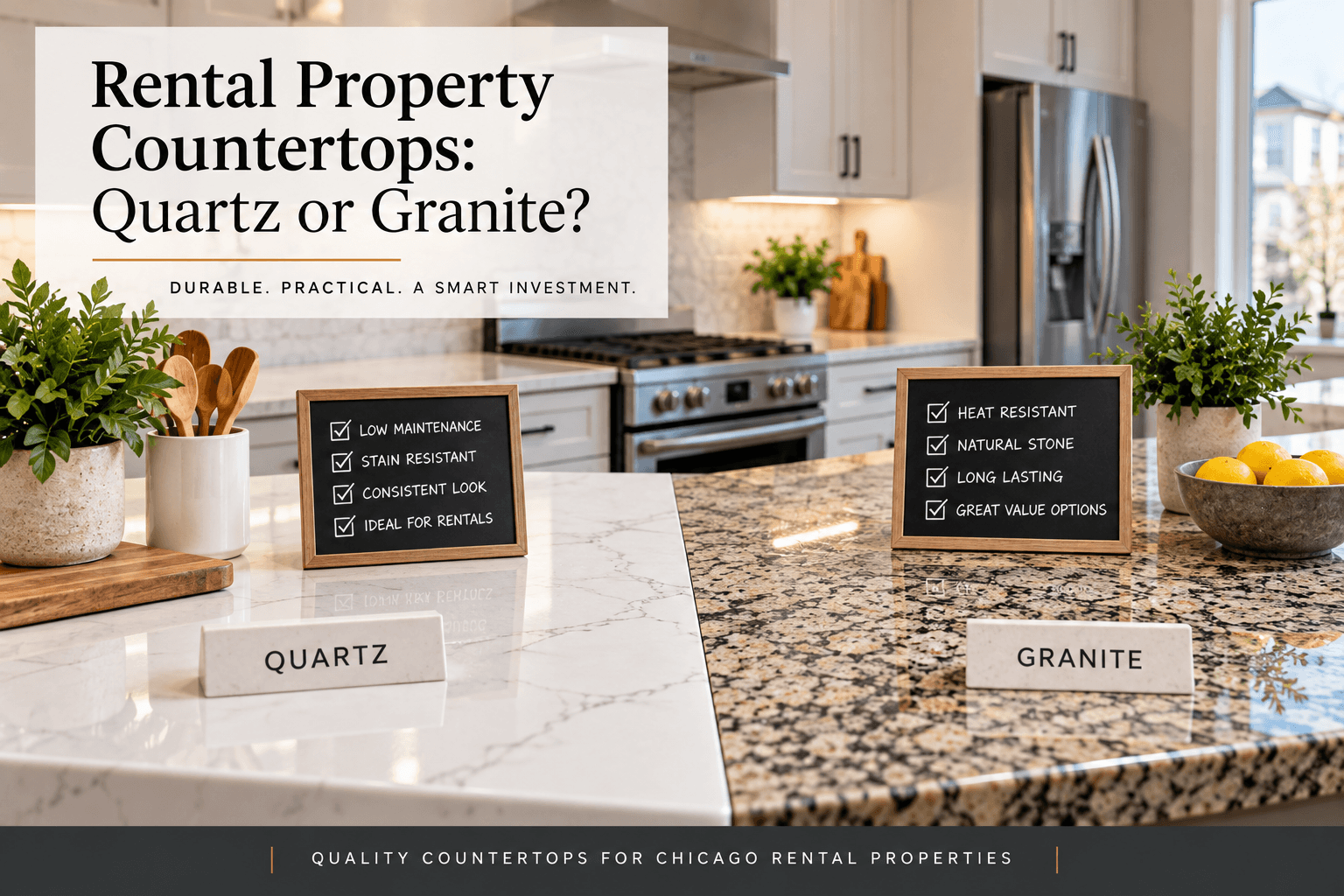
Rental property countertops have to satisfy a different standard than countertops chosen for an owner-occupied kitchen. A landlord may care about appearance, but the surface also needs to survive tenant turnover, cleaning crews, hot cookware, spills, move-outs, maintenance calls, and years of people using the kitchen without treating the countertop as carefully as the person who paid for it. Quartz and granite can both work extremely well in rentals, but they solve different ownership problems. Quartz reduces routine maintenance and makes repeat installations easier to match, while granite offers natural-stone durability, strong heat resistance, and the possibility of finding cost-effective slabs for individual units.
Quick answer: Quartz is usually the simpler choice for landlords who want low maintenance, consistent colors across several units, and no routine sealing. Granite can be an excellent choice when heat resistance, natural stone, long service life, or available slab value matters more. The right choice depends less on which material is “better” and more on how many units you own, how the property is managed, how often tenants change, and what type of maintenance you want to avoid.
If you are upgrading a rental in Chicagoland, the same fabrication standards used for Chicago kitchen countertops still matter: accurate measurements, durable edges, well-planned sink cutouts, sensible seams, and a material that fits the way the property will actually be used.
The Landlord Question Is Different From the Homeowner Question
A homeowner may select a countertop because they love one particular slab.
A landlord may need to ask:
Can I maintain this easily for the next ten years?
Will a new tenant damage it?
Can my cleaner use normal products on it?
What happens when somebody puts a hot pan on it?
Can I match it later if another unit needs countertops?
Will this still look presentable after several turnovers?
Those questions change the material decision.
Rental surfaces are part of an operating property.
They have to survive people with different habits.
One tenant may wipe every spill immediately.
Another may leave coffee on the counter overnight.
One may use trivets.
Another may place a hot pan wherever it fits.
You cannot design the property around the most careful tenant you hope to find.
You need to think about normal real-world use.
What Owners Are Actually Paying For
The initial countertop price matters.
But it is not the only cost.
A rental countertop may create expenses later through:
- maintenance;
- sealing;
- repairs;
- replacement;
- turnover delays;
- cleaning;
- matching problems;
- damage disputes.
That means the lowest installation price is not necessarily the lowest ownership cost.
Suppose one surface costs slightly less at installation but requires more attention from the owner or property manager between tenants.
Another may cost more initially but require almost no routine maintenance.
The right comparison is not:
Which slab is cheaper today?
It is:
What will this countertop ask from me over the time I own the property?
Al Jory’s countertop cost guide explains why material price alone does not determine the finished project total; fabrication, cutouts, edges, tear-out, delivery, and installation all affect the real number.
Why Quartz Works So Well in Rentals
Quartz solves one of the biggest landlord problems:
maintenance that depends on somebody remembering to do it.
Engineered quartz is nonporous.
It does not require routine sealing.
That removes one recurring maintenance question from the property.
For a homeowner, sealing natural stone may be easy to remember.
For someone managing:
- four condos;
- six rental homes;
- twelve apartments;
it becomes another maintenance item multiplied across every unit.
Quartz eliminates that particular task.
Homeowners and property owners comparing options can review Al Jory Marble’s quartz countertops for available colors, patterns, and fabrication details.
Quartz Is Easier to Standardize Across Multiple Units
This is an important advantage that does not get discussed enough.
Natural granite varies from slab to slab.
Quartz is manufactured.
That gives the owner more control when several kitchens are supposed to look similar.
Imagine renovating five units over three years.
With quartz, you may be able to stay within:
- the same collection;
- the same color family;
- the same general pattern.
That can help create a consistent property standard.
Granite is different.
Even slabs sold under the same stone name can vary naturally.
That is part of granite’s beauty.
But it can complicate exact matching if Unit 2 is renovated three years after Unit 1.
For a single rental house, that may not matter at all.
For a multi-unit owner trying to create a repeat finish package, it can matter considerably.
Standardization Makes Future Renovations Easier
Property owners often discover the value of standardization after the first few turnovers.
You already know:
cabinet finish
countertop
paint
flooring
hardware.
When another unit becomes vacant, you do not need to redesign the kitchen.
You repeat the package.
That can simplify:
- purchasing;
- estimating;
- decision-making;
- tenant marketing;
- project coordination.
The countertop becomes part of a repeatable renovation specification.
Quartz fits that model well because predictable appearance is one of its strengths.
The Biggest Quartz Weakness in a Rental: Heat
This is where landlords need realistic expectations.
Quartz contains resin binders.
High concentrated heat can damage the material.
That means tenants should use:
- trivets;
- hot pads;
under very hot cookware.
A careful homeowner will probably remember.
Will every tenant?
Maybe not.
That does not automatically disqualify quartz.
Thousands of busy kitchens use quartz successfully.
But if your rental has a tenant profile or layout where hot cookware is likely to land directly on the countertop repeatedly, heat tolerance deserves consideration.
Granite Has an Advantage Around Heat
Granite is natural stone and handles kitchen heat very well.
The Natural Stone Institute describes granite as a highly durable surface with strong resistance to normal kitchen heat, although even natural stone should not be subjected unnecessarily to severe localized thermal shock.
That makes granite appealing in rentals where you want fewer rules about how people interact with the countertop.
The owner still should not encourage anyone to place extremely hot cookware directly on the surface.
But granite provides more heat tolerance than resin-based engineered quartz.
You can explore Al Jory Marble’s granite countertops when comparing natural-stone options.
Granite Has a Different Maintenance Tradeoff
Granite is natural stone.
Depending on the actual granite, an impregnating sealer may be appropriate to improve stain resistance.
But this is where online advice becomes too generic.
You will often read:
“Granite must be sealed every year.”
That is not universally true.
The Natural Stone Institute notes that many granite countertops are already highly moisture resistant and that sealing can provide additional stain resistance where appropriate. Some granites may benefit from treatment more than others.
For property owners, the practical question is:
What does this actual granite need?
Not:
What does the internet say every granite needs?
If you choose granite for rentals, ask about the care requirements of the slab you are actually installing.
One Rental House and Twenty Apartments Are Different Decisions
This is where I would stop treating every landlord alike.
One single-family rental
You may want:
- natural stone;
- visual character;
- higher-end presentation.
Granite may make excellent sense.
A condo rented to long-term tenants
Quartz may reduce maintenance and keep the finish looking consistent.
A two-flat or three-flat
Either can work.
Material availability and the specific kitchens may matter more than standardization.
A larger multi-unit portfolio
Quartz becomes especially attractive because repeatability and low maintenance become more valuable as the number of kitchens increases.
The same countertop decision has a different operational impact at different portfolio sizes.
Tenant Turnover Changes What “Durable” Means
Durability is not only whether the slab breaks.
Turnover brings its own wear.
A kitchen may go through:
tenant moves out
→ cleaner comes in
→ maintenance inspection
→ repairs
→ painting
→ new tenant moves in.
Every cycle means more activity around the countertop.
People place:
- tools;
- boxes;
- cleaning supplies;
- paint equipment;
where they normally would not during everyday living.
A rental countertop should tolerate the reality of make-ready work.
That is one reason I would avoid overly delicate material selections in standard rentals.
Quartz Is Strong for Make-Ready Simplicity
Imagine a unit becomes vacant Friday.
The next tenant arrives Wednesday.
You have several days to:
- paint;
- clean;
- repair;
- inspect.
With quartz, there is no question about whether the stone needs resealing before the new lease.
Clean it.
Inspect it.
Address any actual damage.
Move on.
For landlords managing turnover personally, that simplicity has value.
Granite Can Be Excellent for Long-Term Ownership
Granite has another advantage:
it is a proven natural material that can remain useful far longer than many lower-cost countertop products.
That matters if you plan to hold the building for:
10 years
15 years
20 years.
A good granite installation may survive multiple cabinet paint colors, appliance replacements, and tenants.
The style may age.
The stone itself can keep going.
This is especially useful in properties where the owner wants to renovate once and avoid replacing the countertop every time the kitchen receives a cosmetic update.
What About Laminate?
Landlords often compare stone against laminate because the initial price can be lower.
Laminate can be appropriate in budget-sensitive rentals.
But the ownership question is different.
Damage near:
- sinks;
- seams;
- hot cookware;
- edges;
can sometimes mean replacing the entire counter.
Quartz and granite usually represent a larger initial investment, but they can also move the kitchen into a different durability and perceived-quality category.
This does not mean every Class C apartment needs premium stone.
It means owners should compare the cost of replacement frequency, not only the first invoice.
Rental Property Countertops Should Fit the Rent Level
This is one of the most important decisions.
Do not overbuild the property.
If the kitchen improvement will not support:
- rent;
- tenant quality;
- property positioning;
- longer useful life;
the most expensive stone in the yard probably does not make financial sense.
Likewise, do not underbuild a premium rental where the kitchen is expected to compete with newer properties.
Think about where the property sits in its market.
Entry-level rental
Prioritize:
- durability;
- clean appearance;
- manageable material cost.
Mid-market rental
Quartz and accessible granite often fit naturally.
Premium rental
The countertop may contribute meaningfully to:
- listing photos;
- perceived quality;
- leasing appeal.
You may have more room to choose a stronger pattern or upgraded material.
The material should support the property strategy.
The Best Rental Countertop Usually Is Not the Most Dramatic One
A huge dramatic vein may look incredible.
It may also be unnecessary.
Rental kitchens often benefit from surfaces that:
- photograph cleanly;
- hide normal wear;
- coordinate with several paint colors;
- remain visually neutral.
That does not mean boring.
It means adaptable.
The countertop may still be there after:
white cabinets become gray
or
gray cabinets become wood-tone.
A versatile surface gives the owner more flexibility later.
Mid-Tone Patterns Can Hide Everyday Use
Extremely solid dark countertops can show:
- dust;
- fingerprints;
- water marks.
Extremely bright uniform white may reveal certain stains or marks more obviously.
Moderate pattern and movement can help disguise normal daily use.
That could mean:
- soft gray veining;
- subtle speckle;
- mid-tone granite movement.
For a rental, visual forgiveness can be a feature.
The countertop should still look clean after cleaning, but it does not need to advertise every fingerprint between cleanings.
Think About Future Cabinet Colors
A landlord may repaint cabinets years before replacing the countertops.
That makes neutral stone particularly useful.
Good rental surfaces often coordinate with:
- white;
- gray;
- greige;
- wood tones;
- navy.
Our countertop colors guide explains how undertones in quartz and natural stone interact with different cabinet finishes.
For rental properties, I would put more weight on versatility than on chasing a very specific design trend.
Avoid Countertop Choices That Lock You Into One Kitchen
Imagine selecting stone containing:
- strong orange;
- unusual blue;
- heavy red movement.
That may work beautifully with the current cabinets.
But when you renovate again in eight years, your cabinet options become narrower.
That is not necessarily wrong.
A premium rental can have a distinctive design.
But for owners who value flexibility, neutral stone usually gives more freedom.
Sink Areas Cause More Rental Problems Than the Middle of the Counter
Most stone problems do not begin in the middle of an empty slab.
High-use zones deserve more attention.
Around the sink you may see:
- standing water;
- soap residue;
- mineral deposits;
- cleaning chemicals.
That means fabrication quality matters.
Pay attention to:
- sink cutout;
- faucet drilling;
- seam location;
- caulking;
- backsplash transition.
A lower-priced slab with excellent fabrication is often a better rental investment than an expensive slab with poor detailing.
Undermount or Drop-In Sink?
For many renovated rentals, undermount sinks create a cleaner, more updated appearance.
They also make it easy to wipe crumbs and water directly into the sink.
But the stone cutout becomes part of the finished surface and needs proper fabrication.
Drop-in sinks can still be appropriate, especially where:
- budget;
- existing cabinetry;
- replacement simplicity;
drive the project.
There is no rule that every rental needs an undermount sink.
Make the selection fit the level of the property.
Simple Edges Usually Make More Sense
A rental does not generally need an elaborate countertop edge.
A simple eased edge has several advantages:
- clean appearance;
- works with most kitchens;
- easy to reproduce;
- less stylistically specific.
Decorative profiles can make sense in luxury properties, but they rarely improve the everyday economics of a normal rental.
For investor kitchens, simplicity is often an advantage.
Outside Corners Deserve Attention
A countertop corner near a busy walkway can receive repeated contact from:
- bags;
- furniture;
- moving boxes;
- hips;
- appliances being moved.
This is particularly relevant during tenant turnover.
Layout and edge treatment should minimize unnecessarily vulnerable projections.
Stone is durable.
But no countertop benefits from being used as a moving-day bumper.
Seams Should Be Practical, Not Just Hidden
A rental owner may care less about having a completely invisible seam than a homeowner building a dream kitchen.
That does not mean seam planning should be careless.
A seam should still:
- be properly supported;
- avoid weak locations;
- make sense visually;
- allow safe fabrication and installation.
But forcing an oversized one-piece installation merely to eliminate a seam can add unnecessary risk and cost.
For rental work, good fabrication should win over bragging rights about having no seam.
One Unit at a Time vs. Renovating Several Units
This is where property owners can think differently.
If you have several identical or nearly identical kitchens, coordinate them as a group.
That can help establish:
- repeat measurements;
- common sink models;
- common edge profile;
- consistent countertop material;
- predictable fabrication.
You may still need individual field measurements because buildings are not perfectly identical.
But standardizing the specification can make the overall renovation program much easier to manage.
Use the Same Sink Across Multiple Units When Possible
This sounds like a plumbing decision.
It is also a countertop decision.
The sink determines the cutout.
If five units use five different sink models, you now have five fabrication variables.
Using one proven sink model across multiple units can simplify:
- replacement;
- fabrication;
- maintenance;
- future purchasing.
The same logic applies to faucets and certain appliances.
Standardization reduces surprises.
Keep Records After Installation
Property owners should record:
Material name
Quartz manufacturer/color or granite name
Sink model
Edge profile
Installation date
Photos of finished kitchen
For quartz, keeping the exact product information can make later matching easier.
For granite, photographs can help document the original natural variation even if an exact slab match is impossible years later.
Good property records save time.
What Happens if Part of the Countertop Gets Damaged?
This is one reason to think ahead.
With quartz, exact matching years later can depend on whether the product is still manufactured and whether color or pattern batches have changed.
With granite, exact matching can be difficult because natural slabs vary.
That means owners should not assume either material guarantees an invisible partial replacement.
If a project leaves a useful extra piece after fabrication, ask whether keeping it makes sense.
For very small future repairs or matching details, original material can be useful.
Can Granite Be Repaired?
Certain chips or localized damage may be repairable depending on:
- size;
- location;
- stone;
- color.
A repair does not necessarily mean the countertop must be replaced.
The same is true for some quartz damage.
The best solution depends on what actually happened.
Do not allow a maintenance worker to attack a chip with random glue before having the damage evaluated.
A poor repair can be harder to correct later.
The Cleaning Crew Needs the Right Instructions
This may be more important than the tenants.
Between renters, owners often bring in a cleaning service.
Cleaning crews work quickly.
They may arrive with:
- degreasers;
- disinfectants;
- abrasive products;
- acidic cleaners.
Make sure the products being used are appropriate for the countertop.
Our countertop care guide explains the differences between quartz and natural-stone maintenance.
For rental properties, a simple written cleaning note can prevent accidental surface damage during turnovers.
Granite Does Not Need a Complicated Maintenance Program
Natural stone sometimes gets presented as though owning it requires constant work.
It does not.
Granite maintenance is generally straightforward.
Clean normally with suitable products.
Address spills.
Determine whether the specific stone benefits from sealer.
The Natural Stone Institute notes that many granite countertops are already highly moisture resistant and that sealing, when appropriate, provides additional stain resistance rather than making the stone completely stain-proof.
For a rental owner, the important thing is knowing what the installed stone actually requires.
Quartz Does Not Mean Indestructible
Low maintenance is not the same thing as no rules.
Quartz still deserves reasonable care.
Tenants should avoid:
- extremely hot cookware directly on the surface;
- aggressive solvents;
- abrasive misuse.
Likewise, standing on a countertop or striking an exposed edge with a heavy object can damage almost any surface.
Landlords should not market quartz as impossible to harm.
It is simply easier to maintain in several important ways.
Put Basic Countertop Care in the Move-In Information
You do not need a legal document about the countertop.
A simple note can help.
For quartz:
- use a trivet for very hot cookware;
- clean with mild products;
- report damage.
For granite:
- clean with suitable stone-safe products;
- wipe spills;
- do not use harsh acid cleaners.
That may prevent damage caused purely by ignorance.
Most tenants are not trying to destroy the property.
They may simply not know what surface was installed.
Should a Rental Kitchen Have a Waterfall Island?
Usually, I would question whether the additional material and fabrication cost improves the rental enough to justify it.
In a premium downtown condo?
Possibly.
In a standard suburban rental?
Probably not where I would put the first dollar.
A waterfall requires additional slab material and fabrication.
For an investment property, I would usually put money first into:
- quality horizontal surfaces;
- good sink;
- durable cabinet hardware;
- functional lighting.
Luxury details should follow the positioning of the property.
What About Full-Height Stone Backsplashes?
The same logic applies.
A slab backsplash can be beautiful.
It can also increase:
- material requirement;
- fabrication;
- outlet cutouts;
- replacement complexity.
For a high-end rental, that visual impact may contribute meaningfully to the property.
For a normal long-term rental, tile may provide better flexibility.
The investment should match the tenant market.
Granite Can Be a Strong Value When the Right Slab Is Available
One reason not to rule out granite is material availability.
Granite exists across many price levels.
A durable, attractive slab that is available locally can sometimes create excellent value.
Do not compare:
premium granite
against
entry-level quartz
and conclude that the categories themselves have a fixed price relationship.
Compare the actual surfaces you are willing to install.
That is why written project estimates matter more than generic price charts.
Quartz Can Save Owner Attention
This is difficult to assign a dollar amount to.
But it is real.
Owners with busy portfolios value fewer maintenance decisions.
If quartz eliminates the need to think about:
- sealing;
- natural stone variation;
- stain absorption;
that operational simplicity has value.
For a landlord with one property who enjoys natural stone, that value may be small.
For a property manager responsible for dozens of kitchens, it may be much more meaningful.
When I Would Lean Toward Quartz
Quartz deserves a particularly close look when the property has:
- several rental units;
- frequent tenant turnover;
- third-party cleaning crews;
- standardized renovation packages;
- owners who want minimal countertop maintenance;
- light contemporary interiors;
- a need for more predictable color matching.
This is not because granite cannot work.
It is because quartz solves several management problems at once.
When Granite Makes More Sense
Granite becomes very attractive when:
- heat tolerance is a major concern;
- the owner wants natural stone;
- one individual kitchen is being renovated;
- a good-value slab is available;
- natural variation improves the property;
- the owner expects to hold the property long term.
Granite can also be particularly useful when the kitchen receives heavy cooking use.
It is a material people have used successfully in hard-working kitchens for decades.
What About a Vacation or Short-Term Rental?
That is an interesting middle ground.
Short-term rentals may experience:
- frequent turnovers;
- less tenant accountability;
- cleaning after every stay;
- lots of different users.
Quartz’s low maintenance can be attractive.
But granite’s heat tolerance can also be valuable when guests do not know the house rules.
Here I would consider:
- cleaner routine;
- property quality;
- design;
- expected abuse.
The answer may be different for a luxury short-term rental than for a basic unit.
What About a Rental Condo?
Quartz often makes a lot of sense in rental condos because:
- the kitchen may be compact;
- low maintenance matters;
- consistent contemporary appearance photographs well.
Al Jory’s existing Chicago condo guidance already notes that low-maintenance surfaces can be especially useful in rented or part-time units.
If the condo is positioned as a higher-end rental and the owner wants natural stone, granite is still completely viable.
The building type does not dictate the material.
The ownership strategy does.
Do Not Ignore Installation Access
Landlords sometimes focus so heavily on price that they overlook access.
A rental may be:
- third-floor walk-up;
- high-rise;
- narrow bungalow;
- garden unit.
Those conditions can affect:
- piece size;
- seam placement;
- delivery;
- installation labor.
A fabricator should know about access before the stone is cut.
This matters for quartz and granite equally.
A perfect slab that cannot reach the kitchen in one piece needs a different fabrication plan.
Get the Quote Based on the Real Rental Scope
Before comparing quartz and granite pricing, provide:
- approximate dimensions;
- kitchen photos;
- unit address;
- sink;
- cooktop if applicable;
- backsplash plan;
- existing countertop removal requirements;
- building access;
- number of units.
Al Jory Marble’s countertop quote guide explains why these details produce a far more useful estimate than asking only for a square-foot price.
For multi-unit work, also identify whether the layouts repeat.
That may influence how the project can be planned.
Do Not Compare Only the Material Price
A landlord should compare the installed project.
Ask whether the estimate includes:
- material;
- templating;
- fabrication;
- sink cutout;
- edge;
- seams;
- delivery;
- installation;
- tear-out;
- disposal.
An inexpensive material quote can become much less attractive once missing work is added.
The property owner needs the number that gets the unit from old countertop to finished countertop.
Make-Ready Time Matters
Suppose Unit A can be completed on schedule and leased three days earlier because selections were finalized and fabrication was coordinated properly.
That may matter more financially than saving a small amount on material.
Vacancy has a cost.
This is why rental-property renovations should focus on:
- predictable scope;
- decisions made early;
- materials that are actually available;
- accurate measurements.
Do not design the kitchen around a slab that cannot arrive for six weeks when the lease needs to start next month.
Availability is part of the buying decision.
A Rental Countertop Should Still Look Good
Practical does not mean ugly.
The kitchen affects:
- listing photos;
- showings;
- tenant perception;
- the overall feel of the unit.
A countertop often occupies a large visual area.
Replacing dated laminate or heavily damaged surfaces with quartz or granite can make the entire kitchen feel more finished even if the cabinets remain.
A sensible investment material can still look excellent.
FAQs About Rental Property Countertops
Are quartz or granite countertops better for rental properties?
Both can work. Quartz generally requires less routine maintenance and provides more consistent appearance across multiple units. Granite provides natural variation, strong durability, and excellent heat resistance. The right choice depends on the property and management strategy.
Does quartz need sealing in a rental property?
No. Engineered quartz is nonporous and does not require sealing, which can make it attractive for landlords who want fewer recurring maintenance tasks.
Does granite need to be sealed between every tenant?
Not automatically. Sealing needs depend on the specific granite, existing treatment, and absorption characteristics. Some granite benefits from an impregnating sealer, while other dense stones may require less frequent treatment.
Which countertop is easier to match across several apartments?
Quartz generally offers greater pattern and color consistency because it is manufactured. Natural granite varies from slab to slab, even within the same named material.
Which countertop handles heat better?
Granite generally offers greater resistance to concentrated kitchen heat. Quartz contains resin binders, so trivets or hot pads should be used beneath very hot cookware.
Is granite too much maintenance for a rental?
Not necessarily. Granite can be easy to maintain when the owner understands the particular stone and uses appropriate cleaning products. The tradeoff is that some natural granite may need sealing, while quartz does not.
Should rental countertops be neutral?
Neutral materials often give landlords greater flexibility with future cabinet, flooring, and paint updates. However, a higher-end rental can justify a stronger design if it supports the property’s market position.
Can landlords use the same countertop specification across multiple units?
Yes. Standardizing the material, sink, edge, and general fabrication specification can simplify future renovations. Final field measurements should still reflect each actual kitchen.
Should I choose the cheapest quartz or granite for a rental?
Not automatically. Compare the full installed project, material availability, expected maintenance, fabrication quality, and long-term durability rather than choosing solely from the lowest square-foot price.
Choose for the Owner You Want to Be
There is no universal winner between quartz and granite for rental property countertops.
The decision becomes easier once you decide what you want from the property.
If you want:
low maintenance,
predictable appearance,
repeatability across units,
and fewer recurring stone-care decisions,
quartz is difficult to ignore.
If you want:
natural stone,
strong heat resistance,
long service life,
and a surface with unique character,
granite remains an excellent rental material.
The important part is choosing intentionally.
Do not install quartz simply because someone said all rentals should have quartz.
Do not install granite simply because granite sounds more premium.
Look at:
the tenant,
the rent level,
the kitchen,
the number of units,
your maintenance system,
and how long you expect to own the property.
Then choose the surface that creates the fewest problems while still making the kitchen worth showing.
Al Jory Marble fabricates and installs quartz and granite surfaces from its Crestwood shop for kitchens, rental properties, multi-unit projects, and residential renovations throughout Chicago and the surrounding suburbs. Property owners can request a free countertop estimate for one unit or provide details on several kitchens that are being upgraded together.
Al Jory Marble
Phone: (708) 362-7674
Address: 4711 135th St, Crestwood, IL 60418
Email: aljorymarble9446@gmail.com
Hours: Mon – Sat: 9:00 am – 6:00 pm

Serving Chicago & Surrounding Areas
Get Your Free Kitchen Countertop Estimate
Fill out the form and our team will get back to you in next 24 hours.