Written by Al Jory Marble Team
Published: September 16, 2026
Read Time: 17 minutes
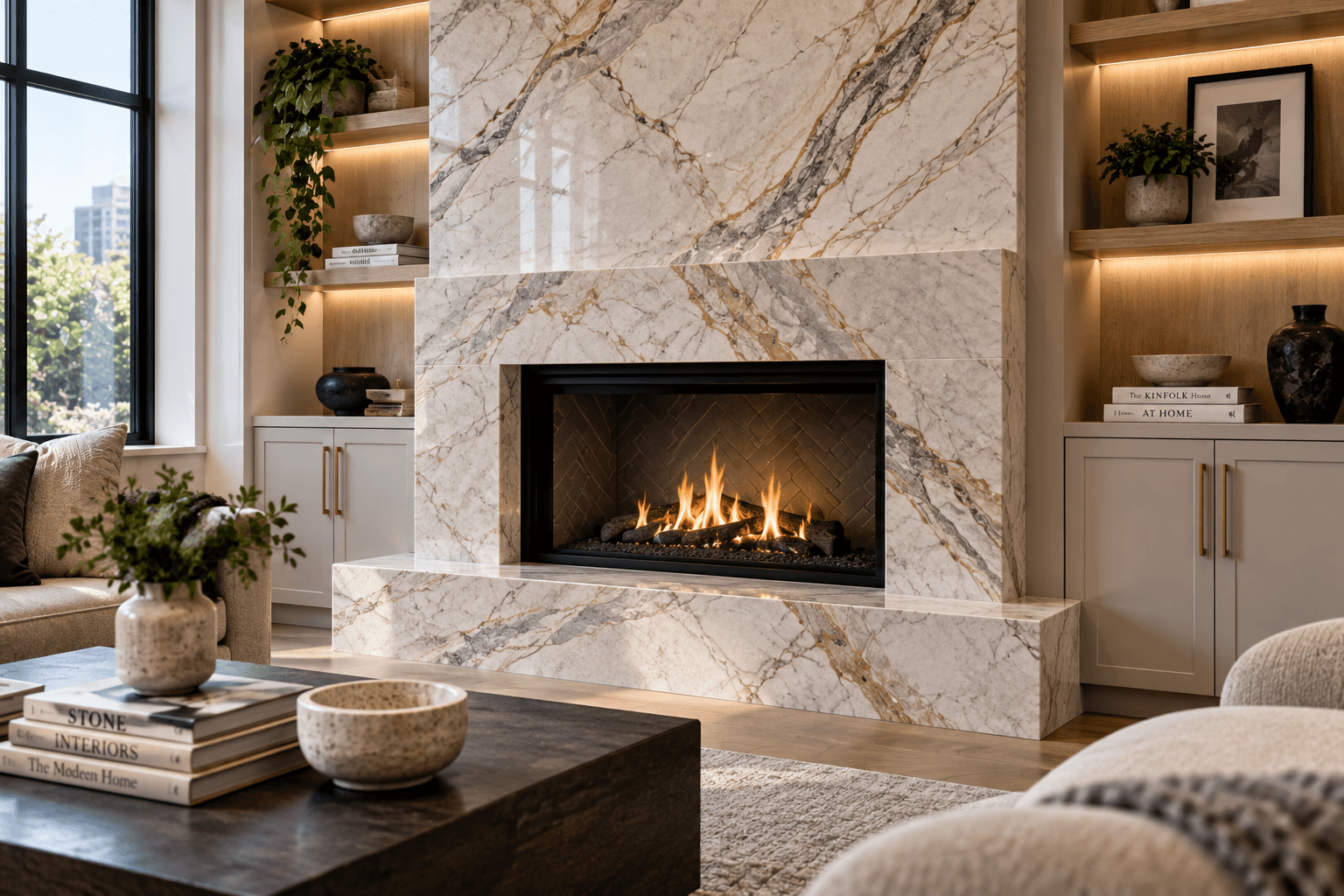
Stone fireplace surround projects give homeowners a chance to use natural material very differently from a kitchen countertop. Instead of creating a horizontal work surface, the stone becomes part of the architecture of the room. Marble can frame a traditional fireplace with soft movement, dark granite can create a modern focal point, and dramatic quartzite can turn an entire fireplace wall into a natural-stone feature. The right choice depends on the fireplace system, the amount of stone being used, the desired finish, slab movement, the hearth design, and how the pieces will actually be fabricated and installed.
Quick answer: Marble, granite and quartzite can all work beautifully around fireplaces when the stone and installation are appropriate for the specific fireplace system. Decide whether you want a traditional surround, a hearth, or a full-height feature wall first. Then choose the slab, finish, vein layout and fabrication details around those dimensions. Fireplace manufacturer requirements and applicable clearances should be confirmed before the stone is cut.
Homeowners already choosing Chicago kitchen countertops can also ask whether material from the same project—or a compatible remnant—could be used to connect the kitchen and living areas visually.
First Decide What the Fireplace Should Become
Do not start by asking:
Which marble should I buy?
Start by deciding what part of the fireplace will actually be stone.
There is a major difference between updating three small surround pieces and covering an entire wall.
A fireplace project may include only:
- two vertical side pieces;
- one header above the opening;
- a hearth.
Or it may include:
- floor-to-ceiling stone;
- a wide feature wall;
- stone around a television;
- floating mantel;
- stone returns around the sides.
Those are completely different fabrication projects.
The size of the stone pieces, slab quantity, seam plan, access and cost all depend on the architecture first.
Four Very Different Ways to Use Stone Around a Fireplace
Rather than treating every fireplace project alike, it helps to think in terms of the visual result you want.
The Traditional Surround
This is the classic approach.
Stone frames the firebox with:
left leg
right leg
top header.
A hearth may sit below.
This design works particularly well in:
- Chicago bungalows;
- traditional living rooms;
- historic homes;
- transitional interiors.
Because the pieces are comparatively small, a traditional surround can also be an excellent use for a remnant.
The Clean Contemporary Frame
A modern fireplace may use wide rectangular slabs with minimal decorative detail.
The emphasis is on:
- clean edges;
- proportion;
- stone color;
- texture.
Dark granite and honed natural stone can work especially well here.
Instead of decorative trim, the material itself creates the character.
The Floor-to-Ceiling Feature Wall
This is where slab selection becomes much more important.
The stone may extend from the hearth all the way to the ceiling.
A dramatic natural slab can become the primary artwork in the room.
With a large installation, you need to think about:
- panel size;
- seams;
- vein flow;
- television placement;
- mantel;
- wall outlets;
- installation access.
This is no longer simply a fireplace trim project.
It is a stone wall.
The Hearth-Led Fireplace
Sometimes the hearth is the strongest element.
A thick or wide stone hearth may:
- project into the room;
- create a bench-like appearance;
- visually anchor the fireplace.
In that type of design, the hearth material and thickness deserve as much attention as the surround.
Marble Creates a Completely Different Fireplace Than Granite
Material names are not interchangeable stylistically.
Each creates a different feeling in the room.
Marble for a Softer, More Architectural Look
Marble works especially well around fireplaces because the application lets homeowners enjoy natural veining without many of the everyday concerns associated with a heavily used kitchen surface.
A fireplace surround is not normally exposed to:
- lemon juice;
- tomato;
- vinegar;
- constant food preparation.
That makes marble particularly attractive here.
Depending on the slab, marble can feel:
- classic;
- European;
- historic;
- contemporary;
- sculptural.
Carrara may create a quieter appearance.
Calacatta can produce stronger veining and contrast.
Darker marbles can make the fireplace feel much more dramatic.
Homeowners considering natural marble can review Al Jory Marble’s marble countertops and slabs to see how different marble families vary in movement and appearance.
Granite for a Stronger, More Grounded Fireplace
Granite creates a different personality.
It can feel heavier, darker and more architectural.
That can work especially well in:
- contemporary living rooms;
- basements;
- modern family rooms;
- fireplaces paired with wood cabinetry;
- darker interiors.
Granite also gives homeowners a very wide range of visual options.
Some slabs are nearly uniform.
Others contain:
- crystals;
- movement;
- veining;
- metallic mineral detail.
Dark granite with a honed or leathered finish can be especially effective when the goal is a fireplace that feels understated rather than glossy.
Al Jory Marble’s granite countertops and slabs page shows how much natural variation exists within the material category.
Quartzite When the Slab Should Be the Main Feature
Quartzite can produce some of the most dramatic fireplace walls.
Large natural movement becomes especially powerful when viewed vertically.
Instead of seeing only a narrow countertop strip, you see several feet of continuous stone.
That is where quartzite can become almost artwork.
It can work particularly well for:
- floor-to-ceiling fireplaces;
- wide contemporary feature walls;
- bookmatched installations;
- fireplaces visible from an open kitchen.
Homeowners comparing dramatic natural stone can review quartzite countertops and slabs separately without turning this article into another general quartzite guide.
Engineered Quartz Needs a Different Conversation
Engineered quartz is not the same thing as natural granite, marble or quartzite.
It contains manufactured components and resin binders.
That means its suitability close to a fireplace depends on:
- the specific quartz product;
- fireplace type;
- heat exposure;
- manufacturer’s installation requirements.
Do not assume that because a quartz surface works well in a kitchen, every quartz slab is automatically suitable directly beside a fireplace opening.
Check the requirements for the actual product before fabrication.
When heat exposure is an important part of the design, natural-stone selection should be evaluated carefully.
The Natural Stone Institute specifically notes that thermal conductivity can matter when natural stone is used as a fireplace surround between a heat source and surrounding materials.
A Fireplace Is One of the Best Places to Shop Remnants
This is where fireplace projects become interesting from a material standpoint.
A traditional surround may require relatively little stone.
That means a homeowner may be able to use a piece that would never be large enough for a kitchen.
A remnant could provide material for:
- side legs;
- header;
- hearth;
- mantel shelf.
And the material itself is not lower quality because it is a remnant.
It is simply smaller.
Al Jory Marble’s countertop remnants guide specifically identifies fireplace surrounds and hearths as good remnant applications.
Why that matters
Imagine finding a dramatic piece of marble or quartzite that would be expensive to use across an entire kitchen.
The fireplace might require only a fraction of that material.
That lets the homeowner use something much more distinctive without buying enough stone for an entire countertop project.
Measure Before Falling in Love With a Remnant
A remnant still needs to fit.
Before choosing one, determine approximately:
- firebox width;
- firebox height;
- width of each surround leg;
- header height;
- hearth dimensions;
- overall wall dimensions.
If the design includes a full-height wall, a remnant may no longer make sense.
A piece can also have:
- existing cuts;
- irregular edges;
- unusable portions.
What matters is the amount of usable stone.
Not simply the outside dimensions of the leftover piece.
The Hearth Deserves Its Own Design Decision
The hearth can dramatically change how the fireplace feels.
A thin flush hearth creates one appearance.
A deep raised hearth creates another.
A broad stone hearth may even function visually like a bench.
Consider:
- width;
- projection;
- height;
- material;
- edge treatment.
The hearth may match the surround exactly.
Or it may contrast.
For example:
white marble surround
- dark granite hearth.
That can work very well when the contrast is intentional.
What generally works less successfully is using two materials that are almost—but not quite—the same.
A Stone Fireplace Surround Depends Heavily on Slab Layout
This is where fabrication expertise becomes especially visible.
Fireplaces naturally have a centerline.
That means people notice balance.
Imagine one side of the fireplace containing heavy dramatic veining while the opposite side is almost completely blank.
Natural stone does not need to be perfectly symmetrical.
But the pieces should feel related.
Before cutting, consider how the slab will be divided among:
- left side;
- right side;
- header;
- hearth.
A thoughtful layout can make even a relatively small remnant look exceptional.
Bookmatching Can Turn the Fireplace Into Artwork
Bookmatching uses adjoining stone faces to create a mirrored pattern.
With the right marble or quartzite, this can create an almost symmetrical natural image around the fireplace.
It works especially well on:
- large feature walls;
- fireplaces without many interruptions;
- strongly veined stone.
But bookmatching requires the right slabs.
Not every natural stone is available in a sequence that supports it.
And not every pattern looks better mirrored.
This should be explored when selecting the slabs rather than requested after fabrication has already started.
Sometimes Continuity Is Better Than Symmetry
A different approach is to let veins flow naturally across the fireplace.
For example:
one long vein begins on the lower left
→ crosses the center
→ continues upward toward the right.
That can feel more natural than perfect mirroring.
The correct layout depends on what the slab is doing.
There is no universal formula.
That is precisely why full slab viewing matters.
A two-inch sample cannot tell you how a nine-foot vein will interact with a fireplace wall.
Finish Can Change the Fireplace More Than the Stone Name
The exact same slab can feel very different depending on its surface finish.
Polished
A polished finish increases reflection and visual contrast.
It can make:
- veining sharper;
- dark stone richer;
- marble brighter.
Honed
A honed surface reduces reflection.
This often makes natural stone feel:
- softer;
- quieter;
- more architectural.
Honed marble can work particularly well in older Chicago homes where high-gloss material might feel out of place beside original woodwork.
Leathered
Leathering adds tactile texture.
It is especially effective with certain granites.
Dark leathered granite beside warm wood can create a fireplace that feels rich without looking highly polished.
Our countertop finishes guide explains how polished, honed and leathered stone change reflection, texture and perceived color.
The Mantel Changes the Whole Composition
A mantel is not simply an accessory.
It divides the wall visually.
Common approaches include:
- traditional wood mantel;
- thick floating wood shelf;
- stone mantel;
- metal shelf;
- no mantel.
If the stone runs to the ceiling, removing the mantel may allow the full slab movement to remain visible.
In a traditional room, wood may provide needed warmth.
The mantel should be decided before the stone panels are laid out because it may influence where pieces stop and where seams make sense.
Combustible mantel materials also need to follow the requirements of the actual fireplace system.
A Television Above the Fireplace Needs to Be Planned Before Stone
This is one of the easiest ways to create unnecessary drilling later.
If the wall will contain a television, determine early:
- mounting height;
- outlet location;
- cable location;
- bracket position.
The wall structure behind the stone should provide the required support.
Stone should not be treated as though it alone is holding the television.
Planning this before installation avoids turning a finished stone wall into an electrical and mounting puzzle.
The Same Rule Applies to Sconces and Shelves
If the fireplace wall will include:
- sconces;
- shelves;
- controls;
- outlets;
their locations should be established first.
Every opening interrupts the stone.
On a quiet slab, that may matter very little.
On dramatic quartzite or marble, it can matter a lot.
If an outlet lands directly in the most beautiful part of a vein, the visual effect changes.
Electrical requirements should always come first, but the stone layout can then be planned intelligently around the approved locations.
Heat and Clearances Need to Be Resolved Before Fabrication
This is not a place to guess.
Different fireplace systems have different requirements.
The stone fabricator can fabricate the surround to approved dimensions.
But the approved dimensions need to come from:
- fireplace manufacturer instructions;
- project drawings;
- appropriate contractor;
- applicable building requirements.
The Natural Stone Institute notes that the thermal behavior of natural stone matters in fireplace applications because heat transfer through the stone can affect surrounding materials.
That is why material selection and fireplace construction should be coordinated rather than treating the stone as purely decorative.
Existing Fireplaces Often Hide Uneven Conditions
Replacing an old fireplace surround may reveal:
- brick;
- mortar;
- plaster;
- drywall;
- old adhesive;
- previous repairs.
The visible fireplace may look square while the wall beneath it is not.
Stone does not adjust itself around major irregularities.
The substrate may need preparation before installation.
Final measurements should therefore reflect the wall condition the stone will actually be installed against.
Do Not Template Too Early
Imagine measuring the fireplace before old tile is removed.
Then demolition reveals:
- another layer of tile;
- damaged substrate;
- uneven masonry.
The final dimensions may change.
Whenever possible, fabrication measurements should be taken after the relevant construction conditions have been established.
That reduces the risk of:
- gaps;
- pieces that are too large;
- incorrect corner dimensions.
Large Panels Introduce an Access Problem
A beautiful slab wall on paper may not be installable as one giant piece.
The panel has to travel through:
- exterior door;
- hallway;
- stairwell;
- elevator;
- living room opening.
Large natural-stone panels are rigid and heavy.
If the fireplace is on an upper floor or inside an older Chicago home, access may influence the seam plan.
A seam is often preferable to attempting to maneuver a panel that cannot safely reach the room.
Seams Should Follow the Architecture When Possible
A large installation may need seams because of:
- slab dimensions;
- access;
- panel size;
- stone limitations.
The question is not always how to eliminate every seam.
It is where to put them.
A seam may disappear more naturally:
- near a mantel line;
- along an architectural break;
- where the stone movement supports it.
A good seam plan respects both fabrication and appearance.
Mitered Corners Can Give Stone More Visual Weight
Some fireplaces project from the wall or include side returns.
A mitered joint can allow the stone pattern to wrap around the corner while creating the appearance of thicker material.
This can be especially attractive on:
- modern fireplaces;
- thick hearths;
- projecting feature walls.
Mitering requires more fabrication and more attention to the slab pattern.
It should be part of the design from the beginning.
Should the Fireplace Match the Kitchen?
It can.
But it does not need to.
If the fireplace and kitchen are visible within the same open floor plan, there are two strong approaches.
Repeat the Kitchen Stone
Using material from the same slab can subtly connect the spaces.
This can work especially well if enough stone remains from the kitchen project.
Choose a Coordinating Contrast
The fireplace can become the darker or more dramatic element.
For example:
light kitchen quartzite
- dark granite fireplace.
Or:
quiet kitchen quartz
- expressive natural-marble fireplace.
The spaces feel connected without looking copied.
Ask About the Fireplace Before the Kitchen Slab Is Cut
If you are already completing another stone project, this is an important question.
There may be enough material remaining from:
- kitchen;
- island;
- vanity;
to fabricate the fireplace.
But the fabricator needs to know early.
Once the slab has been divided for another project, the remaining pieces may no longer contain the dimensions needed for the fireplace.
Whole-project planning can make much better use of stone.
Fireplace Stone Does Not Need a Kitchen Countertop Edge
A fireplace surround is architecture.
It does not need to automatically inherit whatever edge profile is used in the kitchen.
The exposed edges may be:
- polished;
- eased;
- mitered;
- concealed by adjacent materials.
The correct detail depends on how the stone meets:
- wall;
- floor;
- hearth;
- mantel.
This is one of the reasons fireplace fabrication should be treated as its own project.
What Changes the Price?
A small fireplace surround and a full-height feature wall should not be compared by square footage alone.
Finished cost can change because of:
- marble, granite or quartzite selection;
- remnant versus full slab;
- hearth;
- number of panels;
- bookmatching;
- seams;
- mitered corners;
- cutouts;
- finish;
- installation access.
A three-piece remnant surround may be relatively straightforward.
A bookmatched quartzite wall that reaches the ceiling is a very different fabrication job.
The estimate should reflect the actual design.
What the Fabricator Needs Before Cutting Begins
The project is ready for fabrication when the important variables are no longer placeholders.
That generally means confirming:
- fireplace opening dimensions;
- approved clearances;
- hearth dimensions;
- mantel design;
- final wall condition;
- material;
- finish;
- vein orientation;
- television or electrical openings;
- expected panel divisions.
Al Jory Marble’s custom countertop fabrication services include in-house cutting and finishing from the Crestwood shop, allowing the stone layout and fabricated pieces to be based on the actual project dimensions.
A Few Fireplace Combinations That Work for Different Reasons
Classic Chicago Bungalow
Carrara or another softer marble.
Honed finish.
Traditional wood mantel.
Simple hearth.
The stone feels compatible with older architecture rather than trying to make the entire room ultra-modern.
Contemporary Family Room
Dark granite.
Leathered finish.
Minimal mantel or no mantel.
Warm wood nearby.
The texture becomes more important than shine.
Open Luxury Kitchen and Living Room
Quartzite fireplace wall.
Kitchen uses a related warm natural stone.
The materials coordinate across the room without being identical.
Small Traditional Fireplace Update
Premium marble remnant.
Three-piece surround.
Matching hearth.
This can create major visual impact without requiring enough material for a full slab wall.
The best design depends on the house.
Not on whichever fireplace image happens to be trending.
FAQs About Stone Fireplace Surrounds
What is the best natural stone for a fireplace surround?
Marble, granite and quartzite can all work well. Marble provides classic veining, granite offers darker and highly durable options, while quartzite can create dramatic natural movement. Suitability should also be evaluated against the requirements of the actual fireplace system.
Can marble be used around a fireplace?
Yes. Marble is commonly used for fireplace surrounds and is particularly attractive because the application avoids many of the food-acid concerns homeowners have with marble kitchen countertops.
Can I use a remnant for a fireplace?
Yes. Traditional surrounds and hearths can be excellent remnant projects because they often require significantly less material than kitchens or large countertop installations.
Can stone run from the fireplace to the ceiling?
Yes, when the wall, fireplace system and project design support it. Large floor-to-ceiling installations usually require more detailed slab layout, seam planning and installation access.
Does a fireplace surround need seams?
Not always. Smaller surrounds often consist of several purpose-cut pieces, while larger slab walls may require seams because of slab size or access limitations.
Should the hearth use the same stone as the surround?
It can. Matching creates a continuous appearance, while using a clearly contrasting stone can make the hearth more visually distinct.
Can a stone fireplace match the kitchen?
Yes. Material from the same slab can create continuity in an open floor plan. A coordinating but different stone can also work when the undertones and overall architecture relate.
Is quartz safe around a fireplace?
Engineered quartz should only be used when the specific manufacturer approves the intended fireplace application and heat conditions. Natural and engineered materials should not be treated as interchangeable around heat.
Let the Slab Determine the Final Composition
A successful stone fireplace surround is not simply a stone color wrapped around a firebox.
The best installations take advantage of what the material already contains.
A vein can become the center of the wall.
A dark granite can become the quiet backdrop.
A remnant can become the most distinctive part of the room.
A honed finish can make a traditional fireplace feel more architectural.
That is why the process should move from:
fireplace dimensions
→ architecture
→ slab
→ layout
→ fabrication.
Not the other way around.
Al Jory Marble fabricates marble, granite, quartzite and other stone surfaces from its Crestwood shop for residential projects throughout Chicago and the surrounding suburbs. Homeowners planning a fireplace, hearth or another custom stone project can request a free estimate after the basic dimensions and design direction are established.
Al Jory Marble
Phone: (708) 362-7674
Address: 4711 135th St, Crestwood, IL 60418
Email: aljorymarble9446@gmail.com
Hours: Mon – Sat: 9:00 am – 6:00 pm


Serving Chicago & Surrounding Areas
Get Your Free Kitchen Countertop Estimate
Fill out the form and our team will get back to you in next 24 hours.