You finish cooking, take a pan off the stove and set it on the countertop.
Is that safe?
It depends on the countertop.
Quartz, granite, quartzite and marble may all look like hard stone surfaces, but they do not react to heat in exactly the same way.
The most important difference is this:
Quartz contains resin binders, while granite, quartzite and marble are natural stone.
That means quartz can be damaged by concentrated heat more easily than natural stone.
Granite and quartzite generally tolerate heat better, while marble can also handle heat but may still experience surface damage, discoloration or thermal stress depending on the situation.
The safest habit with any countertop is simple:
Use a trivet or heat pad under hot cookware.
That small step can prevent a problem that may be difficult or expensive to repair later.
At Al Jory Marble, we fabricate and install kitchen countertops in quartz, granite, quartzite and marble throughout Chicagoland.
Here is how each material handles heat and what homeowners should know before putting a hot pan directly on the surface.
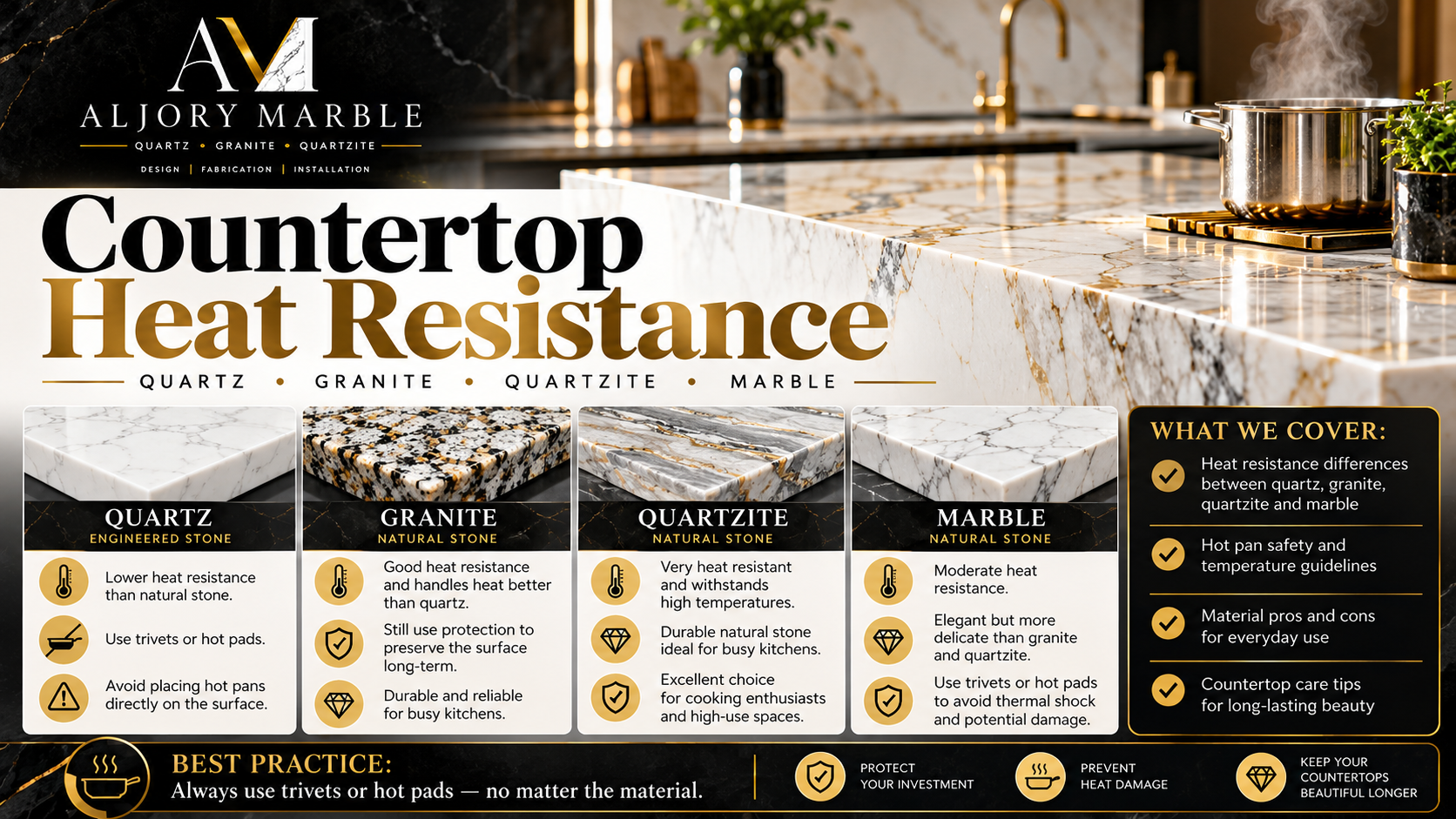
Quick Answer: Which Countertop Handles Heat Best?
| Countertop Material | Heat Resistance | Hot Pan Directly on Surface? | Best Practice |
|---|---|---|---|
| Quartz | Moderate | Not recommended | Always use a trivet |
| Granite | High | Can tolerate heat better, but still use a trivet | Use protection for very hot cookware |
| Quartzite | High | Generally handles heat very well | Use a trivet to reduce thermal shock risk |
| Marble | High but more sensitive overall | Can tolerate heat, but direct heat is still not ideal | Use a trivet |
If heat resistance is one of your biggest concerns, natural stone generally performs better than engineered quartz.
But heat resistance is only one factor.
You should also consider:
- Stain resistance
- Maintenance
- Sealing
- Scratching
- Etching
- Appearance
- Slab variation
- Budget
Why Quartz Reacts Differently to Heat
Quartz countertops are engineered surfaces.
They are made using natural quartz particles combined with resin and pigments.
The stone portion is very heat resistant.
The resin is the more vulnerable part.
When concentrated heat is applied to quartz, the resin can be affected.
Possible damage can include:
- Discoloration
- Yellowing
- Dark marks
- Scorching
- Surface dulling
- Cracking from thermal shock
That is why Jory’s current quartz-care guidance specifically recommends using a trivet beneath hot cookware.
Can You Put a Hot Pan Directly on Quartz?
You should not.
Even if the countertop seems fine after doing it once, repeated exposure can increase the chance of damage.
A pan coming directly from:
- Gas burner
- Electric burner
- Induction cooktop
- Oven
- Broiler
can be much hotter than the surface is designed to handle safely.
The safest rule is:
Do not put very hot cookware directly on quartz.
Use:
- Trivet
- Silicone mat
- Heat pad
- Wooden board designed for hot cookware
What Happens If You Put a Hot Pan on Quartz?
Several things are possible.
Nothing obvious happens
This is why some homeowners assume the practice is safe.
One hot pan may not immediately create visible damage.
That does not mean repeated exposure is harmless.
The surface becomes discolored
Heat can affect the resin and pigments.
A light quartz surface may develop a yellow or brown mark.
The finish changes
A section may look duller or slightly different from the surrounding countertop.
Thermal shock causes cracking
A sudden temperature difference can create stress.
This risk increases when very hot cookware is placed onto a much cooler surface.
Can Heat Damage to Quartz Be Repaired?
Sometimes minor surface problems can be improved.
But heat damage is different from a simple stain.
A stain sits on or enters the surface.
Heat damage may actually change the resin itself.
That can make permanent discoloration difficult to reverse.
If a quartz surface is severely scorched or cracked, replacement of the damaged section may sometimes be more practical than repair.
That is why prevention matters so much.
How Hot Is Too Hot for Quartz?
There is no single safe temperature that applies to every quartz brand.
Quartz manufacturers have different formulations and warranty requirements.
Instead of trying to calculate whether your pan is under some specific temperature limit, use a simpler rule:
If cookware just came from a burner or oven, use a trivet.
That removes the guesswork.
Can You Put a Crockpot on Quartz?
Usually yes, but it is still smart to use a heat-safe mat underneath.
Slow cookers do not typically create the same concentrated heat as a pan straight from a burner.
However, some appliances can warm the countertop significantly over many hours.
This includes:
- Slow cookers
- Air fryers
- Electric griddles
- Toaster ovens
- Pressure cookers
- Hot plates
A small protective mat is an easy precaution.
Can You Put an Air Fryer on Quartz?
Yes, but watch the exhaust.
Many air fryers release very hot air from the rear or bottom.
That heat can affect:
- Countertop
- Backsplash
- Wall surface
- Nearby cabinetry
Leave enough clearance around the appliance and follow the manufacturer’s placement instructions.
A heat-resistant mat beneath the unit can add protection.
Can You Put a Toaster Oven on Quartz?
Yes, but again, heat buildup matters.
A toaster oven can become very hot during use.
Keep it:
- Properly ventilated
- Away from backsplash surfaces when required
- On a suitable protective mat if recommended
The appliance manufacturer’s clearance instructions should always be followed.
Is Granite Heat Resistant?
Yes.
Granite is natural stone formed under intense geological conditions.
It handles heat much better than engineered quartz.
That makes granite countertops a good option for homeowners who cook frequently and want stronger heat resistance.
However, “heat resistant” does not mean “heatproof.”
There is still no real benefit to placing extremely hot cookware directly onto granite when a trivet takes two seconds to use.
Can You Put a Hot Pan Directly on Granite?
Granite can generally tolerate a hot pan better than quartz.
But we still recommend a trivet.
Why?
Because the stone itself is only part of the countertop system.
There may also be:
- Sealer
- Resin-filled natural pits
- Epoxy at seams
- Surface treatments
Very concentrated heat can affect those components.
A trivet protects both the stone and the materials used around it.
Can Granite Crack From Heat?
It is possible, especially with rapid temperature changes.
This is called thermal shock.
Imagine placing extremely hot cookware onto a cold countertop near an open winter window.
The part under the pan expands quickly while the surrounding stone stays cool.
That sudden difference can create stress.
Granite is very strong, but avoiding extreme thermal changes is still wise.
Does Granite Sealer Burn?
A penetrating stone sealer is different from the granite itself.
Very high heat can potentially affect certain sealers or surface treatments.
That does not mean granite becomes unsafe around normal cooking.
It simply means direct extreme heat is unnecessary.
Use a trivet and avoid the issue.
Is Quartzite Heat Resistant?
Yes.
Genuine quartzite is one of the better natural countertop materials for heat resistance.
Jory’s current quartzite guide specifically notes that quartzite handles hot cookware better than quartz.
That makes quartzite countertops attractive to homeowners who want:
- Natural veining
- Strong durability
- Better heat resistance
- A marble-like appearance
Can You Put Hot Pans on Quartzite?
Quartzite handles heat very well.
However, we still recommend using a trivet.
That protects against:
- Thermal shock
- Sealer damage
- Residue transfer from cookware
- Unnecessary surface stress
A trivet is inexpensive compared with repairing or replacing a slab.
Is Quartzite More Heat Resistant Than Quartz?
Generally, yes.
That distinction is important because the names sound similar.
Quartzite is natural stone.
Quartz is engineered with resin.
The resin in quartz is the main reason direct hot cookware is discouraged.
Genuine quartzite does not contain the same engineered resin matrix.
Quartz vs. Quartzite for Homeowners Who Cook a Lot
If heat is one of your top concerns:
Quartzite has the advantage.
If maintenance is your biggest concern:
Quartz may have the advantage.
Quartz does not require sealing.
Quartzite does.
This is why countertop selection should never be based on one characteristic alone.
Is Marble Heat Resistant?
Marble can tolerate heat relatively well because it is natural stone.
But marble has other sensitivities.
It can:
- Etch from acidic foods
- Stain if not properly maintained
- Scratch more easily than quartzite
- Develop patina over time
For homeowners choosing marble countertops, heat may not actually be the biggest maintenance concern.
Acidic ingredients are often more important.
Can You Put a Hot Pan on Marble?
Marble can generally tolerate heat better than quartz.
Still, placing a very hot pan directly on marble is not recommended.
Reasons include:
- Thermal shock
- Possible sealer damage
- Marks from dirty cookware
- Surface stress
Use a trivet.
You lose nothing by protecting the surface.
Can Hot Cookware Stain Natural Stone?
Sometimes what looks like a heat mark may actually be something left on the bottom of the cookware.
For example:
- Grease
- Oil
- Burnt food
- Metal residue
can transfer to the surface.
On porous natural stone, oil may create a darker mark if the countertop is not adequately sealed.
So even if the stone can physically handle the heat, direct cookware contact can still create other problems.
Which Countertop Is Best Near a Stove?
There is no one material that wins in every category.
Quartz
Good for:
- Low maintenance
- Consistent color
- Stain resistance
Main consideration:
- Use trivets for hot pans
Granite
Good for:
- Heat resistance
- Natural appearance
- Durability
Main consideration:
- Requires periodic sealing
Quartzite
Good for:
- Heat resistance
- Hardness
- Natural marble-like appearance
Main consideration:
- Usually needs sealing
Marble
Good for:
- Classic natural appearance
- Baking and pastry work
- High-end kitchens
Main consideration:
- Etching and staining
Jory’s kitchen countertop page also emphasizes matching the material to how the homeowner actually cooks and uses the kitchen.
Does the Countertop Behind a Gas Stove Need Extra Protection?
It depends on the range, backsplash and installation clearances.
Gas ranges produce significant heat.
The countertop and backsplash installation should follow:
- Appliance manufacturer clearances
- Surface manufacturer requirements
- Applicable building codes
This becomes especially important with full-height quartz backsplash.
Quartz contains resin, so engineered slabs should not be installed closer to a high-heat source than the manufacturer permits.
What About the Countertop Next to the Range?
This is one of the most heavily used areas of the kitchen.
People naturally place:
- Hot pots
- Sheet pans
- Cast iron
- Dutch ovens
next to the stove.
If you have quartz, keep a trivet permanently nearby.
If you have granite or quartzite, doing the same is still a good habit.
Can Heat Damage Countertop Seams?
Very high heat near a seam is best avoided.
Countertop seams may contain adhesive or epoxy.
Those materials are different from the stone.
Even if granite or quartzite tolerates heat well, the seam system may not respond exactly the same way.
Avoid placing extremely hot cookware directly on a seam.
Can Heat Damage Sink Cutouts?
The sink area normally does not experience the same direct heat as the range.
But homeowners sometimes place hot pans partly over a sink opening.
Cutouts create narrower sections of material.
It is better to keep high heat away from these areas when possible.
Is Cast Iron More Dangerous for Countertops?
Cast iron holds heat extremely well.
A cast-iron skillet can stay hot long after it leaves the burner.
That makes it particularly important to use a trivet.
Do not assume that because the pan has been off the stove for a few minutes it is already safe for quartz.
What About Dutch Ovens?
Same rule.
A Dutch oven can store a large amount of heat.
If it comes directly from the oven, treat it as extremely hot.
Put it on:
- Trivet
- Heat-resistant board
- Appropriate stove grate
not directly on quartz.
What About Baking Sheets?
A baking sheet coming from a 400°F or 450°F oven should not go directly onto quartz.
Even though the metal is thinner than a skillet, it may still transfer substantial heat.
Use a heat pad.
Can You Put a Hot Coffee Pot on Quartz?
A normal coffee carafe is generally not comparable to a pan straight from a burner.
Still, coffee machines can produce ongoing heat beneath the unit.
A small mat under:
- Coffee maker
- Espresso machine
- Hot-water dispenser
can protect the countertop from long-term heat and moisture.
What About Espresso Machines?
Commercial-style home espresso machines can run hot for long periods.
They may also release steam and water.
A protective mat can help with:
- Heat
- Water
- Coffee spills
- Metal feet scratching the surface
Can Steam Damage Countertops?
Normal kitchen steam is generally not a major problem for stone countertops.
But concentrated steam from appliances can affect:
- Cabinet bottoms
- Wall paint
- Engineered materials
- Adhesives
Pay attention to where hot steam vents.
Can Heat Damage a Full-Height Quartz Backsplash?
Potentially.
This is why heat-source clearance is important.
A full-height slab backsplash may sit behind:
- Range
- Cooktop
- Toaster oven
- Coffee station
If quartz is used, appliance and quartz manufacturer requirements should guide the installation.
Our full-height backsplash guide covers some of the planning considerations for slab backsplash.
Does Dark Quartz Handle Heat Better Than White Quartz?
Do not assume color changes the heat rules.
Dark quartz may hide certain marks differently, but the resin is still part of the material.
Use the same heat precautions regardless of color.
Does Thick Quartz Handle Heat Better?
Thickness does not remove the resin issue.
A thicker quartz slab may behave differently structurally, but direct concentrated heat can still affect the surface.
Use a trivet on both 2cm and 3cm quartz.
Does Honed Stone Handle Heat Differently?
Finish does not fundamentally change the material’s heat resistance.
A honed granite is still granite.
A polished quartzite is still quartzite.
The finish changes the texture and appearance, not the basic geology.
What Is Thermal Shock?
Thermal shock happens when one part of a material changes temperature much faster than another.
For example:
A very hot pan is placed on a cold countertop.
The area under the pan heats and expands.
The surrounding area remains cooler.
That difference creates stress.
Natural stone handles heat well, but extreme temperature differences can still create problems.
Why Chicago Winters Matter
Chicagoland kitchens can experience stronger indoor-outdoor temperature differences during winter.
A countertop near:
- Exterior wall
- Drafty window
- Patio door
may be colder than another part of the kitchen.
That does not mean you cannot use natural stone in winter.
It simply reinforces the value of avoiding extreme thermal shock.
Should You Use a Trivet on Every Countertop Material?
Yes.
This is one of those recommendations where there is almost no downside.
A trivet costs very little.
It helps protect:
- Quartz
- Granite
- Quartzite
- Marble
- Seams
- Sealers
Even highly heat-resistant stone does not become less useful because you protected it.
Best Trivets for Stone Countertops
Look for something that:
- Does not conduct heat easily
- Does not trap moisture
- Will not scratch the countertop
- Is large enough for the cookware
Common materials include:
- Silicone
- Cork
- Wood
- Heat-resistant composite
Avoid using a thin towel as your only protection for extremely hot cookware.
Can You Cut Directly on Heat-Resistant Stone?
Heat resistance and scratch resistance are different issues.
Granite and quartzite may be hard, but that does not mean cutting directly on them is a good habit.
A knife can:
- Dull quickly
- Leave metal marks
- Damage softer stone
- Create unnecessary wear
Use a cutting board.
Does Heat Resistance Mean the Countertop Is Indestructible?
No.
Every countertop has strengths and weaknesses.
A material can be:
- Heat resistant
- But porous
or:
- Stain resistant
- But heat sensitive
This is why comparing materials based on a single feature can lead to the wrong choice.
Best Countertop for a Serious Home Cook
If you regularly use:
- Cast iron
- Dutch ovens
- Multiple burners
- High-heat cooking
granite or quartzite may be worth considering because of their natural heat resistance.
But if you strongly prefer low maintenance and are comfortable using trivets, quartz may still be an excellent choice.
The right material depends on your habits.
Best Countertop for a Low-Maintenance Kitchen
Quartz is often the easiest.
It:
- Does not require sealing
- Resists common household stains
- Comes in consistent patterns
- Is easy to clean
The tradeoff is simply that you should be disciplined about hot cookware.
Best Countertop for Bakers
Marble has traditionally been popular for pastry work because it stays relatively cool.
That can be useful for:
- Dough
- Pastry
- Chocolate work
But acidic ingredients can etch marble.
Homeowners who love marble should understand and accept its natural patina.
Heat Resistance vs. Stain Resistance
These are different.
Quartz:
Excellent stain resistance, lower heat tolerance
Granite:
Strong heat resistance, needs sealing
Quartzite:
Strong heat resistance, generally needs sealing
Marble:
Good heat resistance, more vulnerable to etching and staining
There is no perfect countertop.
There is only the material whose tradeoffs best match the homeowner.
Heat Resistance vs. Scratch Resistance
Again, separate issue.
Quartzite is exceptionally hard.
Granite is also very durable.
Quartz resists ordinary wear but can still be scratched or chipped.
Marble is softer.
Heat resistance should be considered alongside daily use.
Heat Resistance vs. Maintenance
This is where homeowners often make the final decision.
If you want:
Lowest maintenance: Quartz
If you want:
High heat resistance: Granite or quartzite
If you want:
Natural luxury and accept patina: Marble
What Should You Do If You Accidentally Put a Hot Pan on Quartz?
Remove the pan.
Let the surface return to room temperature naturally.
Do not immediately pour cold water on the area.
That could create another sudden temperature change.
Once cool, inspect for:
- Discoloration
- Dullness
- Cracking
- Surface change
If there is visible damage, contact a countertop professional before using harsh cleaners or abrasives.
Do Not Try to Scrub Away a Heat Mark Aggressively
If the damage is actually inside the resin, scrubbing harder will not solve it.
Abrasive cleaners can make the finish worse.
Avoid:
- Steel wool
- Sandpaper
- Harsh scouring powders
- Strong solvents
unless a manufacturer or qualified professional specifically recommends a treatment.
How to Protect Countertops Around a Busy Stove
Create a simple landing zone.
Keep a trivet or heat board permanently beside the range.
That way you do not have to look for one while holding a hot pan.
This is especially useful when cooking:
- Pasta
- Soups
- Cast-iron dishes
- Roasts
- Sheet-pan meals
Small habits prevent big problems.
What Should You Ask Before Choosing a Countertop?
If you cook often, ask the fabricator:
- How heat resistant is this material?
- Does it contain resin?
- Does it require sealing?
- Can hot pans damage the finish?
- What maintenance does it need?
- Is it suitable behind my range?
- What does the manufacturer require?
- Does the warranty exclude heat damage?
Those questions are more useful than simply asking, “Which countertop is strongest?”
Quartz, Granite or Quartzite: Which Is Best Around Heat?
If heat resistance is the priority:
Quartzite and granite usually have the advantage.
If easy maintenance is the priority:
Quartz usually has the advantage.
If natural character and traditional luxury are the priority:
Marble may still be the right choice.
Jory’s broader quartz vs. granite vs. quartzite comparison can help if you are weighing more than heat resistance.
Frequently Asked Questions About Hot Pans and Countertops
Can you put a hot pan directly on quartz?
It is not recommended. Quartz contains resin that can discolor or become damaged from concentrated heat. Use a trivet.
Can you put a hot pan directly on granite?
Granite handles heat very well, but a trivet is still recommended to protect the stone, sealer and nearby seams.
Can you put a hot pan on quartzite?
Quartzite is highly heat resistant, but using a trivet helps reduce unnecessary thermal stress.
Can you put a hot pan on marble?
Marble tolerates heat better than quartz, but direct extreme heat is still unnecessary. Use a trivet.
Which countertop handles hot pans best?
Granite and genuine quartzite are among the strongest common countertop choices for heat resistance.
Why does quartz burn?
The natural quartz particles do not burn easily. The resin binder used to manufacture the slab is more sensitive to concentrated heat.
Can a hot pan turn quartz yellow?
Heat can discolor the resin in some quartz countertops, potentially creating yellow or brown marks.
Can heat cracks in quartz be repaired?
Small damage may sometimes be repaired, but severe heat-related discoloration or cracking can be difficult to reverse.
Can I put an air fryer on quartz?
Yes, but follow the appliance clearance instructions and consider using a heat-resistant mat underneath.
Can I put a crockpot on quartz?
Generally yes, but a mat or trivet underneath is an easy precaution during long cooking periods.
Can I put a toaster oven on granite?
Yes, but adequate ventilation and manufacturer clearances should still be followed.
Do I need a trivet on granite?
Granite is highly heat resistant, but a trivet remains the safest habit.
Is quartzite more heat resistant than quartz?
Yes. Genuine quartzite is natural stone and does not contain the resin binder used in engineered quartz.
Is granite or quartz better for someone who cooks a lot?
Granite provides better direct heat resistance. Quartz provides easier maintenance. The better choice depends on which characteristic matters more to you.
Can countertop seams be damaged by heat?
Very concentrated heat near a seam should be avoided because seam adhesives may respond differently from the surrounding stone.
Can a hot pan crack natural stone?
Extreme thermal shock can create stress even in heat-resistant natural stone, which is another reason trivets are recommended.
Choosing Kitchen Countertops for the Way You Actually Cook
The best countertop is not simply the one that looks best in a showroom.
It should fit the way you use your kitchen.
If hot cookware is constantly moving from the stove to the counter, heat resistance deserves more weight in your decision.
If you want almost no routine maintenance, quartz may still be preferable even though you need to use trivets.
Al Jory Marble fabricates and installs custom kitchen countertops in quartz, granite, quartzite and marble throughout Chicago and the surrounding suburbs.
Visit the showroom to compare full slabs and talk through how each material handles heat, stains, maintenance and everyday cooking.
You can also visit Jory Marble Granite Quartz INC, 4711 W 135th St, Crestwood, IL 60418 to see the materials in person.


Serving Chicago & Surrounding Areas
Get Your Free Kitchen Countertop Estimate
Fill out the form and our team will get back to you in next 24 hours.