
Written by the Al Jory Marble team. Updated September 25, 2026.
Quick answer: A waterfall island is one where the stone turns 90 degrees at the end and runs down to the floor, so the island reads as a single block rather than a slab on cabinets. It’s the most requested island detail we fabricate and the one most dependent on the shop doing it: the mitred joint at the corner has to be tight, and the veining has to continue around it. Done well, it’s the centrepiece of the kitchen. Done poorly, the corner shows a dark line and the pattern stops dead — and everyone notices, even if they can’t say why.
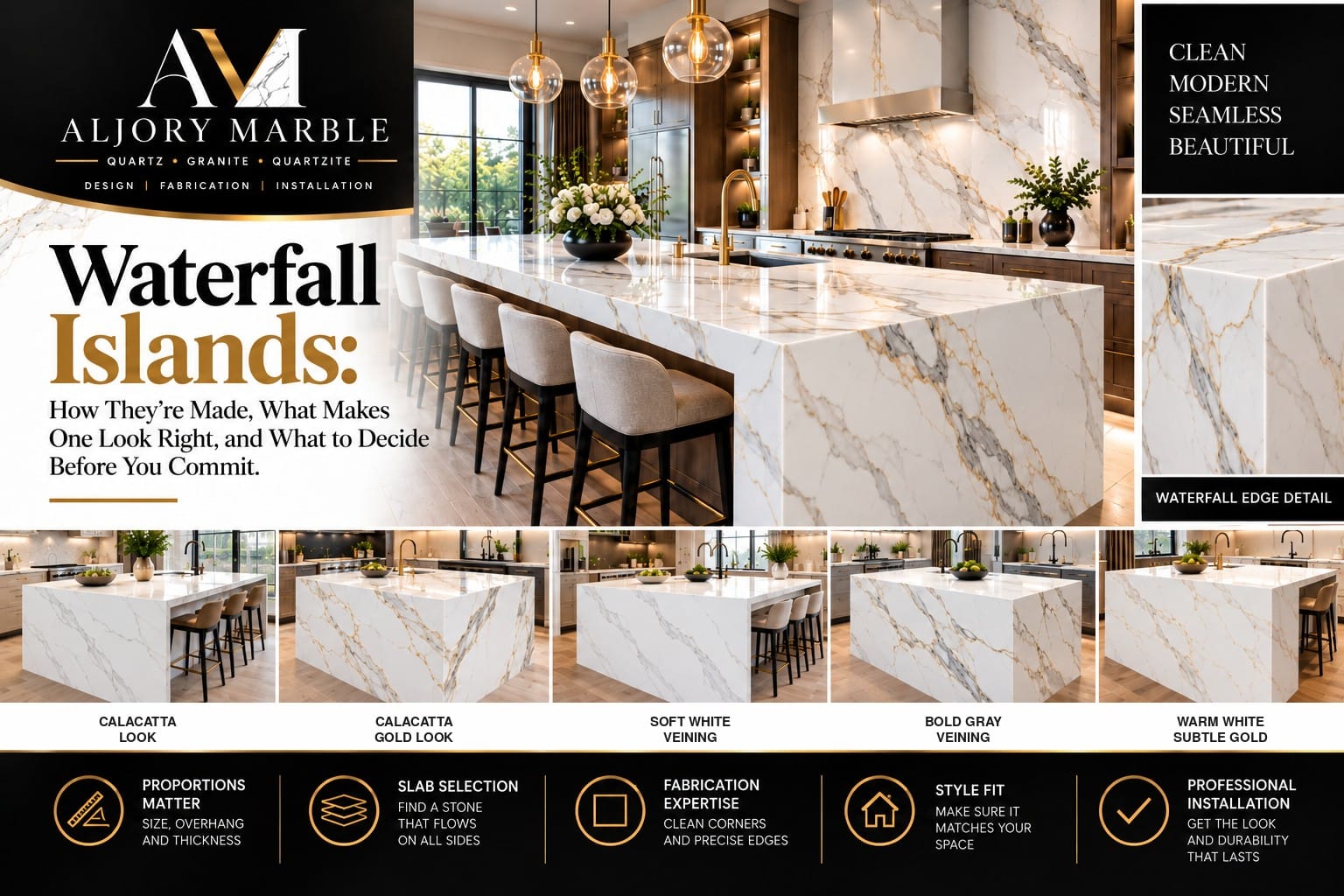
Waterfall Islands: How They’re Made, What Makes One Look Right, and What to Decide Before You Commit
Thinking about a waterfall island? Bring your island dimensions — we’ll tell you what your slab can do.
📞 Call (708) 362-7674 · 📝 Free written estimate · 🏗 See waterfall work in Crestwood
What Makes a Waterfall Island Look Right
| Detail | Done well | Done badly |
|---|---|---|
| The corner joint | Mitred at 45° so the seam is a hairline at the edge | A butt joint showing a visible dark band |
| The veining | Continues over the corner and down the leg | Stops at the top and restarts unrelated |
| The two sides | Both legs cut so the pattern relates | One leg mismatched from the other |
| Thickness | Consistent top to floor | Top and leg visibly different |
| The floor meeting | Clean, level, scribed to the floor | A gap, or a leg cut short |
| Overhang support | Engineered where seating sits | Unsupported stone spanning too far |
The corner is the whole job. Everything else is ordinary fabrication; the mitre and the vein continuation are what separate a waterfall you’d photograph from one you’d rather not look at.
The Decisions to Make Before Fabrication
One leg or two?
A single waterfall end reads as a deliberate accent and costs less. Two — one at each end — reads as a solid block of stone and roughly doubles the leg material. Kitchens with the island open on both sides usually want two; a run that terminates against cabinetry only needs one.
Which stone?
Waterfalls are made or broken by movement. Marble, Calacatta, quartzite and marble-look quartz turn the corner dramatically. A near-uniform stone still looks good but loses most of the effect — and at that point a simpler island may be the better spend. See our Calacatta and quartzite pages.
Seating or no seating?
A waterfall end removes the knee space at that end of the island. If you planned stools there, they move — usually to the long side, which changes the overhang and the support. Decide this before templating, not after.
Thickness?
Standard slab thickness is the norm. If you want the heavier, more architectural look, the top is built up with a mitred edge — see edge profiles — and the waterfall legs are built to match.
Island open on both sides? Then it’s usually a two-leg job — tell us and we’ll quote both options.
📞 Call (708) 362-7674 · 📝 Free written estimate · 🏗 See waterfall work in Crestwood
How We Fabricate One
- You pick the slab at the Crestwood yard, with the waterfall in mind — we look at where the movement runs
- We template the island and the floor, because floors are rarely level and the leg has to meet it cleanly
- We lay the pieces out on a photograph of your slab so the veining continues around the corner
- The corner is mitred — two pieces cut at 45° so they meet as a fine line rather than a visible seam
- Dry-fit in the shop before anything goes on a truck
- Our crew sets it, scribes the leg to the floor, and supports any overhang properly
All of it happens under one roof — see our fabrication process. Mitred waterfall corners are the job most often sent out by shops that don’t fabricate in-house, and that’s where the control over the veining is lost.
What It Adds to the Cost
A waterfall adds material — each leg is roughly the height of the island in additional stone, and it usually pushes the job into another slab — plus mitring and layout labour. It’s one of the larger single upgrades in a kitchen, and it’s also the most visible. Full island pricing is in our kitchen island countertop cost guide, and slab counts in how many slabs a kitchen needs.
When We’d Talk You Out of It
- The stone has little movement — you’d pay for the drama without getting it
- The island is small — a waterfall on a compact island can look heavy rather than elegant
- You need seating at that end and can’t move it
- The budget is tight elsewhere — an upgraded slab across the whole kitchen often beats one dramatic corner
- It’s a rental or a flip — the return rarely justifies it; see rental property countertops
We’d rather place the money where it shows. Sometimes that’s the waterfall and sometimes it isn’t.
Care and Practicality
| Question | Answer |
|---|---|
| Do the legs get damaged? | Occasionally at floor level, from vacuum cleaners and shoes. Rounded or eased bottom edges help |
| Is cleaning harder? | No — it’s the same surface, with a little more of it |
| Does it affect seating? | Yes, at the waterfall end. Plan seating on the long side |
| Can it be added later? | Only with the same slab in stock, which is rarely the case. Decide up front |
| Does it work with all cabinets? | Yes, though the cabinet end panel is hidden, which can save a little on cabinetry |
See One Before You Decide
Waterfall corners are hard to judge from photographs — the joint and the vein continuation only really read in person. Come to the Crestwood showroom, look at full slabs standing up, and we’ll show you how the movement would turn the corner on the stone you’re considering.
4711 W 135th St, Crestwood, IL 60418 · Directions · Mon–Sat 9am–6pm · Walk-ins welcome
About Al Jory Marble
Al Jory Marble is a family-run countertop fabricator at 4711 W 135th St, Crestwood, IL 60418, serving Chicago and the suburbs. Mitred waterfall corners are cut, dry-fitted and finished in our own shop and set by our own crew — nothing is sent out. Founded by Motie Hamdan and Naser Hamdan, with decades of family stone experience behind the work. (708) 362-7674.
Waterfall Island FAQs
What is a waterfall island?
An island where the stone turns down at the end and runs to the floor, so the island reads as one block.
What makes a good waterfall corner?
A tight mitred joint and veining that continues around it. Both are fabrication, not material.
Does it cost much more?
It adds the leg material — often pushing into another slab — plus mitring and layout time. See our island cost guide.
One leg or two?
Two if the island is open at both ends; one if a run terminates into cabinetry.
Which stones suit it best?
Those with real movement — marble, Calacatta, quartzite and marble-look quartz.
Can I still have seating?
Not at the waterfall end. Plan stools on the long side and tell us before templating.
Can quartz be used?
Yes, and marble-look quartz is one of the most popular choices for it.
Will the seam show?
A mitred corner shows a fine line, not a band. A butt joint shows a dark band — ask which you’re getting.
Does the leg sit on the floor?
Yes, scribed to it. Floors are rarely level, which is why we template the floor too.
Can it be added to an existing island?
Only if the same slab is still available, which is uncommon. Decide before fabrication.
Is it still in style?
It’s the most requested island detail we fabricate, and the clean mitred version reads as architectural rather than trend-led.
How do I start?
Bring your island dimensions to Crestwood and we’ll show you what your slab can do.
Get a Free Written Estimate
Request a quote · Call (708) 362-7674 · Showroom: 4711 W 135th St, Crestwood IL · Mon–Sat 9am–6pm
Related: island countertop cost · vein matching & bookmatching · edge profiles · fabrication · kitchen countertops · gallery




Serving Chicago & Surrounding Areas
Get Your Free Kitchen Countertop Estimate
Fill out the form and our team will get back to you in next 24 hours.