
Choosing a kitchen countertop is only part of the design.
You also have to decide what happens on the wall directly above it.
For many homeowners, that decision comes down to three common backsplash options:
- A short 4-inch countertop backsplash
- Tile backsplash
- Full-height slab stone backsplash
All three can work.
But they create very different kitchens.
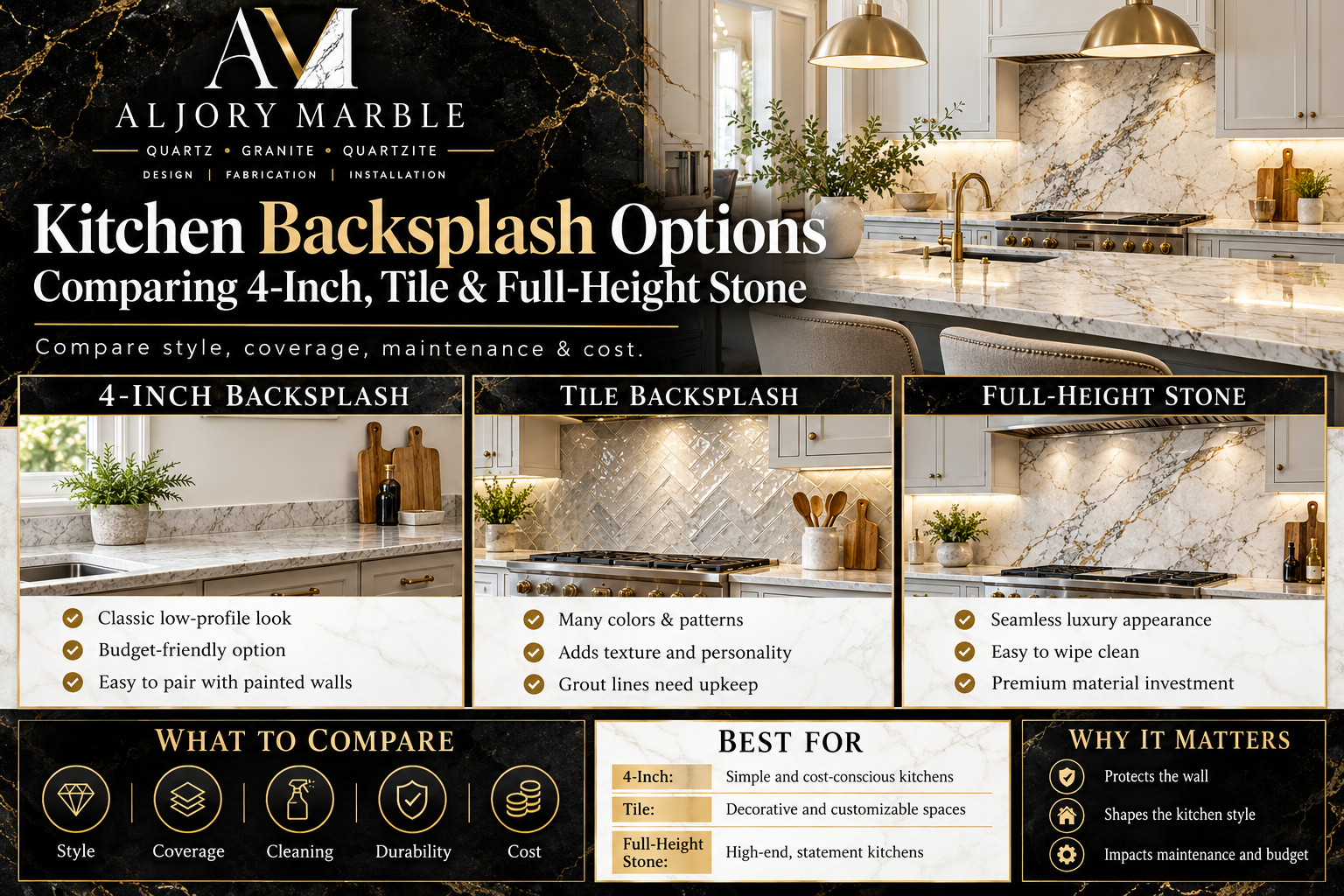
A 4-inch backsplash is simple and usually uses less material. Tile gives you the widest range of colors, patterns and price points. A full-height slab backsplash creates a seamless, high-end look by continuing quartz, granite, marble or quartzite up the wall.
The right choice depends on your budget, countertop material, cooking habits, maintenance preferences and the look you want to create.
If you are already planning new kitchen countertops, it is smart to think about the backsplash before the countertop slab is fabricated.
The backsplash can affect how much material you need, how the slab is laid out and even which parts of a strongly veined stone should be reserved for the wall.
This guide compares all three options so you can decide what makes sense for your kitchen.
Quick Answer: 4-Inch Backsplash vs. Tile vs. Full-Height Stone
Here is the simple comparison.
| Backsplash Type | Best For | Main Advantage | Main Consideration |
|---|---|---|---|
| 4-inch countertop backsplash | Simple kitchens and tighter budgets | Uses less material and is easy to coordinate | Leaves most of the wall exposed |
| Tile backsplash | Homeowners wanting design flexibility | Huge range of colors, shapes and prices | Grout lines require cleaning |
| Full-height stone backsplash | Luxury and statement kitchens | Seamless appearance with fewer visual breaks | Uses more slab material and requires planning |
There is no single option that is best for every kitchen.
The important part is matching the backsplash to how you use the room and how much visual attention you want the countertop material to receive.
What Is a 4-Inch Countertop Backsplash?
A 4-inch backsplash is a short strip of countertop material installed vertically against the wall behind the countertop.
The exact height can vary, but four inches is one of the most common traditional sizes.
For example, if you install quartz countertops, the fabricator may cut narrow pieces of the same quartz and place them along the back wall.
This creates a small transition between the horizontal countertop and the painted wall.
Why homeowners choose a 4-inch backsplash
A short backsplash can make sense when you want:
- A simple finished edge
- Less stone than a full-height backsplash
- Lower material usage
- An easy-to-clean area directly behind the counter
- Painted walls above the backsplash
- A straightforward kitchen design
It can also be useful when the backsplash is not intended to become a major design feature.
Is a 4-Inch Backsplash Outdated?
Not necessarily.
Design trends change, but that does not mean every traditional detail suddenly becomes wrong.
A 4-inch backsplash can still look appropriate in:
- Transitional kitchens
- Traditional kitchens
- Rental properties
- Secondary kitchens
- Simple countertop replacements
- Kitchens where the wall will remain painted
- Budget-conscious renovations
The key is whether it looks intentional with the rest of the kitchen.
A short backsplash paired with clean quartz and a simple painted wall can look very different from an older laminate countertop with an attached backsplash.
The material, edge profile, cabinetry and wall finish all matter.
Can You Use a 4-Inch Stone Backsplash With Tile Above It?
You can.
But this combination needs to be planned carefully.
You would have:
Countertop → 4-inch stone backsplash → tile
Some homeowners like the layered look.
Others prefer having the tile begin directly at the countertop because it creates fewer horizontal breaks.
If you know you definitely want tile, ask yourself whether the 4-inch stone strip adds something visually.
If not, you may prefer to skip the short backsplash and let the tile meet the countertop directly.
What Is a Tile Backsplash?
Tile remains one of the most common backsplash materials because there are so many options.
Tile can be:
- Ceramic
- Porcelain
- Glass
- Marble
- Natural stone
- Handmade
- Mosaic
- Large-format
- Subway style
It can be quiet enough to disappear behind the countertops or bold enough to become the main feature of the kitchen.
That versatility is the biggest advantage of tile.
Why Homeowners Choose Tile Backsplash
Tile works well when you want to introduce a material that is different from the countertop.
For example:
White quartz countertop + blue handmade tile
Taj Mahal quartzite + warm beige tile
Dark granite + simple white subway tile
Calacatta-style quartz + soft neutral ceramic tile
Tile allows you to add:
- Color
- Texture
- Pattern
- Contrast
- Handmade details
without using another entire section of countertop slab.
Does Tile Backsplash Cost Less Than Full-Height Stone?
Often, yes, but the final answer depends on the materials you select.
A simple ceramic tile backsplash can be considerably less expensive than extending premium quartzite or marble across an entire wall.
However, tile itself can also become expensive.
Designer tile, handmade tile, natural stone mosaics and complex installation patterns may increase the project cost.
Labor matters too.
A detailed mosaic backsplash may require far more installation time than a basic subway tile.
So the most useful comparison is not simply:
tile vs. stone
It is:
the specific tile and installation vs. the specific slab and fabrication work.
If you are comparing the total project price, our countertop cost guide explains why slab quantity, fabrication complexity, backsplash, cutouts and installation can all affect the finished price.
What Is a Full-Height Stone Backsplash?
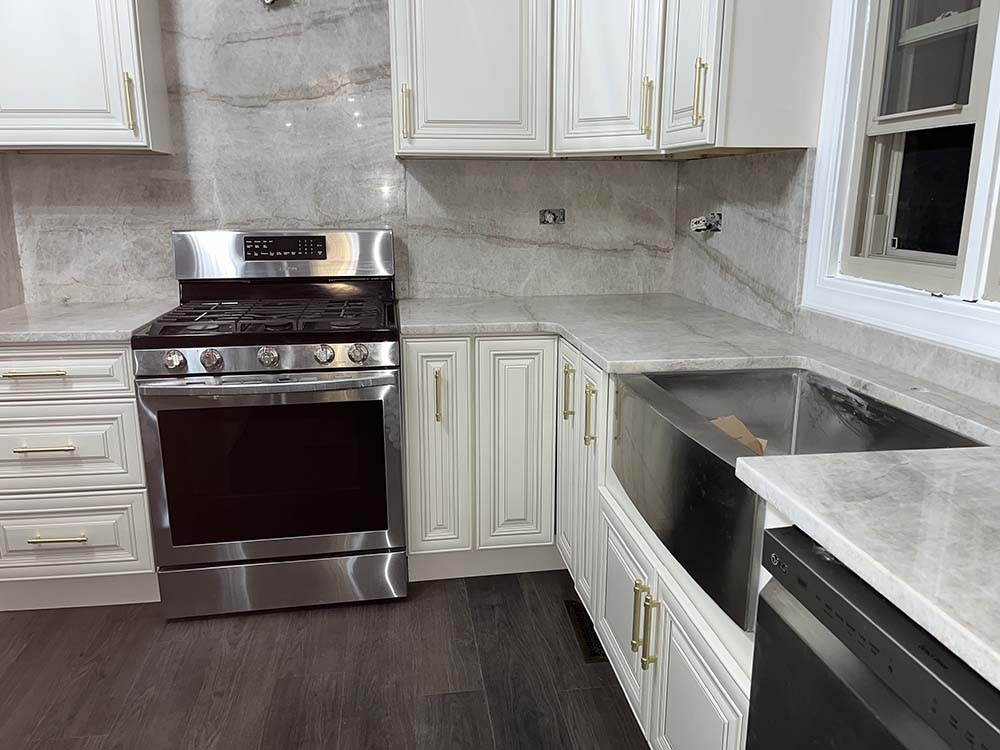
A full-height stone backsplash continues slab material vertically from the countertop up the wall.
It may extend:
- From countertop to upper cabinets
- From countertop to floating shelves
- Behind a range
- To the bottom of a range hood
- Around a kitchen window
- Across an entire feature wall
Instead of introducing another material, the countertop surface becomes part of the wall.
A full-height backsplash can be fabricated from:
- Quartz
- Granite
- Marble
- Quartzite
This creates a very different look from tile because there are no small individual pieces breaking up the pattern.
If you are considering this option, our detailed full-height stone backsplash planning guide explains slab layout, outlets, veining, seams and material planning in more detail.
Why Full-Height Stone Has Become So Popular
Large stone surfaces create visual continuity.
Imagine a white quartz countertop with bold gray veins.
With tile, the veining ends at the horizontal counter and another material begins.
With slab backsplash, that stone pattern can continue vertically onto the wall.
The kitchen may appear:
- Cleaner
- Larger
- More continuous
- More architectural
- More luxurious
Strongly veined materials can create particularly dramatic results.
Which Backsplash Has the Fewest Grout Lines?
Full-height slab stone.
That is one of its biggest practical advantages over traditional tile.
A slab backsplash may still have seams depending on the wall size and material layout, but there are usually far fewer joints than you would have with individual tiles.
A tile backsplash may contain dozens or even hundreds of grout lines.
That does not make tile a bad choice.
It simply creates a different maintenance routine.
Which Kitchen Backsplash Is Easiest to Clean?
For everyday cleaning, slab material is often one of the simplest options because there are fewer joints and grout lines.
With quartz or polished stone, the wall surface can usually be wiped down easily.
Tile itself is also easy to clean.
The part that sometimes requires more attention is the grout.
Cooking areas can expose a backsplash to:
- Grease
- Sauce
- Oil
- Water
- Food splatter
- Steam
Those substances can settle into grout joints over time.
A properly installed and maintained tile backsplash can still perform very well, but homeowners who strongly dislike cleaning grout often prefer large-format surfaces.
Is Quartz Good for a Full-Height Backsplash?
Quartz is a popular option because its patterns are predictable and the material can coordinate directly with the countertop.
For homeowners using quartz countertops, matching slab backsplash can create a very consistent design.
Marble-look quartz is especially popular for this style because bold veining can create the appearance of natural stone while keeping the pattern controlled.
However, the material must always be used according to the manufacturer’s requirements, especially around cooking appliances and heat sources.
Is Quartzite Good for a Slab Backsplash?
Yes.
Quartzite can create an especially dramatic backsplash because it is natural stone.
Every slab has its own movement.
Materials such as Taj Mahal, Mont Blanc and other veined quartzites can create a wall that feels more like a natural-stone feature than a conventional backsplash.
If you are already considering quartzite countertops, decide whether you want slab backsplash early.
The reason is simple:
The backsplash needs material too.
If all of the best areas of the slab are allocated to the island and perimeter counters before the backsplash is considered, achieving the look you want later may become much more difficult.
What About Marble Backsplash?
Marble can create one of the most classic full-height backsplash designs.
The natural veining can make the wall look completely unique.
Marble is particularly attractive in kitchens where the stone itself is meant to be the focal point.
But homeowners should understand marble before selecting it.
Marble can etch when exposed to acids.
It can also develop a natural patina over time.
That does not mean marble should never be used in kitchens.
It means the homeowner should choose it because they appreciate how natural marble behaves, not because they expect it to behave exactly like engineered quartz.
If you are considering the material, see our marble countertops options before making the final decision.
Can Granite Be Used as a Full-Height Backsplash?
Yes.
Granite is sometimes overlooked because many of today’s slab backsplash photos feature white quartz, marble or quartzite.
But granite can work very well.
A granite with strong movement can create a dramatic feature wall.
A quieter granite can give the kitchen a more traditional natural-stone appearance.
The most important question is whether you want that particular slab pattern covering a larger vertical surface.
Seeing the full slab in person becomes especially valuable because a small sample cannot show how an active granite pattern may look across an entire wall.
Which Backsplash Works Best With Calacatta Countertops?
It depends on how much veining you want.
Option 1: Matching Calacatta slab backsplash
This creates the most continuous look.
The countertop and backsplash become one visual composition.
Option 2: Simple tile
A quiet tile allows the Calacatta countertop to remain the main feature.
Option 3: Contrasting tile
Color or texture can give the room more personality.
The mistake is assuming that a dramatic countertop automatically requires an equally dramatic backsplash.
Sometimes the best backsplash is the one that allows the countertop to stand out.
Should Your Backsplash Match Your Countertops?
It can, but it does not have to.
There are three common approaches.
Matching
Use the same countertop material on the wall.
This works particularly well with slab backsplash.
Coordinating
Choose a tile that picks up one of the colors in the countertop.
For example, a warm beige tile may coordinate with the softer tones in Taj Mahal quartzite.
Contrasting
Use the backsplash to introduce a completely different color or texture.
This can work well when the countertops are simple.
There is no requirement that the backsplash and countertop match exactly.
The goal is for the materials to look intentional together.
What Backsplash Works Best With Busy Countertops?
Usually something quieter.
If the countertop contains:
- Strong veins
- Heavy movement
- Multiple colors
- Large mineral patterns
adding a heavily patterned backsplash can make the room feel visually crowded.
A simpler backsplash allows the countertop to remain the feature.
This might mean:
- Neutral tile
- Matching slab
- Large-format tile
- Simple paint with a short stone backsplash
What Backsplash Works Best With Plain Countertops?
A quieter countertop gives you more freedom.
For example, a solid white or lightly patterned quartz countertop can work with:
- Handmade tile
- Geometric tile
- Colored tile
- Mosaic accents
- Natural stone tile
- Textured tile
In that situation, the backsplash can become the design feature instead of the countertop.
Full-Height Stone vs. Tile: Side-by-Side Comparison
| Feature | Full-Height Stone | Tile |
|---|---|---|
| Grout | Very little or none across large sections | Multiple grout joints |
| Pattern | Large continuous pattern | Repeating individual pieces |
| Cleaning | Generally simple surface cleaning | Tile plus grout maintenance |
| Design options | Limited to slab selections | Extremely wide variety |
| Material usage | Can require significant slab area | Does not use countertop slab |
| Vein matching | Possible with careful planning | Not applicable in the same way |
| Installation | Requires fabrication and careful handling | Installed piece by piece |
| Style | Seamless and architectural | Flexible and customizable |
| Budget | Can increase slab and fabrication cost | Wide range from affordable to premium |
4-Inch Backsplash vs. Tile: Which Makes More Sense?
Choose a 4-inch backsplash if you want:
- A simple installation
- Less additional material
- Painted wall above the countertop
- A traditional or understated finish
- To keep the project straightforward
Choose tile if you want:
- More wall protection
- More design choices
- Color or texture
- A separate material from the countertop
- A backsplash extending up to cabinets or a hood
Neither option is automatically better.
It depends on the room.
4-Inch Backsplash vs. Full-Height Stone
These are almost opposite approaches.
A short backsplash uses stone sparingly.
A full-height backsplash makes the stone one of the largest visual surfaces in the room.
A 4-inch backsplash may be better when:
- Budget matters
- The countertop itself is enough of a feature
- You want painted walls
- The project is primarily a countertop replacement
Full-height stone may be better when:
- The kitchen is a major remodel
- You selected a slab specifically for its pattern
- You want fewer grout lines
- The backsplash is part of the design
- You want the stone to become a focal point
Does a Full-Height Backsplash Require Another Slab?
Sometimes.
This is one of the most important things homeowners should understand before choosing slab backsplash.
A standard kitchen countertop already uses material for:
- Perimeter counters
- Island
- Sink sections
- Cooktop sections
You may also need material for:
- Waterfall panels
- Window sills
- Vanity pieces
- Short backsplashes
A full-height backsplash can use a large amount of stone.
Depending on the slab dimensions and the kitchen layout, adding the backsplash may push the project into another slab.
That is why backsplash decisions should be discussed before finalizing how many slabs are required.
Al Jory Marble’s current cost guidance also lists full-height backsplash as one of the project details that can increase material requirements and overall fabrication scope.
Can Remnants Be Used for a Backsplash?
Sometimes, particularly for smaller sections.
For example, a leftover piece may work for:
- A short backsplash
- A small coffee bar
- A small section behind a sink
- A vanity backsplash
A full kitchen wall usually requires much larger pieces.
Whether a remnant works depends on its dimensions, pattern and whether the piece can be cut safely for the required area.
Why Slab Layout Matters With Full-Height Backsplash
This is where a countertop fabricator becomes especially important.
Imagine a quartzite slab with one beautiful diagonal vein.
That vein could be used:
- Across the center island
- Along the perimeter countertop
- Behind the range
- Across a waterfall panel
But the same section of stone cannot be used in every location.
The fabricator has to decide where each kitchen piece will come from on the slab.
That is called slab layout.
When the backsplash is included in the plan from the beginning, the fabricator can consider it along with the countertop pieces.
If it is added after the main pieces are already cut, the most desirable portions of the slab may no longer be available.
Al Jory Marble handles countertop fabrication in its Crestwood shop, allowing slab layout, cutouts, edges, countertop sections and backsplash pieces to be coordinated as part of the same project.
What Is Vein Matching?
Vein matching means planning adjacent stone pieces so the natural or printed pattern transitions as intentionally as possible.
This becomes especially important with:
- Calacatta
- Marble
- Quartzite
- Dramatic marble-look quartz
For example, a strong vein in the countertop may visually continue onto a vertical waterfall panel.
In some installations, the backsplash can also be laid out to complement the movement in the countertop.
Perfect continuation is not always possible because of:
- Slab size
- Cutouts
- Wall dimensions
- Material limitations
- Number of slabs
But early planning gives the fabricator more options.
What Happens Around Electrical Outlets?
Outlets are one reason slab backsplash requires more planning than people sometimes expect.
A tile installer can cut individual tiles around electrical boxes.
With slab stone, the openings have to be accurately positioned in a much larger fabricated piece.
The layout may need to account for:
- Standard outlets
- GFCI outlets
- Light switches
- USB outlets
- Appliance switches
For new kitchen construction, some homeowners also coordinate with the electrician and designer to reduce how much outlet placement interrupts dramatic stone.
Electrical work must still comply with applicable codes.
Design should never override electrical safety requirements.
Can Stone Backsplash Go Behind a Stove?
Stone is commonly used behind cooking areas, but the specific situation matters.
The backsplash material, appliance type, manufacturer’s clearance requirements and heat exposure should all be considered.
This is especially important with engineered surfaces.
Never assume that because a material works as a countertop, every part of it can be installed at any distance from every heat source.
The appliance and surface manufacturer’s requirements should be followed.
Should Backsplash Go Behind the Range Hood?
It can.
This is one of the places where full-height stone can create a particularly impressive design.
Stone may continue:
- To the bottom of the hood
- Behind the hood
- To the ceiling
Which option looks best depends on:
- Hood style
- Upper cabinets
- Ceiling height
- Slab dimensions
- Vein direction
- Overall kitchen design
If you are planning stone behind a hood, decide early because the wall dimensions may significantly increase the amount of slab material needed.
Can Stone Backsplash Go Around a Window?
Yes.
Stone can be fabricated around kitchen windows.
Some designs also continue the material into:
- Window sill
- Side returns
- Surrounding wall
These details can look very clean, but they also require accurate measurement.
Windows are rarely perfectly symmetrical in older homes.
The finished fabrication should therefore be based on the actual space rather than assumptions from a drawing.
What Comes First: Countertop or Backsplash?
In most kitchen remodels, the countertop is installed before the final backsplash.
The common order is:
Cabinets → Countertop Template → Countertop Fabrication → Countertop Installation → Backsplash
This allows the backsplash to meet the actual installed countertop.
We explain the complete construction sequence in our guide to what comes first in a kitchen remodel.
If that new article is not live yet, add this internal link after publishing it.
When Should You Decide on Your Backsplash?
Ideally, before countertop fabrication.
You do not necessarily need every final tile box sitting in the house.
But you should know whether you are planning:
- No backsplash
- Short stone backsplash
- Tile backsplash
- Full-height slab backsplash
Full-height slab backsplash is especially important to decide early because it affects material quantity and slab layout.
Do You Need to Pick the Backsplash at the Same Time as the Countertop?
You do not have to make the final decision on the same day.
But looking at the two materials together is helpful.
If you are visiting a countertop showroom, bring:
- Cabinet door sample
- Flooring sample
- Paint sample
- Backsplash tile sample if you have one
Then look at everything next to the full slab.
This is much more useful than making separate decisions from online photos.
Lighting, undertones and stone variation can look completely different in person.
How to Choose Between the Three Options
Ask yourself these six questions.
1. Do I want the countertop material to continue up the wall?
If yes, consider full-height stone.
2. Do I want more color or texture?
Tile gives you the most options.
3. Am I trying to keep the project simple?
A 4-inch backsplash may be enough.
4. Do I dislike grout?
Full slab stone minimizes grout lines.
5. Is budget the biggest priority?
Compare a short backsplash or straightforward tile with the added material required for full-height slab.
6. Did I choose the countertop because I love the slab itself?
If the stone is the star of the kitchen, extending it onto the wall may be worth considering.
Best Backsplash for a Countertop Replacement Without a Full Remodel
If you are only replacing countertops, a full-height backsplash may require additional work if an existing backsplash is already installed.
In these projects, homeowners may choose:
- A new short countertop backsplash
- New tile after removing the existing tile
- Full-height slab after preparing the wall
The right choice depends partly on what is already there.
Do not assume a new slab can simply be installed over every existing wall surface.
The backsplash area needs to be evaluated as part of the project.
Best Backsplash for a New Luxury Kitchen
For a luxury remodel, full-height stone is worth considering when the slab itself is one of the main design features.
Large islands and open kitchens expose more countertop surface than older kitchens.
Carrying that material vertically can tie together:
- Island
- Perimeter counters
- Range wall
- Waterfall edges
- Shelving
But luxury does not automatically mean more stone.
A beautifully selected handmade tile behind natural quartzite can look just as intentional.
Good design is about choosing materials that work together rather than simply using the most expensive option everywhere.
Is Full-Height Stone Worth It?
It can be.
The value is strongest when you specifically want:
- A continuous stone look
- Fewer visual breaks
- Less grout
- Dramatic veining
- A statement range wall
- A high-end finish
It may not be worth the additional material for a homeowner who simply wants a functional backsplash and prefers tile.
There is no reason to pay for an entire additional slab simply because full-height backsplash is currently popular if it is not the look you actually want.
Which Option Is Best for Resale?
There is no backsplash that guarantees a higher resale price.
A clean, well-designed kitchen is more important than chasing one trend.
For resale-minded homeowners, the safest choices are often materials that coordinate naturally and do not overwhelm the room.
That can be:
- Neutral tile
- Simple stone backsplash
- Matching quartz slab
- Warm natural stone
Choose something that works with the overall kitchen.
Common Backsplash Planning Mistakes
Choosing the backsplash too late
This is especially risky if you want full-height stone because the slab may already have been cut.
Using too many competing patterns
Strong countertop veins plus highly patterned tile can make the room visually busy.
Forgetting about outlets
Outlets become very noticeable on a large stone backsplash.
Looking only at tiny countertop samples
A small sample does not show the movement of an entire natural-stone slab.
Ignoring slab quantity
A full-height backsplash may change how many slabs your kitchen requires.
Not planning the range and hood together
The range wall is often the most visible backsplash area in the kitchen.
Treat the appliances, hood and backsplash as one composition.
Choosing based only on trends
A backsplash can remain in your kitchen for many years.
Choose something you actually want to live with.
4-Inch vs. Tile vs. Full-Height Stone: Final Comparison
If you want the simplest answer:
Choose a 4-inch backsplash when you want a straightforward, lower-material solution and do not need the wall to become a major design feature.
Choose tile when you want the widest selection of colors, textures, patterns and budgets.
Choose full-height stone when you want the countertop material to become part of the wall and create a seamless, statement look.
None of these choices is universally right.
The best backsplash is the one that fits the countertop, kitchen design, daily use and total project budget.
Frequently Asked Questions
Is a 4-inch backsplash still popular?
It is still used, particularly for straightforward countertop replacements, traditional kitchens, rental properties and projects where homeowners want painted walls above the counter.
Is a 4-inch backsplash cheaper than tile?
It can be, especially when it uses a small amount of the same countertop material. Actual pricing depends on the material, available slab area and tile you are comparing it with.
Is tile cheaper than a slab backsplash?
Basic tile is often less expensive than full-height premium slab stone. Designer tile and complex installation can narrow the difference, so compare the actual project costs.
Does a kitchen need a backsplash?
A backsplash protects the wall behind work areas and provides a finished transition above the countertop. The height and material can vary depending on the kitchen.
Can I have no backsplash at all?
Some kitchens use painted or otherwise finished walls directly above the countertop. Areas exposed to water and cooking splatter may require more cleaning and maintenance.
Should backsplash match the countertop?
No. It can match, coordinate or intentionally contrast with the countertop.
Can quartz be used as backsplash?
Yes, quartz is commonly used for slab backsplash. Manufacturer installation and heat-clearance requirements should always be followed.
Can quartzite be used for full-height backsplash?
Yes. Quartzite can create a dramatic natural-stone backsplash, especially when slab layout and veining are planned before fabrication.
Can granite be used as backsplash?
Yes. Granite can be fabricated into both short backsplash pieces and larger slab backsplash sections.
Can marble be used as kitchen backsplash?
Yes. Marble provides natural veining and a classic appearance, although homeowners should understand that marble can etch and develop patina.
Which backsplash is easiest to clean?
Large slab surfaces generally have fewer grout lines, making routine wiping easier. Tile is also easy to clean, but the grout may require additional maintenance.
Should countertops be installed before tile backsplash?
Usually, yes. The installed countertop establishes the finished lower line for the backsplash.
Should I decide on a slab backsplash before countertop fabrication?
Yes. This is important because the backsplash can use a significant amount of slab material and affect how the countertop pieces are laid out.
Can my countertop and backsplash come from the same slab?
Sometimes. It depends on the dimensions of the kitchen, slab size, pattern and how much material the entire project requires.
Will I need another slab for a full-height backsplash?
Possibly. A full-height backsplash can substantially increase the material required, especially in kitchens with large islands, waterfall panels or extensive wall coverage.
Planning New Kitchen Countertops and Backsplash in Chicagoland?
The best time to think about the backsplash is before the countertop slab is cut.
That gives you the freedom to compare a short stone backsplash, tile and full-height slab without discovering later that the material you wanted for the wall has already been used elsewhere.
Al Jory Marble fabricates and installs custom kitchen countertops in quartz, granite, marble and quartzite throughout Chicago and the surrounding suburbs.
Our team handles templating, slab layout, fabrication and installation from our Crestwood shop, including countertop projects with full-height stone backsplash.
See the material in person before deciding how much of it you want in your kitchen.
Visit Jory Marble Granite Quartz INC, 4711 W 135th St, Crestwood, IL 60418 or contact us for a free countertop measurement and written estimate.

Serving Chicago & Surrounding Areas
Get Your Free Kitchen Countertop Estimate
Fill out the form and our team will get back to you in next 24 hours.