
Written by Al Jory Marble Team
Updated September 7, 2026
This Kitchen Countertop Buying Guide is designed for homeowners who want to choose a countertop based on more than a color sample. The right surface needs to work with the way you cook, clean, entertain, use your kitchen, maintain your home and budget for the complete project—not simply look good under showroom lighting.
Choosing kitchen countertops means making several connected decisions. Do you cook every day? Do children use the island for meals or homework? Do you want genuine natural stone? Would marble etching bother you? Are you planning a large waterfall island? Will the existing cabinets stay? How important are easy cleaning and low maintenance?
A successful countertop project combines appearance, durability, fabrication, installation and everyday usability.
This guide walks through those decisions so you can compare materials, visit a showroom and request estimates knowing what actually matters.
Kitchen Countertop Buying Guide: Start With Your Lifestyle, Not the Color
It is easy to begin a kitchen remodel by looking at dramatic veining, bright white slabs and beautifully staged kitchens online.
But your first question should be much simpler:
How will this countertop actually be used?
A household that prepares several meals every day has different priorities from a kitchen used mainly for coffee, entertaining and occasional cooking. Families may prioritize stain resistance and simple cleanup. Serious cooks may care more about heat tolerance. Someone who loves natural stone may happily accept periodic sealing because having a one-of-a-kind slab matters more.
Before choosing the material, consider:
- How often you cook
- Whether children regularly use the counters
- How concerned you are about staining
- Whether hot cookware is frequently near the countertop
- How much maintenance you realistically want
- Whether you prefer consistent patterns or natural variation
- The size of your kitchen island
- Whether you want a full-height backsplash
- Whether you want waterfall ends
- How long you expect to remain in the home
- Your complete project budget, not simply the slab price
There is no countertop material that wins every category.
The best choice is the one whose strengths match your kitchen and whose compromises you are comfortable living with.
Why Kitchen Countertops Matter More Than Most Remodeling Choices
Countertops are one of the few parts of a kitchen that homeowners both look at and physically use every day.
They influence the room in several ways:
- Function: food preparation, serving, cleanup and daily activity
- Durability: resistance to scratches, heat, spills and wear
- Maintenance: cleaning, sealing and long-term care
- Design: color, veining, texture and visual balance
- Layout: islands, overhangs, sinks, cooktops and seating
- Resale appeal: countertops are among the finishes buyers notice immediately
- Project cost: material, fabrication and installation can represent a significant portion of a kitchen remodel
This is why material selection should not be separated from fabrication and installation planning.
A beautiful slab is only the beginning.
Kitchen Countertop Buying Guide: Quartz vs. Granite vs. Quartzite vs. Marble
The four materials homeowners compare most often are quartz, granite, quartzite and marble.
All four can create an excellent kitchen, but they differ in maintenance, heat tolerance, staining, consistency and natural variation.
Quartz
Quartz countertops are engineered surfaces designed for durability, consistency and relatively easy maintenance.
Quartz may be a strong choice if you want:
- No routine sealing
- Strong stain resistance
- More predictable patterns
- Marble-inspired designs
- Easy everyday cleaning
- A wide variety of colors
Granite
Granite countertops are natural stone, meaning every slab has its own mineral pattern and character.
Granite may be right for you if you want:
- Genuine natural stone
- Excellent heat resistance
- Strong durability
- Unique slab variation
- A proven kitchen surface
- Natural movement and depth
Quartzite
Quartzite countertops are natural stone and are especially attractive to homeowners who want dramatic movement combined with strong durability.
Quartzite may be worth considering if you want:
- Genuine natural stone
- Marble-like veining
- Excellent heat performance
- Strong scratch resistance
- Premium visual impact
- A statement island or focal surface
Marble
Marble countertops offer natural character that manufactured materials are designed to imitate, but marble also requires more care.
Marble may suit you if:
- Authentic natural stone is important
- You appreciate natural aging and patina
- You understand etching
- You are willing to maintain the surface
- Unique veining matters more than perfect consistency
For a deeper material comparison, read the quartz vs. granite vs. quartzite guide.
Quartz Countertops: Low Maintenance and Predictable Design
Quartz has become a popular kitchen option because it combines good everyday performance with an enormous range of colors and patterns.
It is nonporous and normally does not require periodic sealing. Coffee, cooking oils, sauces and other common kitchen spills are less likely to penetrate the surface when cleaned normally.
Quartz also provides greater pattern consistency than natural stone.
That can be helpful when a project includes:
- Long countertop runs
- Multiple slabs
- Large islands
- Matching perimeter counters
- Full-height backsplashes
- Waterfall panels
Homeowners who like marble-inspired designs but want easier maintenance often consider quartz first.
The main limitation to understand is heat.
Because engineered quartz contains resin, hot cookware should generally be placed on a trivet instead of directly on the countertop.
Quartz is also manufactured rather than quarried. Some buyers love the consistency. Others specifically want the irregularity and depth of genuine natural stone.
Neither preference is wrong.
Granite Countertops: A Natural-Stone Workhorse
Granite remains a strong choice for homeowners who want natural stone with excellent kitchen performance.
Every slab is different.
Some granite has relatively quiet movement. Other slabs include dramatic minerals, sweeping patterns and strong changes in color.
Because granite is naturally heat resistant, it is often attractive to homeowners who cook frequently.
Granite may also provide excellent long-term durability when properly fabricated, installed and maintained.
The tradeoff is that natural stone is porous.
Depending on the particular granite and finish, periodic sealing may be recommended.
That maintenance is usually manageable, but it should be understood before purchasing.
If you want genuine natural stone and appreciate variation from slab to slab, granite deserves serious consideration.
Quartzite Countertops: Natural Movement With Serious Durability
Quartzite and quartz sound similar, but they are not the same material.
Quartz is engineered.
Quartzite is natural stone quarried from the earth.
Quartzite is generally hard, performs well around heat and can offer dramatic natural movement that resembles high-end marble.
For large islands, quartzite can become a major architectural feature rather than simply a work surface.
Consider quartzite if you value:
- Natural slab variation
- Strong durability
- Excellent heat resistance
- Dramatic veining
- Premium visual impact
Quartzite can require periodic sealing and may cost more than many standard granite or quartz selections.
Because slabs vary naturally, the actual slab should be inspected whenever possible rather than selecting solely from a small sample.
Marble Countertops: Beautiful, Authentic and More Demanding
A serious Kitchen Countertop Buying Guide should also be honest about marble.
Marble is beautiful because it is real natural stone. Its depth, veining and movement are exactly what quartz manufacturers frequently try to reproduce.
But marble behaves differently from quartz, granite and quartzite.
Acidic substances such as lemon juice, vinegar, tomato and wine can etch the surface. Marble can also absorb staining agents if spills remain long enough to penetrate.
That does not mean marble is a bad kitchen material.
It means marble should be chosen by someone who understands it.
Marble may be a good fit when:
- Genuine marble is specifically what you want
- You appreciate natural patina
- You understand that etching can happen
- You are comfortable with maintenance
- Perfect long-term uniformity is not your priority
Marble may not be a good fit when:
- Every small mark will bother you
- You want an almost maintenance-free countertop
- You expect the surface to remain unchanged
- You do not want to think about acidic spills
A more expensive stone is not automatically a better stone.
It is only better if it matches the way you live.
What Does Calacatta Actually Mean?
Calacatta has become one of the most popular countertop styles, but the name can create confusion.
You may encounter:
- Natural Calacatta marble
- Calacatta-inspired quartz
- Calacatta quartzite
- Multiple manufactured quartz patterns using Calacatta names
These surfaces may look similar from across the kitchen while behaving very differently.
Instead of asking only, “Do you have Calacatta?”, ask what the actual material is.
Then determine:
- Is it quartz, marble or quartzite?
- Does it require sealing?
- Can it etch?
- How does it handle heat?
- Is the pattern consistent?
- Can you view the actual slab?
Explore the Calacatta countertops options when you are ready to compare specific materials.
Kitchen Countertop Buying Guide: See the Full Slab Before You Decide
Small samples are useful for narrowing choices.
They are not the whole story.
This matters especially with granite, quartzite and marble because natural stone can change dramatically from one area of a slab to another.
A small sample may show the basic color.
A full slab can reveal:
- Vein direction
- Dramatic areas of movement
- Quiet sections
- Mineral variation
- Color transitions
- Natural fissures
- How the pattern might look across an island
Even dramatic quartz patterns deserve to be viewed at a larger scale.
A vein that seems subtle on a sample may become the dominant feature across a nine-foot island.
When possible, bring:
- Cabinet-door samples
- Flooring samples
- Paint colors
- Hardware finishes
- Backsplash samples
- Photos of the room in natural light
A “white” countertop can lean warm, cool, gray, cream or even slightly blue depending on the product.
Seeing everything together can prevent an expensive design mismatch.
Large Kitchen Islands Need More Planning
Large islands have become a centerpiece in many kitchens, but they create additional countertop decisions.
A large island can affect:
- Number of slabs
- Seam placement
- Vein direction
- Sink positioning
- Cooktop positioning
- Overhang
- Support
- Edge profile
- Waterfall panels
- Total project cost
If you want a waterfall edge, mention it before the slab is ordered.
If you want veining to continue from the horizontal countertop down the vertical waterfall panel, slab layout must be planned around that transition.
Large islands also need to be compared with usable slab dimensions.
If the island cannot be fabricated from one usable portion of a slab, a seam may be necessary.
That should be determined before fabrication—not discovered on installation day.
Countertop Seams: What Homeowners Should Expect
A seam does not automatically mean the project was poorly planned.
Slabs have physical size limits, and kitchens include long runs, corners, sinks, cooktops and complicated layouts.
The goal is good seam planning.
A properly planned seam should be:
- Supported
- Tight
- Level
- Positioned logically
- Color-matched as closely as practical
- Planned around the slab pattern
Strongly veined materials deserve additional attention because the eye naturally follows the movement across the joint.
Before fabrication starts, ask where the seams are expected.
Knowing the plan before the slab is cut is far better than noticing the seam location after installation.
Countertop Edge Profiles: Small Detail, Big Difference
Edge profiles can change the character of the entire countertop.
A simple eased edge works well with many modern and transitional kitchens.
A beveled edge adds more definition.
Decorative profiles can complement traditional cabinetry.
A mitered edge can create the appearance of a substantially thicker countertop without using a solid slab of that thickness.
Consider:
- Cabinet style
- Countertop thickness
- Island dimensions
- Material
- Overall design
- Cleaning
- Budget
More complicated does not automatically mean more luxurious.
Sometimes a simple edge allows dramatic stone to remain the focal point.
Polished, Honed or Matte?
Finish changes how the countertop interacts with light.
A polished finish reflects more light and generally makes colors and veining appear richer.
A honed finish has less reflection and creates a softer appearance.
With marble, a honed finish can also make normal etching less visually noticeable than it may appear on a highly reflective polished surface.
Quartz manufacturers may offer polished, matte and specialty textures depending on the product.
Whenever possible, see the finish in person rather than deciding from a photograph.
Kitchen Countertop Buying Guide to Cost: Compare the Complete Project
Countertop pricing is about more than price per square foot.
The final estimate can be affected by:
- Material
- Number of slabs
- Total square footage
- Fabrication
- Edge profile
- Sink cutouts
- Cooktop cutouts
- Full-height backsplash
- Waterfall panels
- Existing countertop removal
- Disposal
- Delivery
- Installation
- Difficult access
- Complex seams or layouts
That is why two kitchens using similarly priced slabs can receive substantially different estimates.
The existing Countertop Cost Guide should remain the deeper pricing resource.
For buying purposes, remember one important rule:
Compare complete written quotes with the same scope of work.
A lower number is not necessarily a better price if major items are missing from the estimate.
Can You Measure the Kitchen Yourself?
Rough measurements are useful when you are trying to understand approximate project size or early budgeting.
They should not replace professional final measurements.
Walls may not be perfectly straight. Corners are not always exactly 90 degrees. Cabinets can be slightly out of level.
Final measurements also need to account for:
- Sink position
- Cooktops
- Appliance clearances
- Overhangs
- Fillers
- Wall conditions
- Cabinet geometry
Professional templating captures the actual layout before the slab is fabricated.
This is one of the most important steps between material selection and cutting.
Why Countertop Fabrication Matters as Much as the Slab
A beautiful slab is raw material.
Fabrication transforms that slab into your kitchen.
Professional countertop fabrication affects:
- Final dimensions
- Slab layout
- Vein placement
- Seam quality
- Edge consistency
- Sink cutouts
- Cooktop openings
- Waterfall alignment
- Polished edges
- Fit against cabinets and walls
Imagine choosing an expensive quartzite slab only to have its most attractive vein disappear into a sink opening or meet awkwardly at a seam.
That is not a material problem.
It is a layout and fabrication issue.
When comparing countertop companies, ask:
Who is actually measuring, cutting and fabricating my slab?
Professional Countertop Installation Matters
The original guide was right to emphasize installation, and that should remain an important part of this hub.
Professional countertop installation is where measurements, fabrication and planning come together.
A typical project may include:
- Consultation
- Material selection
- Written estimate
- Final measurements or templating
- Slab layout
- Fabrication
- Existing countertop removal when necessary
- Delivery
- Setting and leveling
- Seam work
- Final inspection
- Cleanup
The physical installation may happen relatively quickly.
The planning before installation is what makes that day successful.
For a deeper explanation of timing, read the countertop installation timeline.
Can You Replace Countertops Without Replacing Cabinets?
Often, yes.
If your existing cabinets are structurally sound, properly secured and sufficiently level, you may be able to replace the countertops without replacing the cabinetry.
That can dramatically change the kitchen while avoiding the cost and disruption of a full cabinet remodel.
Before proceeding, consider:
- Cabinet condition
- Cabinet level
- Structural support
- Existing layout
- New countertop weight
- Sink changes
- Appliance changes
The countertop replacement service is the relevant next step for homeowners who want to keep existing cabinetry while replacing old surfaces.
If new cabinets are being installed, they should normally be completed before final countertop templating.
Decide on the Sink Before the Stone Is Cut
The sink should not be an afterthought.
It affects fabrication.
The fabricator needs to know whether you are using:
- An undermount sink
- Drop-in sink
- Farmhouse or apron-front sink
- Workstation sink
- Another specialty configuration
You should also finalize the important fixtures that may require countertop holes, including:
- Faucet
- Soap dispenser
- Filtered-water faucet
- Air switch
- Other deck-mounted accessories
Changing the sink after fabrication begins may require modifications or may not be possible depending on the cutout.
Choose it early.
What Happens to Plumbing During Countertop Replacement?
Homeowners frequently overlook plumbing until installation week.
Before the project starts, establish:
- Who disconnects the existing sink
- Who disconnects the faucet
- Who reconnects the new sink
- Whether the garbage disposal will remain
- Whether plumbing needs to move
- When reconnection can happen after installation
Countertop installation and plumbing are related, but they are not necessarily performed by the same trade.
Knowing responsibilities ahead of time prevents unnecessary delays.
Full-Height Backsplash or Traditional Tile?
A full-height slab backsplash extends countertop material up the wall rather than stopping at a traditional short backsplash.
The look can be dramatic, particularly with strongly veined quartz, quartzite or marble.
A full-height backsplash may require:
- Additional material
- Vein planning
- Outlet cutouts
- Wall measurements
- Range and hood coordination
- Additional fabrication
Traditional tile offers more individual material choices and can make future changes easier.
Neither approach is automatically better.
The important thing is deciding before material quantities are finalized.
Waterfall Islands Need to Be Planned Early
A waterfall island continues the countertop vertically down one or both sides.
It creates a strong architectural effect, but it also requires additional material and fabrication.
For directional slabs, the transition between the horizontal and vertical surfaces should be planned carefully.
You may want the veining to appear as though it naturally continues over the edge.
That requires slab-layout planning before cutting begins.
A waterfall is not simply an extra piece of stone.
It is part of the composition.
Chicago Condos and High-Rises Require Different Planning
Countertop installation in a Chicago condominium may involve logistics that do not exist in a suburban single-family home.
Building management may require:
- Certificate of insurance
- Freight-elevator reservation
- Contractor registration
- Approved work hours
- Loading-dock scheduling
- Hallway protection
- Advance notice
Elevator dimensions, stairways and unit entrances can also affect the size of pieces that can physically reach the kitchen.
The existing Chicago condo countertop replacement guide covers this situation in more detail.
If you live in a high-rise, check building requirements before the countertop is fabricated.
Access limitations can affect seam planning.
Countertop Remnants: When You Do Not Need a Full Slab
Not every project requires a new full slab.
Countertop remnants can make excellent surfaces for smaller projects such as:
- Bathroom vanities
- Bar tops
- Laundry rooms
- Coffee stations
- Fireplace surrounds
- Desks
- Utility counters
- Small islands
- Bench tops
A remnant is not necessarily lower-quality material.
It is often a usable portion remaining after another project has been fabricated.
The limitation is size and availability.
A full kitchen typically requires coordinated slabs, while a bathroom vanity may fit perfectly on an available remnant.
Kitchen Countertop Buying Guide: Maintenance by Material
Maintenance should influence the buying decision before installation.
Quartz
Quartz generally requires simple routine cleaning and no sealing. Protect it from direct high heat with trivets.
Granite
Use stone-safe cleaners and maintain sealing when appropriate for the specific granite.
Quartzite
Use suitable stone-care products and reseal when necessary.
Marble
Clean spills promptly, avoid harsh cleaners and understand that acidic substances may etch the surface.
Good habits for every countertop
Regardless of material:
- Use cutting boards
- Wipe spills promptly
- Use trivets
- Avoid unnecessarily abrasive cleaners
- Follow the care recommendations for the specific material
Durable does not mean indestructible.
Current Countertop Design Ideas Worth Considering
Trends can be useful for inspiration, but a good kitchen should not depend entirely on whatever happens to be popular this year.
Current design directions worth considering include:
- Large statement islands
- Full-height slab backsplashes
- Calacatta-inspired quartz
- Dramatic quartzite
- Warm neutral tones
- Natural stone with strong movement
- Waterfall ends
- Mitered island edges
- Honed and matte finishes
- Contrasting island and perimeter countertops
Use trends as inspiration rather than rules.
A kitchen that fits the architecture of the home and the homeowner’s preferences tends to age better than one designed around a single trend.
Common Countertop Buying Mistakes
This section may save homeowners more money than almost any other part of this Kitchen Countertop Buying Guide.
Choosing from a tiny sample
A sample can show color, but it cannot reveal the composition of a full natural-stone slab.
Buying marble without understanding marble
Marble is beautiful, but buyers should understand etching and maintenance before installation.
Comparing only the material price
Fabrication, installation, removal, cutouts and specialty work all affect the finished project cost.
Forgetting about the sink
The sink influences fabrication and should be selected before the stone is cut.
Ignoring seam placement
Ask where seams are expected, particularly with highly directional stone.
Changing the design after templating
Moving cabinets, sinks or appliances after final measurements can create expensive changes.
Choosing only because something is trending
Choose for your kitchen, your lifestyle and your maintenance expectations.
Waiting too long to involve the fabricator
Large islands, waterfalls, full-height backsplashes and complex layouts benefit from fabrication input early in the process.
Questions to Ask a Countertop Fabricator Before Hiring Them
Bring these questions when you compare countertop companies:
- Can I see the actual slab?
- Who performs the final measurements?
- Who fabricates the countertop?
- Is fabrication performed in-house or subcontracted?
- Who installs the pieces?
- Where will the seams be?
- Can I review the slab layout for dramatically veined materials?
- What exactly is included in the written estimate?
- Is old countertop removal included?
- Which edge profiles are available?
- What needs to be completed before templating?
- Who handles plumbing disconnection and reconnection?
- How should this exact material be maintained?
- What happens if the cabinets are not level?
- What is the expected project timeline?
- Who should I contact after installation if I have a question?
Clear answers before fabrication are considerably more valuable than surprises afterward.
Kitchen Countertop Buying Guide FAQs
What is the easiest kitchen countertop to maintain?
Quartz is generally one of the easiest materials to maintain because it is nonporous and normally does not require sealing. This makes it especially attractive for busy households.
Is quartz or granite better for a kitchen?
Neither is universally better. Quartz offers low maintenance and more predictable patterns. Granite provides genuine natural stone, excellent heat resistance and unique variation.
Is quartzite the same as quartz?
No. Quartz is engineered, while quartzite is natural stone. They differ in appearance, maintenance, heat tolerance and slab consistency.
Is marble practical for a kitchen?
Yes, for the right homeowner. Marble can etch and requires more care than quartz, granite or quartzite. Homeowners who specifically appreciate genuine marble often accept those characteristics.
What is the best countertop for a busy family?
Quartz is frequently a strong option because it is easy to clean, nonporous and does not generally need sealing. Granite can also work very well for households that prefer natural stone.
Can I replace countertops without replacing my cabinets?
Often, yes. Cabinets need to be structurally sound, secure and sufficiently level to support the new countertop.
Will my countertops have seams?
They may. Slab dimensions, kitchen layout, long runs, islands, access and pattern direction can all influence seam requirements.
Should I choose the exact natural-stone slab?
Whenever possible, yes. Granite, quartzite and marble contain natural variation that cannot be accurately represented by a small sample.
How much do kitchen countertops cost?
Pricing depends on the material, slab quantity, size, fabrication, edge profile, cutouts, backsplash, removal and installation. Read the Countertop Cost Guide for the deeper pricing discussion.
How long does the countertop process take?
The complete process includes selection, templating, fabrication, scheduling and installation. Read the countertop installation timeline for a detailed breakdown.
Use This Kitchen Countertop Buying Guide Before Requesting Quotes
A Kitchen Countertop Buying Guide should leave you with better questions, not simply a list of popular materials.
Before requesting an estimate, identify your priorities.
Decide whether you prefer natural or engineered material. Think honestly about maintenance. Consider the size of the island. Choose the sink early. Decide whether you want a waterfall or full-height backsplash. Look at complete slabs. Ask where seams may be located.
Most importantly, compare the finished project, not simply the slab price.
The best countertop is not necessarily the most expensive surface or the one currently appearing most often in design photos.
It is the surface you will still be happy using years after installation.
See Full Slabs and Plan Your Countertop Project in Crestwood
For Chicagoland homeowners who want to compare materials in person, Al Jory Marble offers countertop material selection, fabrication and installation from its Crestwood location.
Explore the material options:
Then review the services involved in turning the material into the finished countertop:
Ready to discuss your kitchen? Request a free countertop estimate or call (708) 362-7674.
Al Jory Marble
4711 135th St
Crestwood, IL 60418
Phone: (708) 362-7674
Hours: Monday–Saturday, 9:00 a.m.–6:00 p.m.
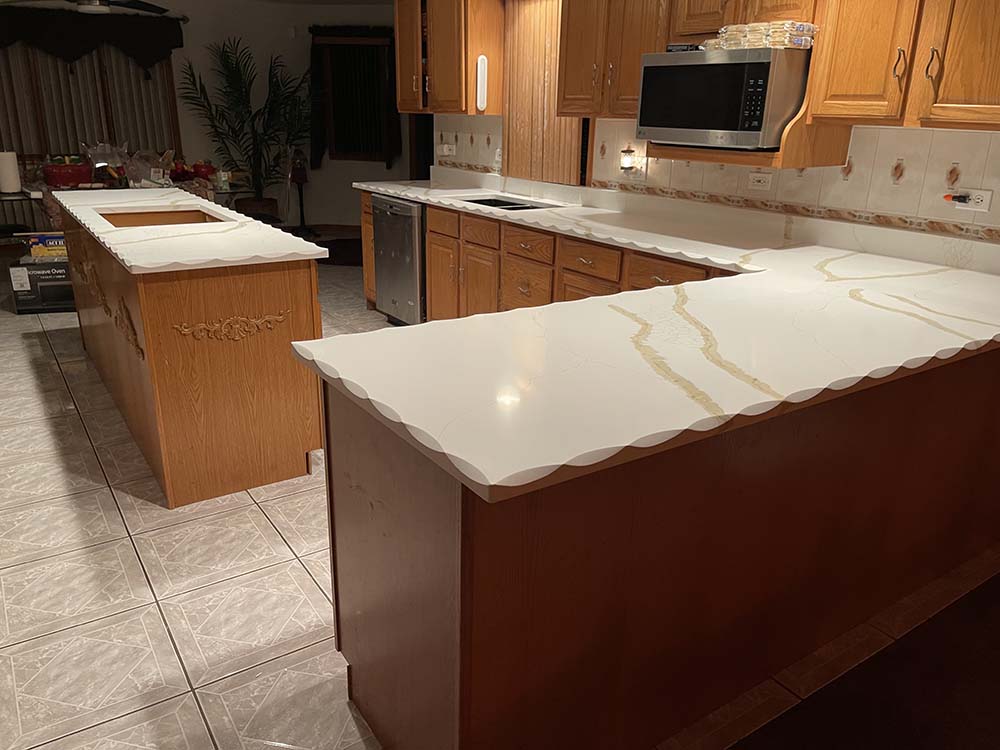
Visit Our Crestwood Showroom
Ready to Upgrade Your Kitchen?Ready to Upgrade Your Kitchen?Ready to Upgrade Your Kitchen?
- 4711 W 135th St Crestwood IL 60418
- Mon – Sat: 9:00 am – 6:00 pm

Get Your Free Kitchen Countertop Estimate
Fill out the form and our team will get back to you in next 24 hours.