
Complete Countertop Cost Guide
Written by Al Jory Marble Team
Updated September 7, 2026
This Countertop Cost Guide helps Chicagoland homeowners understand what they are actually paying for when purchasing new countertops. The slab matters, but so do the measurements, fabrication, sink and cooktop cutouts, edge work, seams, delivery, installation, old-counter removal and details of the room itself.
That is why two homeowners can choose similar-looking countertops and receive very different estimates.
If you are planning new kitchen countertops, replacing an existing surface or comparing quartz with natural stone, understanding the quote before choosing the slab can prevent expensive surprises later.
Quick answer: countertop pricing is determined by much more than square footage. The biggest factors usually include:
- Material and exact slab selected
- Total usable square footage
- Number of slabs required
- Slab thickness
- Layout and seam planning
- Edge profile
- Sink and cooktop cutouts
- Waterfall panels
- Full-height backsplash
- Existing countertop removal
- Fabrication complexity
- Delivery and access
- Installation requirements
The smartest way to budget is to compare the complete installed project, not an advertised square-foot price by itself.
Countertop Cost Guide: What Does a Countertop Really Cost in 2026?
Homeowners searching online will find dramatically different countertop prices.
One company may advertise $50 per square foot. Another may quote $100 or more. A premium natural stone project may go considerably higher.
The problem is that those numbers may not describe the same thing.
An advertised price might refer only to the slab material, while another company may be including fabrication and installation.
Before comparing prices, find out whether the number includes:
- Material
- Measurement or templating
- Fabrication
- Standard edge
- Sink cutout
- Cooktop cutout
- Delivery
- Installation
- Seaming
- Tear-out
- Disposal
If one quote includes all of those items and another includes only material and basic fabrication, comparing the bottom-line square-foot number is misleading.
Broad Chicagoland planning ranges
For 2026 budgeting, homeowners may encounter broad installed-market ranges approximately like these:
Quartz: roughly $60–$150+ per square foot
Granite: roughly $55–$175+ per square foot
Quartzite: roughly $80–$200+ per square foot
Marble: roughly $75–$200+ per square foot
These are planning ranges, not an Al Jory Marble price quote.
An exact price requires the actual material, layout and project scope. A straightforward kitchen using an accessible slab is different from a large island requiring premium stone, multiple slabs, mitered edges, a waterfall and a full-height backsplash.
That is why a written project estimate is considerably more useful than an internet average.
Why Price Per Square Foot Can Be Misleading
Square footage matters, but stone countertops are not sold and fabricated like carpet.
Imagine a kitchen needs 42 square feet of finished countertop.
That does not necessarily mean the project consumes exactly 42 square feet of slab.
The fabricator has to determine how the pieces fit within the usable slab while accounting for:
- Slab dimensions
- Vein direction
- Sink and cooktop placement
- Seams
- Natural defects or unusable areas
- Island dimensions
- Backsplash pieces
- Waterfall panels
- Pattern matching
A highly directional quartzite may require a different slab layout than a quiet quartz pattern.
Sometimes additional material is needed not because the kitchen is dramatically larger, but because the design requires specific areas of the slabs to align.
This is why the number of slabs can matter almost as much as finished countertop square footage.
Countertop Cost Guide: Quartz, Granite, Quartzite and Marble
Material selection is usually one of the first major pricing decisions.
The right choice should not be based only on which one costs less. Consider maintenance, heat resistance, durability, appearance and how the kitchen will actually be used.
If you are still choosing the material itself, start with our Kitchen Countertop Buying Guide and then use this page to understand how the decision affects your budget.
Quartz Countertop Cost
Quartz countertops are engineered surfaces available in a wide range of price levels.
Several things can move quartz pricing:
- Manufacturer
- Collection
- Pattern
- Veining complexity
- Finish
- Slab thickness
- Slab dimensions
- Number of slabs required
A relatively simple quartz pattern may cost considerably less than a premium Calacatta-inspired surface with large, dramatic veining.
Quartz can also simplify long-term maintenance because it is nonporous and generally does not require sealing.
That does not mean every quartz slab is inexpensive.
Some premium quartz designs can cost more than entry-level natural stone.
Granite Countertop Cost
Granite countertops vary significantly because granite is natural stone.
A common, readily available slab may be relatively economical.
Rare colors, dramatic movement or specialty stone can move into much higher pricing levels.
Granite pricing can be influenced by:
- Stone rarity
- Quarry and origin
- Slab size
- Color
- Pattern
- Availability
- Thickness
- Fabrication complexity
Granite can offer excellent value for homeowners who want genuine natural stone and strong heat resistance.
But there is no universal “granite price.”
The exact slab matters.
Quartzite Countertop Cost
Quartzite countertops generally sit toward the premium end of the market.
There are two reasons.
First, desirable quartzite slabs themselves can be expensive.
Second, quartzite is extremely hard, which can make fabrication more demanding.
Large islands, dramatic veining and multi-slab layouts can also require additional planning and shop time.
Quartzite may be worth the higher investment for homeowners who want:
- Genuine natural stone
- Excellent heat tolerance
- Strong durability
- Dramatic movement
- A premium statement island
- Marble-like appearance without marble’s softness
For many luxury kitchens, the countertop is not merely a surface. It becomes one of the main visual features of the room.
Marble Countertop Cost
Marble countertops can vary enormously depending on the stone.
Carrara and premium Calacatta marble are not priced the same.
Neither are two different Calacatta slabs simply because they share the same general name.
Factors include:
- Marble variety
- Quarry
- Availability
- Slab quality
- Veining
- Slab dimensions
- Thickness
- Fabrication requirements
Marble is also softer than granite or quartzite, so fabrication and handling require care.
If you are specifically considering a bright white surface with bold movement, compare the actual Calacatta countertop options rather than assuming every Calacatta-look product is the same material.
Some are quartz.
Some are marble.
Some are quartzite.
The name alone does not tell you the price or performance.
For additional material comparisons, see Quartz vs. Granite vs. Quartzite.
The Slab You Choose Can Change the Entire Quote
This is one of the most important pricing lessons in this Countertop Cost Guide.
Two slabs of the same general material can cost very different amounts.
Natural stone varies by quarry, rarity, visual character and availability. Manufactured quartz varies by brand and collection.
The slab also affects fabrication yield.
Suppose a natural quartzite has one spectacular section that you want centered on the island. Using that exact area may leave less usable material for the perimeter countertops.
The result could be an additional slab.
That is not necessarily wasted money.
It may be the difference between a generic layout and a kitchen where the stone looks intentionally designed.
This is why viewing full slabs instead of relying entirely on small samples can help both the design and the budget.
Slab Thickness Can Affect Countertop Pricing
Thickness influences appearance, weight, fabrication and sometimes material price.
A substantial countertop edge can also be created using a mitered construction rather than an unusually thick solid slab.
Homeowners interested in an extra-thick island should ask how the appearance will be achieved.
A thicker-looking edge may involve:
- Additional fabrication
- Miter cuts
- Edge assembly
- Pattern alignment
- More shop labor
The thicker look can be beautiful, but it should be planned in the estimate from the beginning.
Countertop Fabrication Is Part of the Price
The slab does not arrive at your home ready to sit on the cabinets.
It has to become a countertop.
Professional countertop fabrication can include:
- Templating
- Digital layout
- Cutting
- Edge profiling
- Polishing
- Sink cutouts
- Cooktop openings
- Faucet holes
- Seam preparation
- Vein matching
- Waterfall fabrication
- Final finishing
This is why a low material price does not necessarily mean a low finished-project price.
A complex project using moderately priced stone may require more fabrication than a straightforward kitchen using more expensive material.
Why in-house fabrication matters when comparing quotes
Ask who actually cuts the slab.
If the showroom sells the material but sends fabrication somewhere else, several companies may become involved in the same project.
Al Jory Marble’s fabrication process is handled from its Crestwood operation, which allows material selection, templating, fabrication and installation to remain connected.
From a budgeting standpoint, that means the company looking at the actual layout is also the company planning how the slab gets cut.
Edge Profiles Can Raise or Lower the Cost
The edge is one of the easiest places to control fabrication cost.
Simple profiles generally require less fabrication.
More detailed edges require more shop time.
Common choices include:
- Eased edge
- Beveled edge
- Bullnose
- Ogee
- Mitered edge
A simple edge is not inferior.
In many contemporary kitchens, an eased edge is actually the cleanest design choice.
If you are trying to control the budget, this is one place where keeping the design simple can save money without making the finished countertop look inexpensive.
Sink and Cooktop Cutouts Affect Fabrication Cost
Every opening requires accurate fabrication.
An undermount sink opening, for example, needs a finished and polished exposed edge because that edge will remain visible after installation.
Your project may require openings for:
- Kitchen sink
- Prep sink
- Cooktop
- Faucet
- Soap dispenser
- Filtered-water faucet
- Air switch
Changing the sink after templating or fabrication has begun can create delays and additional cost.
Choose the sink and major fixtures early.
It is one of the simplest ways to keep the project on budget.
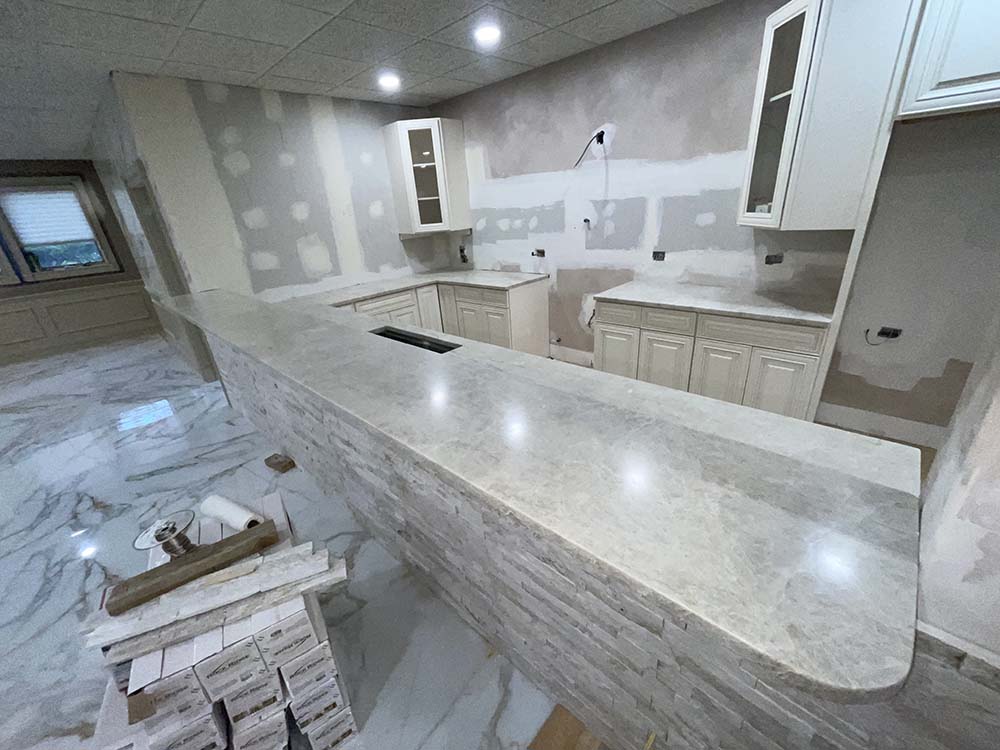
Kitchen Islands Can Change Countertop Cost Quickly
A large island can account for a substantial portion of a countertop budget.
The cost is affected by much more than the island’s square footage.
Consider:
- Can it be cut from one slab?
- Does it require a seam?
- Will the pattern be centered?
- Is there a sink?
- Is there a cooktop?
- How large is the overhang?
- Does the overhang need support?
- Are waterfall ends included?
- Is a thick mitered edge planned?
A simple island is very different from a large quartzite island with a mitered perimeter and two waterfall panels.
Both are “one island.”
They are not remotely the same fabrication project.
Waterfall Countertops Cost More for a Reason
A waterfall design extends the countertop material vertically down one or both sides of the island.
That adds material.
It also adds fabrication.
For highly veined stone, the fabricator may try to create visual continuity between the horizontal countertop and vertical panel.
That requires thoughtful slab placement and precise mitering.
Waterfalls can be worth the investment when the island is intended to be a major design feature.
But if the goal is to reduce countertop cost, eliminating one or both waterfall panels is one of the easiest ways to simplify the project.
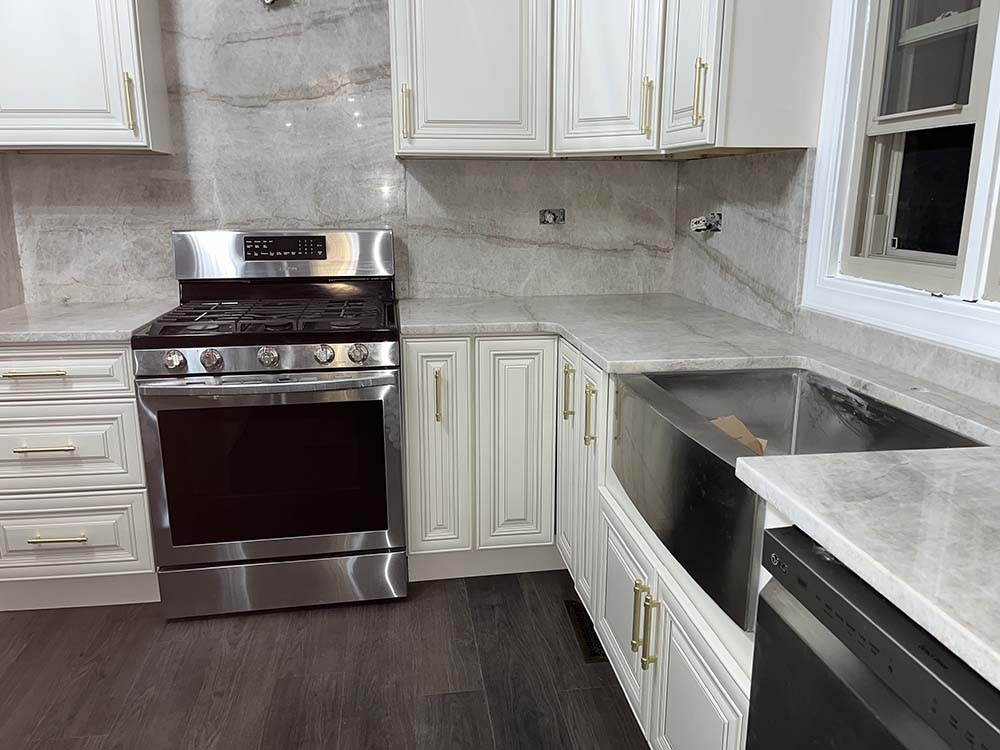
Full-Height Stone Backsplashes Change Material Requirements
A traditional backsplash may use tile or a short stone strip.
A full-height slab backsplash extends countertop material up the wall.
This can create a beautiful continuous appearance, particularly with quartz, quartzite or dramatically veined marble.
It can also add:
- Slab material
- Outlet cutouts
- Fabrication
- Vein matching
- Installation labor
If you want a full-height backsplash, mention it before choosing how many slabs to purchase.
Adding it after the slab layout has been planned may change the material requirements completely.
Countertop Cost Guide: Replacement Costs vs. New Construction
Replacing existing countertops involves different work from installing stone on new cabinets.
With countertop replacement, the project may include:
- Disconnect coordination
- Existing countertop removal
- Tear-out
- Disposal
- Cabinet inspection
- Surface preparation
- New templating
- New fabrication
- Installation
Keeping good existing cabinets can still make countertop replacement considerably less disruptive than a complete kitchen renovation.
But the old countertops do not remove themselves.
Make sure tear-out and disposal are clearly addressed in the estimate.
If a competitor’s quote is much lower, ask whether removal is included.
Installation Is Another Part of the Finished Cost
Professional countertop installation includes more than carrying stone into the room.
The installation team needs to:
- Protect the route into the home
- Move heavy fabricated pieces safely
- Position the countertops
- Level and secure them
- Join seams
- Complete final adjustments
- Inspect the work
- Clean the installation area
A typical residential installation may be completed relatively quickly once the fabrication is finished, but the complete countertop project includes everything leading up to that day.
If scheduling matters to your remodel, read the countertop installation timeline before coordinating cabinets, plumbing and backsplash work.
Chicago Condos and Difficult Access Can Affect the Quote
A suburban home with a driveway and an open path to the kitchen is different from a 30th-floor condominium.
Chicago projects may involve:
- Freight elevators
- Elevator reservations
- Loading docks
- Certificates of insurance
- Restricted work hours
- Parking limitations
- Narrow hallways
- Staircases
- Building protection requirements
Large stone pieces also have to physically fit through the path to the kitchen.
If access requires the countertop to be fabricated in additional pieces, that can influence both labor and seam planning.
Homeowners in multi-story buildings should review the Chicago condo countertop replacement guide before installation.
Good access planning is cheaper than discovering an access problem after the slab has already been cut.
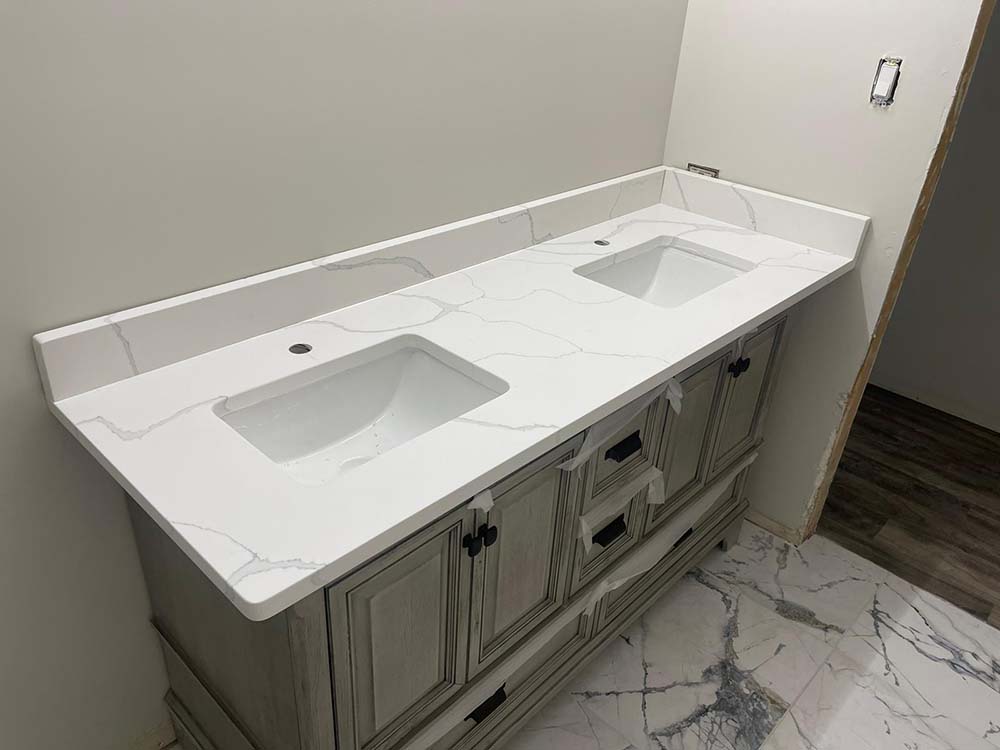
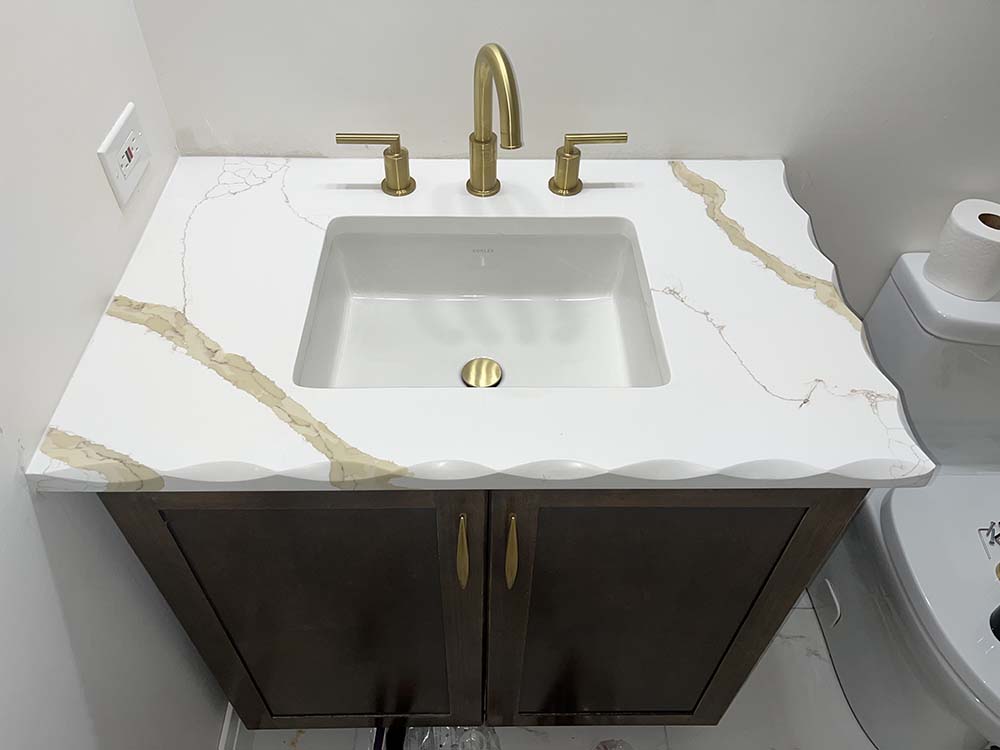
Bathroom Countertop Costs Work Differently
A bathroom vanity may use very little material compared with a kitchen.
That can create an opportunity.
For smaller bathroom vanity tops, a remnant may provide enough stone for the entire project.
This is where countertop remnants can make sense.
But remember:
A remnant can reduce the material cost. It does not eliminate fabrication.
The piece still needs to be measured, cut, edged, polished, fabricated around the sink and installed.
That distinction matters when comparing a remnant quote with a full-slab project.
Commercial Countertop Pricing Has Different Variables
Commercial countertops may involve larger quantities, repeated layouts and more demanding schedules.
Restaurants, offices and retail spaces may require:
- Larger surfaces
- Repeated pieces
- Durable materials
- Service-counter openings
- Specialty shapes
- Off-hour installation
- Coordinating with other trades
A restaurant countertop also has different performance requirements from a decorative bathroom vanity.
Commercial buyers should compare lifecycle, maintenance and installation scheduling—not simply slab price.
How to Save Money Without Making the Countertop Look Cheap
Saving money does not have to mean buying the lowest-quality material.
Some of the best savings come from simplifying decisions that do not materially improve the finished room.
Choose the slab before designing expensive details
Know what the material costs before adding waterfalls, full backsplashes and specialty edges.
Consider a standard edge
A clean eased edge can look excellent and usually requires less fabrication than elaborate profiles.
Use dramatic stone strategically
If a premium slab is important, consider making the island the focal point and using a quieter material elsewhere when the design supports it.
Avoid unnecessary seams and complexity
A straightforward layout is generally easier to fabricate.
Use remnants for smaller surfaces
Bathroom vanities, laundry rooms and small bars may not require a new full slab.
Finalize the sink early
Last-minute fixture changes can create unnecessary fabrication problems.
Avoid changing the layout after templating
Moving a sink, changing an overhang or altering cabinets after measurements are complete may require new measurements or fabrication adjustments.
Compare scope, not just price
A complete quote that looks slightly higher may actually cost less than a low teaser price followed by multiple add-ons.
Countertop Cost Guide: How to Compare Two Quotes Correctly
This may be the most valuable thing you can do before hiring a fabricator.
Place both estimates side by side.
Then check whether each includes the same scope.
Look for:
- Exact material or slab
- Number of slabs
- Square footage
- Slab thickness
- Template or measurement
- Fabrication
- Included edge profile
- Sink cutout
- Cooktop cutout
- Faucet holes
- Seam work
- Backsplash
- Waterfall panels
- Tear-out
- Disposal
- Delivery
- Installation
- Access charges
- Taxes
- Any exclusions
If one quote simply says “countertops installed — $X,” ask for clarification.
A written estimate should help you understand what is driving the number.
The goal is not to find the company willing to write the smallest number at the bottom of a page.
The goal is to know what you are buying.
Red Flags in a Countertop Estimate
A low estimate is not automatically a problem.
A vague estimate is.
Be cautious when:
- The exact material is unclear
- It is unclear whether the price is material-only
- Fabrication is not explained
- Installation is not listed
- No one has discussed the sink
- Tear-out is assumed but not documented
- Edge upgrades are not priced
- Waterfalls or backsplash are not included
- No one has asked about building access
- The company cannot explain who measures, fabricates and installs
- The written estimate does not match what was discussed verbally
Countertops are fabricated specifically for your room.
Clarity before cutting protects both the homeowner and the fabricator.
Is the Cheapest Countertop Quote Usually the Best Deal?
Not necessarily.
Suppose one company quotes a project for less but excludes old-top removal, a sink cutout, an upgraded edge and delivery.
Another quote includes all four.
The first estimate may look better until those items are added later.
That does not mean the more expensive contractor is automatically better, either.
It means you need an apples-to-apples comparison.
Look at workmanship as well as price.
Review completed projects in the countertop gallery and read actual customer reviews before deciding who will cut and install the slab.
For a high-value material, fabrication quality can matter more than saving a small percentage upfront.
Is a More Expensive Countertop Always Better?
No.
Price and suitability are different things.
A busy family that wants almost no maintenance may be happier with quartz than marble.
A serious home cook may appreciate granite or quartzite for heat resistance.
Someone who genuinely loves the way marble ages may happily choose marble despite its higher maintenance.
The best value comes from choosing the material that matches the household.
If you are not sure which surface fits your lifestyle, return to the Kitchen Countertop Buying Guide before deciding based on price alone.
How Much Should You Budget for Unexpected Changes?
A countertop project should begin with a clear estimate, but remodeling sometimes uncovers conditions that cannot be seen until existing materials are removed.
Examples can include:
- Cabinets that are not level
- Damaged cabinet boxes
- Unexpected wall conditions
- Plumbing changes
- Sink compatibility issues
- Access problems
- Last-minute design changes
The best way to avoid unnecessary additional cost is to finalize the layout early and make sure the fabricator sees the actual space.
If the project involves replacement, discuss existing conditions before demolition.
Countertop Cost Guide FAQs
How much do countertops cost in Chicagoland?
The final price depends on material, square footage, slab quantity, fabrication, edge profile, cutouts, backsplash, tear-out and installation. Broad installed-market ranges can start around the mid-$50s per square foot for some materials and exceed $200 per square foot for premium natural stone or complex projects. A project-specific written estimate is more accurate than an online average.
What is usually the most affordable stone countertop?
Common granite and some standard quartz selections can offer relatively accessible pricing, while premium quartzite and rare marble generally cost more. The exact slab matters more than the material category alone.
Is quartz cheaper than granite?
Sometimes, but not always. Standard quartz and granite can overlap significantly in price. Premium designer quartz may cost more than an entry-level granite, while rare granite can exceed many quartz options.
Why does quartzite cost more?
Quartzite can carry a higher slab price and is extremely hard, which can make cutting and fabrication more demanding. Rare colors and dramatic natural movement can raise the price further.
Why is marble expensive?
Marble cost depends heavily on the variety and individual slab. Common Carrara and premium Calacatta marble can occupy very different price levels. Fabrication also requires careful handling because marble is softer than granite or quartzite.
How much does countertop installation add?
Installation cost depends on piece size, number of seams, access, layout and project complexity. When comparing estimates, determine whether installation is already included in the quoted square-foot price.
Do sink cutouts cost extra?
They can. Undermount sinks require accurately cut and polished openings, while cooktops and additional fixtures create other fabrication work. Ask whether the quote includes each cutout rather than assuming it does.
Does a waterfall island cost more?
Yes. A waterfall requires additional material and fabrication. Matching movement across a mitered edge can also require careful slab layout.
Is a full-height backsplash expensive?
It costs more than using the countertop only on horizontal surfaces because it requires additional slab material, fabrication, outlet cutouts and installation.
Are countertop remnants cheaper?
They can reduce the material portion of a small project because you are using an existing piece rather than purchasing a full slab. Fabrication, sink cutouts, edges and installation still require labor.
Can I save money by keeping my existing cabinets?
Often, yes. If your cabinets are structurally sound and level, replacing the countertops without replacing the entire cabinet system can significantly reduce the scope of a kitchen renovation.
Should I buy the countertop from one company and have someone else fabricate it?
That can work, but understand who becomes responsible at each stage. Working with one company for measurement, fabrication and installation can simplify communication when questions about slab layout, seams or fit arise.
How can I get the most accurate countertop estimate?
Have the space measured, identify the material you are considering, select the sink and explain any special features such as waterfalls, full-height backsplash or existing countertop removal. The more complete the scope, the more useful the estimate becomes.
Use This Countertop Cost Guide Before You Approve a Quote
The biggest lesson from this Countertop Cost Guide is that countertop pricing cannot be understood from one square-foot number.
Ask what the number includes.
Understand the material. Look at the full slab. Know whether the project needs one slab or two. Decide on the sink, edge, backsplash and island details. Ask about removal and installation. Discuss access before fabrication.
Then compare written estimates based on the same scope.
That process gives you a much clearer picture of value than choosing whichever advertisement shows the lowest number.
Get a Written Countertop Estimate for Your Actual Project
Every kitchen, bathroom and commercial countertop project has its own combination of material, dimensions and fabrication requirements.
Al Jory Marble helps Chicagoland homeowners compare quartz, granite, quartzite and marble before the material is fabricated.
You can also learn more about Al Jory Marble’s fabrication and installation approach or visit the Crestwood showroom to compare full slabs in person.
Ready for an actual number instead of an internet estimate?
Request a free countertop estimate or call (708) 362-7674.
Al Jory Marble Granite Quartz INC
4711 135th St
Crestwood, IL 60418
Phone: (708) 362-7674
Hours: Monday–Saturday, 9:00 a.m.–6:00 p.m.

Serving Chicago & Surrounding Areas
Get Your Free Kitchen Countertop Estimate
Fill out the form and our team will get back to you in next 24 hours.