
Written by Sam Ali
Published: September 26, 2026
Read Time: 12 minutes
Countertop Vein Matching Chicago Homeowners Should Plan Before the Slab Is Cut
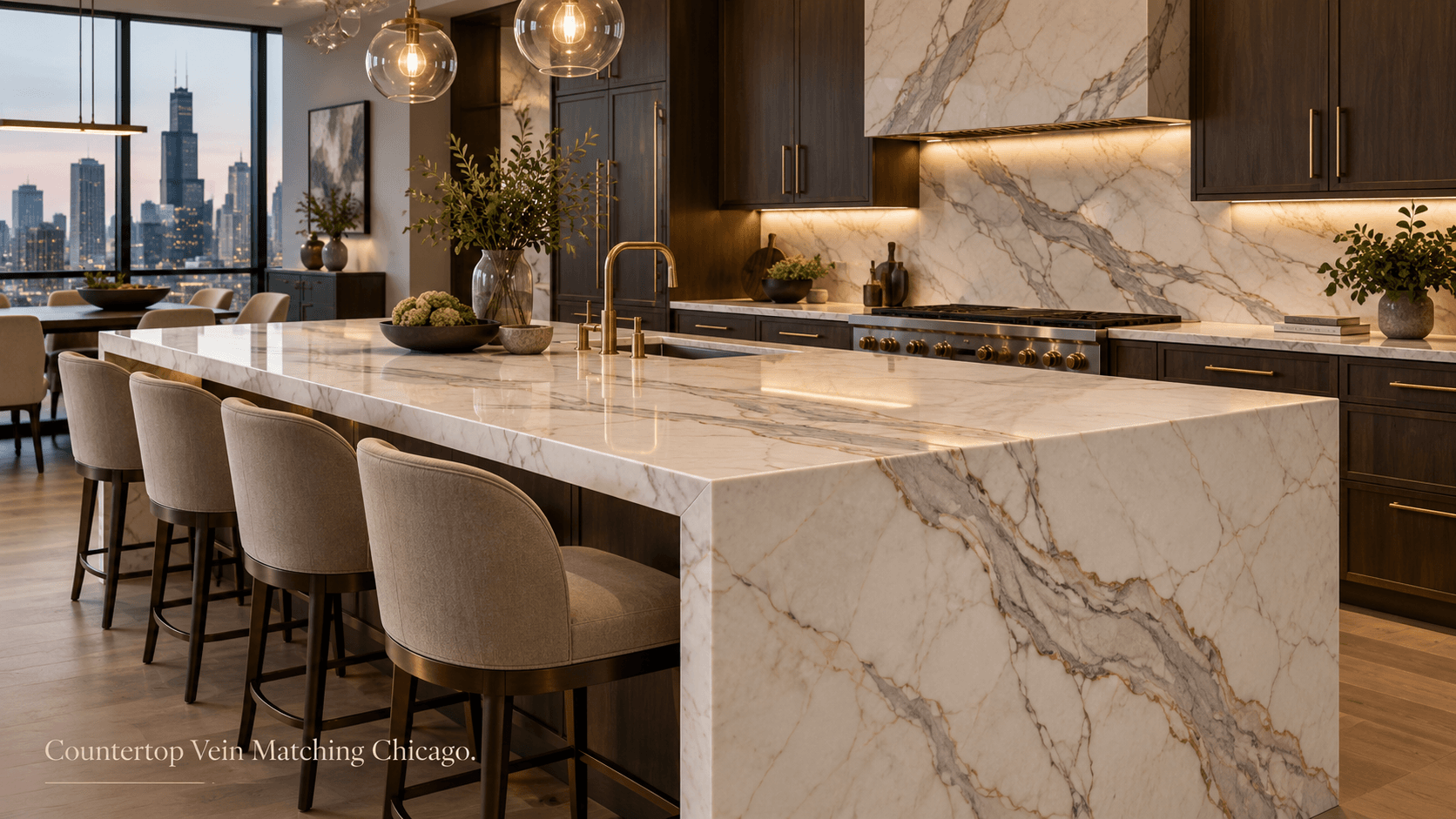
Countertop vein matching Chicago homeowners see in high-end kitchens does not happen automatically. When marble, quartzite or strongly patterned quartz needs more than one countertop piece, the slab must be laid out so major veins and movement meet in a visually intentional way.
That planning becomes especially important around large islands, visible seams, waterfall ends and full-height backsplashes. A beautiful slab can still look disconnected if each piece is cut without considering what will sit beside it.
Quick answer: Countertop vein matching is the process of positioning countertop pieces so visible veins and patterns continue naturally across seams or transitions. Bookmatching is different: it uses sequential slab faces to create a mirrored pattern. Both decisions need to be made before fabrication because they influence slab layout, seam placement, material use and sometimes the number of slabs required.
For a deeper explanation of the fabrication process, Al Jory’s guide to bookmatching and vein matching shows how these decisions fit into slab selection, templating and cutting. The site specifically distinguishes vein matching from bookmatching and notes that both should be planned before fabrication.
Call (708) 362-7674 or request a free countertop estimate if you are considering a strongly veined countertop and want to discuss slab layout before cutting.
What Does Countertop Vein Matching Actually Mean?
Imagine a quartzite slab with one broad gray vein running diagonally across the surface.
Your kitchen requires two countertop pieces separated by a seam.
If those pieces are cut only to maximize slab yield, the vein on the first section may end abruptly at the seam while an unrelated part of the pattern begins on the other side.
The countertop can fit perfectly and still look visually disconnected.
With vein matching, the fabricator considers where each piece comes from on the slab so the pattern on one side of the seam relates naturally to the pattern on the other.
It does not always create a perfectly uninterrupted line.
Natural stone has its own movement.
The goal is to make the transition look intentional.
What Is the Difference Between Vein Matching and Bookmatching?
The terms sound similar, but they create very different results.
Vein Matching
Vein matching tries to continue the natural movement from one countertop section into another.
It is commonly considered around:
- Countertop seams
- Large islands
- Perimeter runs
- Waterfall edges
- Slab backsplashes
The finished design feels continuous rather than mirrored.
Bookmatching
Bookmatching uses consecutive slab faces positioned like an open book.
Instead of continuing in the same direction, the veins mirror one another.
This can create an almost symmetrical pattern.
Bookmatching is particularly dramatic on large uninterrupted surfaces such as a feature backsplash or statement island.
Al Jory’s existing slab-planning guide explains both techniques and notes that true bookmatching requires compatible sequential slabs.
Not Every Countertop Needs Vein Matching
A quiet granite or lightly patterned quartz may not need extensive pattern planning.
The benefit becomes much greater when the material has strong directional movement.
Consider vein matching when you are choosing:
- Calacatta-style quartz
- Calacatta marble
- Strongly veined quartzite
- Dramatic marble
- Large-format patterned quartz
- Stone for a waterfall island
- Stone continuing into a backsplash
The more your eye naturally follows the pattern, the more noticeable an abrupt transition can become.
Countertop Vein Matching Chicago Projects Should Start With the Full Slab
Small samples are useful for checking general color.
They are poor tools for planning vein movement.
A four-inch sample cannot show what happens across an eight- or ten-foot island.
Full slabs reveal:
- Major veins
- Quiet areas
- Color shifts
- Mineral movement
- Natural markings
- Pattern direction
- Areas suited to focal pieces
This is particularly important with natural stone because each slab is unique.
Al Jory’s kitchen-countertop page encourages homeowners to view full slabs and specifically notes that multi-slab projects can be sequenced so veining flows across islands and perimeter surfaces.
Decide Which Part of the Kitchen Deserves the Best Section
A slab has limited real estate.
If your kitchen needs an island, perimeter countertops and a backsplash, every piece competes for material.
Before cutting, decide what matters most visually.
For some homeowners, it is the island.
For others, it is the wall behind the range.
Another homeowner may care most about a waterfall edge visible from the adjoining family room.
The strongest portion of the slab should be reserved for the part of the room where it creates the greatest impact.
This is design through fabrication.
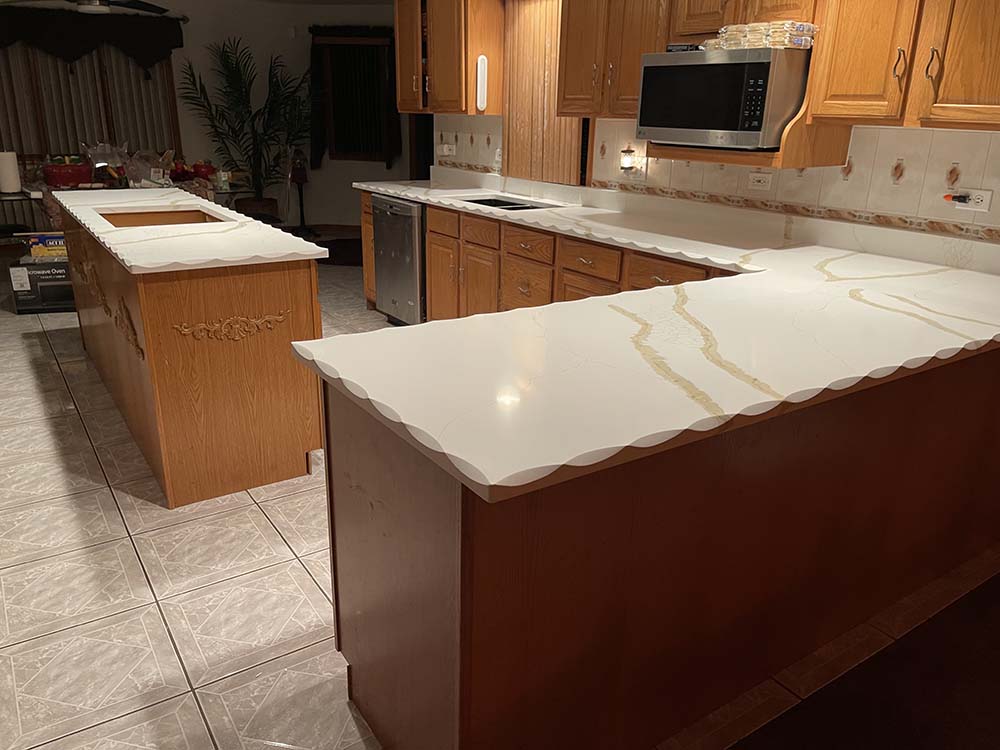
Large Kitchen Islands Make Vein Direction More Important
A large island provides an uninterrupted area where stone movement becomes extremely visible.
That means vein direction can change the entire feel of the room.
A sweeping pattern may run:
- Lengthwise through the island
- Diagonally across it
- Toward the main seating area
- Into a waterfall panel
- Away from a sink opening
There is rarely one universal right answer.
The best orientation depends on the actual slab and kitchen.
The Kitchen Island Countertop Guide covers slab dimensions, island seams, waterfall edges and pattern placement in greater depth.
Do Not Let the Sink Remove the Best Part of the Slab
This happens more easily than homeowners expect.
A dramatic area of stone looks perfect for the island.
Then the sink template is placed directly over the strongest vein.
Much of the feature disappears into the cutout.
That does not necessarily mean the sink needs to move.
It may mean the slab layout should shift slightly.
Before cutting, the fabricator should know the final:
- Sink model
- Sink location
- Faucet placement
- Cooktop dimensions
- Island dimensions
- Seating overhang
A few inches of layout adjustment can preserve an important part of the stone.
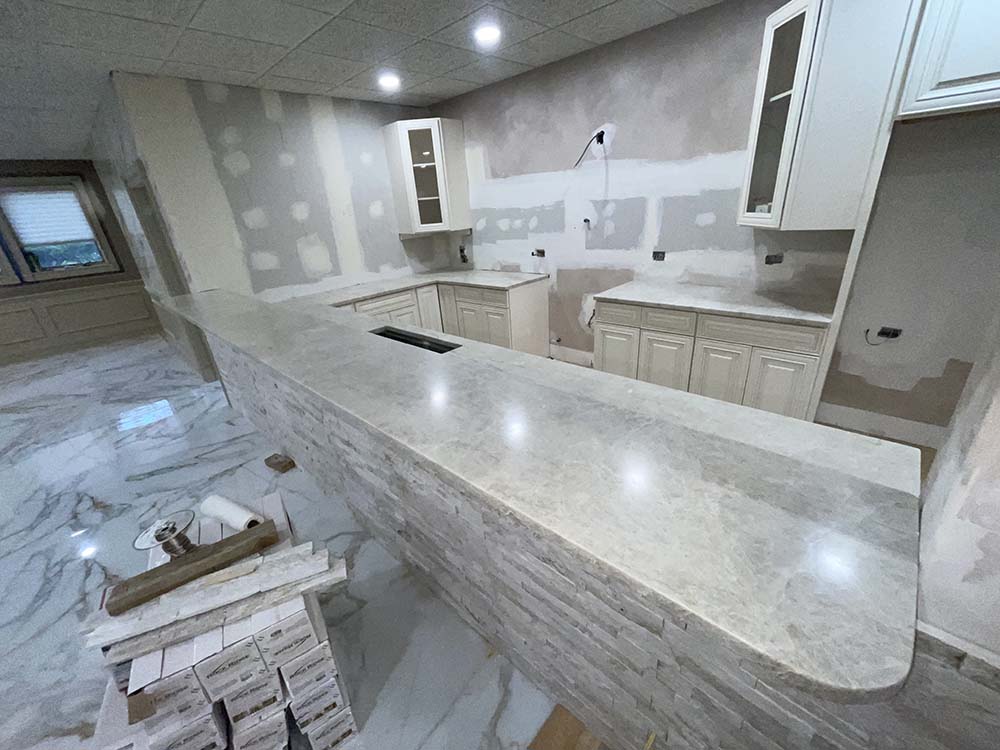
Seam Placement and Vein Matching Need to Be Planned Together
A seam is both a structural decision and a visual decision.
The pieces must be properly supported and practical to fabricate, transport and install.
But once acceptable seam locations are identified, the pattern should also be considered.
Al Jory has a separate countertop seam placement guide explaining where seams are normally positioned and why the joint itself should be tight, level and appropriately color matched. The same page also discusses bookmatching and pattern planning on higher-end work.
A well-made seam should not be treated as a failure.
Some kitchens simply require one.
The goal is to place and finish it intelligently.
Can Countertop Veins Match Perfectly Across Every Seam?
Not always.
And homeowners should be cautious of anyone promising that every natural-stone seam will disappear.
Stone does not repeat itself on command.
Each slab has:
- Fixed dimensions
- Existing vein direction
- Natural variation
- Usable and less desirable areas
- A limited amount of matching material
A fabricator can optimize the layout.
The stone still determines what is physically possible.
A believable continuation usually looks better than forcing an unnatural attempt at perfect symmetry.
Waterfall Islands Need Their Own Vein Plan
A waterfall countertop continues vertically from the island top down toward the floor.
With quiet stone, the transition may be mostly about creating a clean miter.
With dramatic stone, the pattern becomes the main event.
The horizontal countertop and vertical waterfall panel should be planned together so the vein appears to travel over the edge rather than restart randomly.
That usually means reserving adjacent material for the two pieces.
It also means deciding on the waterfall before fabrication.
Adding one after the slab has already been divided may leave no suitable material.
Mitered Edges Make Pattern Alignment More Visible
A mitered edge can create the appearance of a much thicker countertop.
It is particularly popular on statement islands.
But the face piece becomes another visible surface that interacts with the pattern.
If the material is strongly veined, the fabricator needs to consider how the top transitions onto that vertical edge.
The countertop edge profiles guide explains how mitered edges differ from eased, beveled, bullnose and ogee profiles and why edge selection should happen before fabrication begins.
Full-Height Backsplashes Can Continue the Stone Vertically
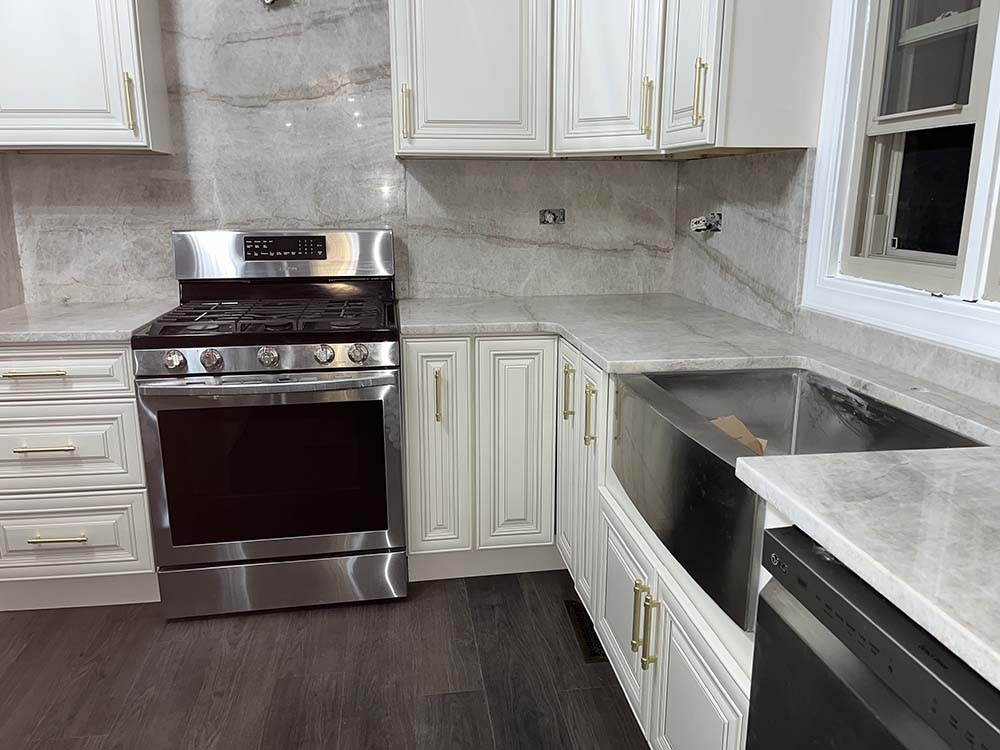
Vein planning becomes even more interesting when the countertop material continues onto the wall.
A full-height stone backsplash may allow a prominent vein to appear to rise from the counter behind the range.
That effect can be beautiful.
But it consumes valuable slab area.
The backsplash cannot simply receive whatever material remains after the counters are cut if visual continuity is important.
Al Jory’s full-height stone backsplash guide explains why backsplash pieces should be considered during initial slab layout rather than at the end of fabrication.
Calacatta Designs Deserve Extra Layout Attention
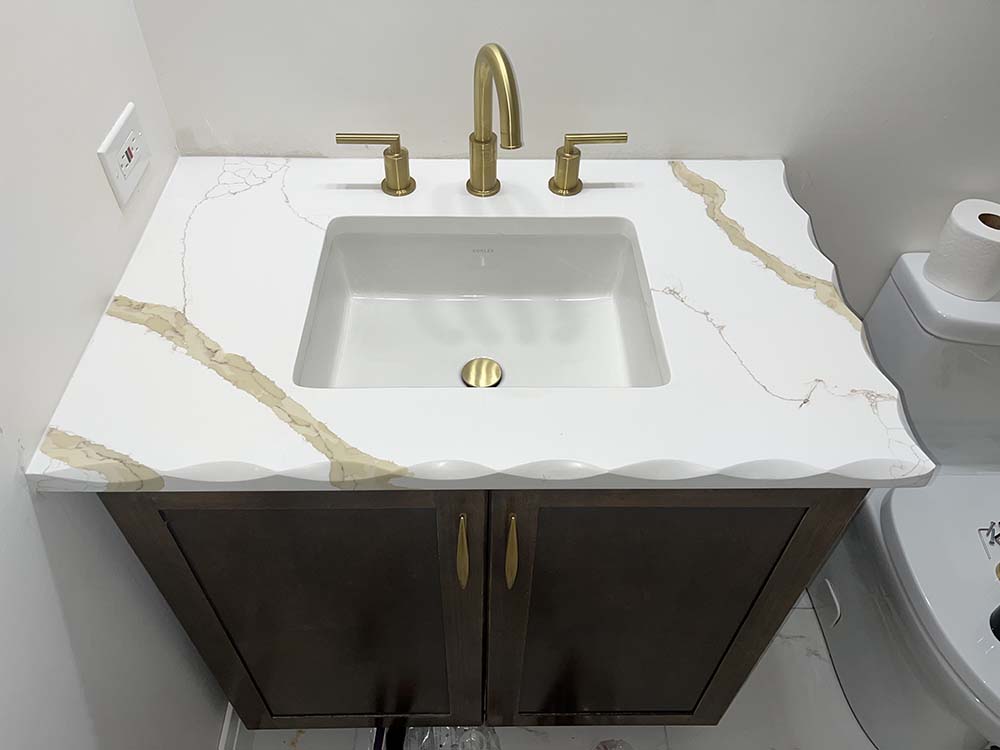
Calacatta-style surfaces are chosen largely because of their distinctive movement.
That makes random placement particularly noticeable.
Whether you are choosing natural marble or engineered Calacatta quartz, think about where the boldest portions will appear.
Al Jory’s Calacatta countertops page specifically explains that its layouts are planned so veining can flow through islands, perimeter surfaces and full-height backsplashes rather than stopping abruptly.
Ask before fabrication:
Where will the strongest vein appear?
What portion becomes the island?
Where is the seam?
What happens at the backsplash?
Will there be a waterfall?
Those decisions determine whether the expensive material actually produces the look that made you choose it.
Quartz and Natural Stone Need Different Expectations
Vein matching is not limited to natural stone.
Modern quartz can have large directional patterns that also need careful orientation.
But quartz is manufactured.
Natural marble and quartzite formed geologically.
That distinction changes what can reasonably be expected.
Patterned Quartz
Quartz may offer more consistency between slabs, although individual patterns can still repeat or shift.
The layout should avoid making repeated design elements look awkward or obviously manufactured.
Marble and Quartzite
Natural stone has genuine variation.
That can create spectacular visual movement, but exact repetition is impossible.
The fabricator is composing the finished kitchen from naturally unique material.
That individuality is part of the appeal.
Countertop Vein Matching Chicago Can Affect Slab Quantity
The most material-efficient layout is not always the most visually attractive layout.
Imagine that your countertops technically fit on two slabs if every piece is nested tightly.
But the island waterfall requires matching adjacent material.
Or a full-height backsplash needs a specific portion of the second slab.
The better visual layout may require more material.
Al Jory’s current countertop cost guide lists bookmatching and vein matching among the factors that can increase slab use and layout time.
That does not mean vein matching always requires another slab.
It means the desired pattern should be discussed before the final material requirement is determined.
How Much Extra Stone Is Worth It?
That is a design and budget decision.
If you are installing relatively quiet material in a secondary kitchen, using another entire slab purely for vein continuity may not make sense.
If you selected an expensive quartzite specifically because of one sweeping vein, sacrificing that design to save material may defeat the reason you bought the stone.
Ask the fabricator to show you the tradeoff.
Sometimes the choice becomes obvious once you see both layouts.
Ask to Review the Layout Before Major Cuts
Homeowners do not need to operate fabrication equipment.
But on a heavily patterned project, it is reasonable to understand where the major pieces will come from.
Before cutting, discuss:
- Island location on the slab
- Vein direction
- Major seam transitions
- Waterfall pieces
- Backsplash pieces
- Large cutouts
- Any areas you especially like or dislike
Al Jory’s countertop fabrication services describe slab selection, digital templating, cutting and vein matching as parts of its in-house fabrication process in Crestwood.
Once those cuts are made, the composition is largely decided.
Why Digital Templating Comes Before Final Vein Layout
You cannot intelligently position kitchen pieces on a slab until you know their actual shapes.
That is why the finished kitchen is templated first.
Templates record the real:
- Wall dimensions
- Cabinet dimensions
- Corners
- Sink opening
- Cooktop opening
- Overhangs
- Unusual angles
Those shapes can then be positioned against the slab.
The vein-matching process works best when it is based on the kitchen that was actually built—not preliminary cabinet drawings.
In-House Fabrication Helps Reduce Handoffs
Pattern-sensitive projects benefit when the person planning the slab layout is working from the same project information used during templating and fabrication.
Al Jory Marble states that its countertops are templated, cut, finished and installed through its Crestwood operation rather than being passed through unrelated companies.
That matters when the homeowner has already identified a particular vein, waterfall transition or backsplash section that needs attention.
A visual decision made during slab selection has to survive all the way through fabrication.
What Should You Decide Before the Slab Is Cut?
For a strongly patterned countertop, confirm:
- Actual slab selection
- Island orientation
- Seam locations
- Vein direction
- Sink and cooktop positions
- Waterfall design
- Full-height backsplash
- Edge profile
- Bookmatching preference
- Which surface should receive the strongest pattern
- Whether additional slab material is acceptable for a better layout
The countertop quote guide is also useful before this stage because waterfalls, slab quantity, cutouts, backsplash choices and fabrication details can all change the scope of a written estimate.
When Vein Matching Matters Most
Countertop vein matching Chicago kitchens benefit from most when the stone itself is intended to be a feature.
It is especially worth discussing for:
Large open kitchens, oversized islands, waterfall designs, dramatic quartzite, Calacatta-style surfaces, full-height backsplashes and kitchens where the island is visible from adjoining living areas.
In these rooms, the countertop is not just a work surface.
It becomes part of the architecture.
When You May Not Need to Spend Extra for It
Not every project requires elaborate pattern coordination.
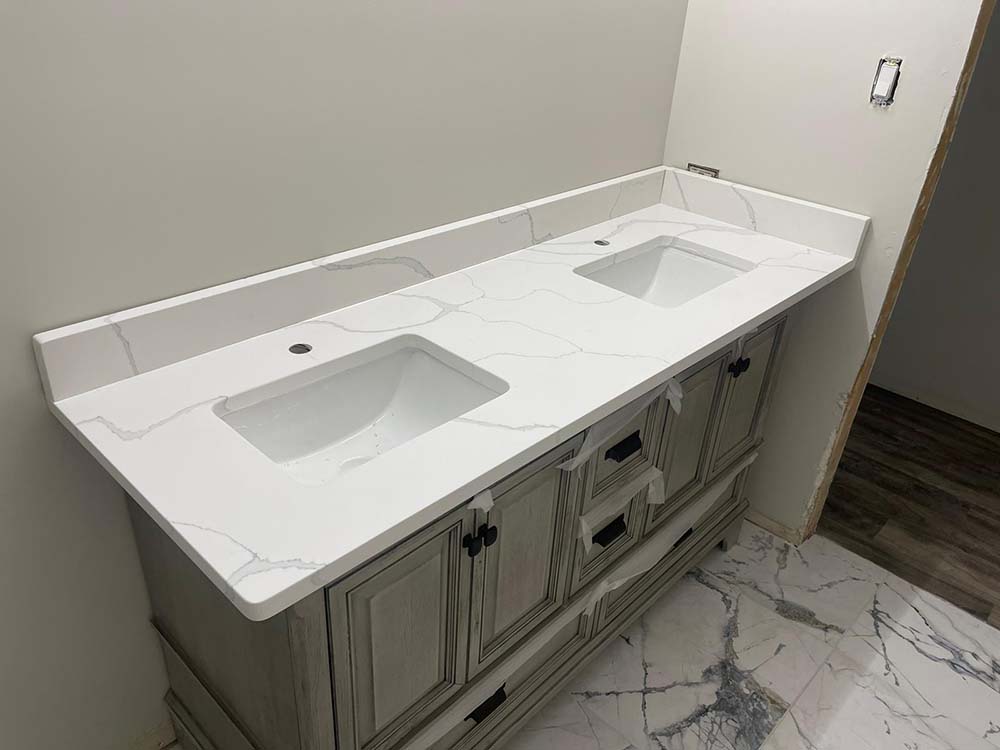
A laundry counter, small vanity or quiet solid quartz may gain very little from additional slab consumption purely for pattern matching.
Even in a kitchen, some patterns are intentionally random enough that trying to continue individual marks does not materially improve the appearance.
Spend the fabrication budget where it changes the finished result.
Countertop Vein Matching Chicago FAQs
What is countertop vein matching?
Countertop vein matching means arranging adjoining countertop pieces so the pattern flows naturally across seams and transitions rather than stopping abruptly.
Is vein matching the same as bookmatching?
No. Vein matching creates continuity. Bookmatching uses sequential slab faces to create a mirrored pattern.
Can quartz countertops be vein matched?
Yes. Strongly patterned quartz should still be laid out thoughtfully so veins and repeated elements relate naturally across adjacent pieces.
Can marble and quartzite veins match perfectly?
Sometimes individual veins can align very closely, but natural stone does not repeat itself perfectly. The goal is usually natural-looking continuity.
Does vein matching make countertops more expensive?
It can. Additional layout work, lower slab yield or an extra slab may increase cost on complex projects.
Can a waterfall island have continuous veining?
Often, yes. The top and vertical panel need to be planned together before cutting so the pattern can transition through the miter.
Can countertop veins continue into a backsplash?
Sometimes. The countertop and backsplash pieces need to be allocated together if continuity up the wall is part of the design.
Should I approve the slab layout before cutting?
For strongly veined or expensive statement stone, reviewing the major layout decisions before fabrication is a sensible step.
Plan the Pattern Before Fabrication
The color of a slab may be what first gets your attention.
The layout is what determines how that slab looks once it becomes a kitchen.
Thoughtful countertop vein matching Chicago homeowners can see across islands, seams, waterfalls and backsplashes requires the fabricator to treat the slab as a complete composition rather than a collection of rectangles.
If you are comparing Chicago kitchen countertops, look at the full slab and ask where its strongest movement will land in your actual kitchen.
Al Jory Marble provides countertop templating, fabrication and installation from its Crestwood location for homes throughout Chicago and the surrounding suburbs.
Call (708) 362-7674 or request a free countertop estimate to discuss your slab, island, seams and layout before fabrication.
Contact Al Jory Marble
Al Jory Marble
Phone: (708) 362-7674
Address: 4711 135th St, Crestwood, IL 60418
Email: aljorymarble9446@gmail.com
Hours: Mon–Sat 9 AM–6 PM




Serving Chicago & Surrounding Areas
Get Your Free Kitchen Countertop Estimate
Fill out the form and our team will get back to you in next 24 hours.