
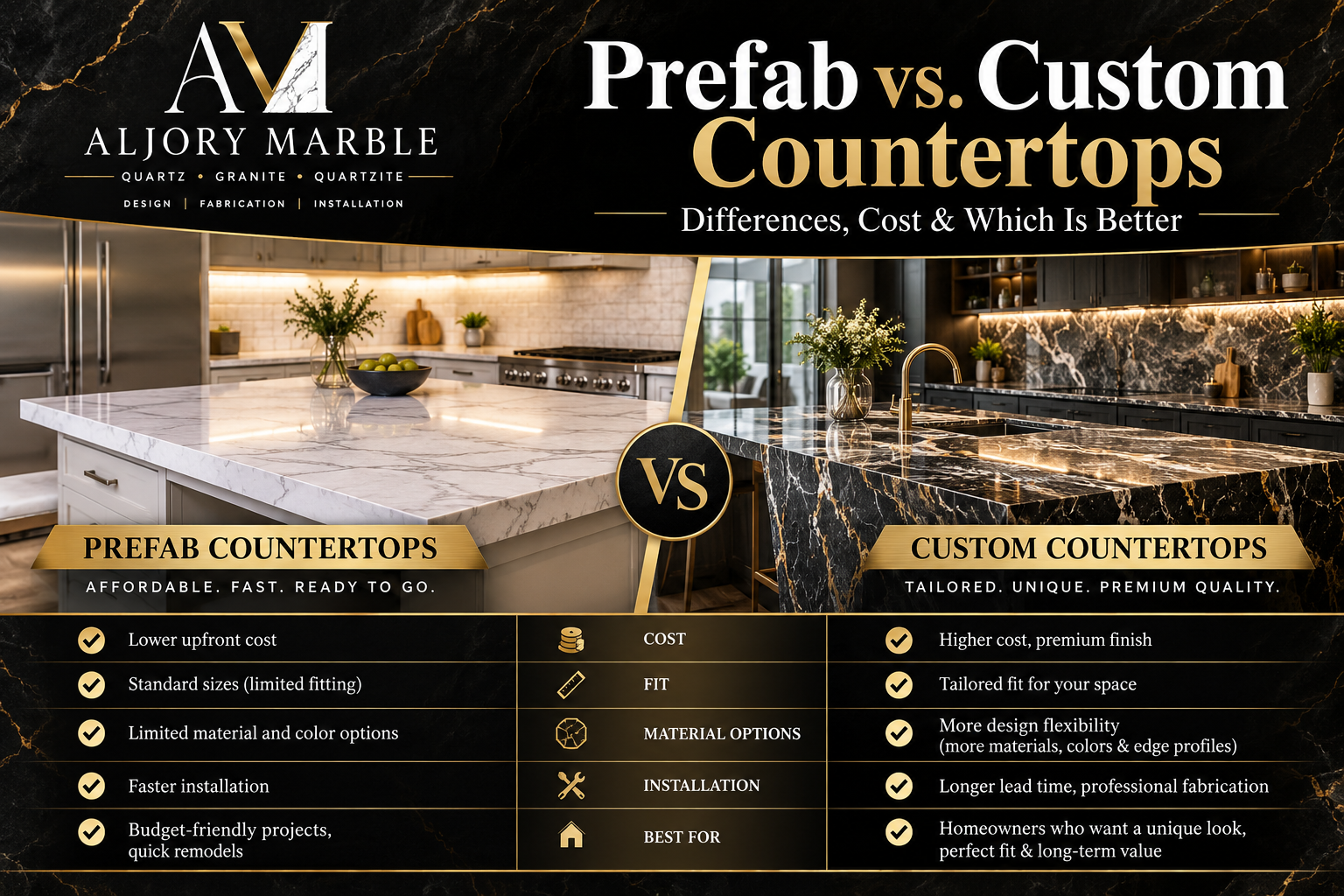
When shopping for new countertops, you may see two very different options:
prefabricated countertops and custom fabricated countertops.
At first glance, they may look similar.
Both can be made from attractive materials. Both can create a finished kitchen or bathroom. And in some situations, a prefabricated countertop may cost less.
But the way the two products are measured, cut, finished and installed is very different.
A prefabricated countertop is generally manufactured in predetermined sizes with certain edges already finished.
A custom countertop starts with a full slab and is measured, cut and finished specifically for your kitchen, bathroom or commercial space.
That difference affects:
- Fit
- Seam placement
- Slab selection
- Edge choices
- Sink and cooktop cutouts
- Island design
- Material usage
- Overall appearance
- Project flexibility
For a simple layout, prefab may work perfectly well.
For kitchens with large islands, unusual walls, custom cabinets, visible veining or specific design details, custom fabrication usually gives the homeowner much more control.
At Al Jory Marble, we provide custom countertop fabrication in our Crestwood, Illinois shop for kitchens, bathrooms and commercial projects throughout Chicagoland.
Here is what you should know before deciding between prefab and custom countertops.
Quick Answer: Prefab vs. Custom Countertops
The easiest way to understand the difference is this:
Prefab countertops are made to standard dimensions first and then adapted to the room.
Custom countertops are measured from the actual room and fabricated specifically to fit it.
| Feature | Prefab Countertops | Custom Countertops |
|---|---|---|
| Size | Predetermined sizes | Cut to actual measurements |
| Slab selection | More limited | Full slab selection |
| Edge options | Usually predetermined | Multiple custom edge choices |
| Seam placement | Less flexible | Planned around layout |
| Sink cutouts | May require modification | Cut for selected sink |
| Cooktop cutouts | More limited | Fabricated to appliance specs |
| Islands | Better for simple sizes | Better for large/custom islands |
| Vein matching | Limited | Can be planned |
| Odd walls | More difficult | Template captures wall variations |
| Cost | Often lower initially | Usually higher due to custom work |
| Design flexibility | Limited | Much greater |
Neither option is automatically right or wrong.
The better choice depends on the room.
What Is a Prefabricated Countertop?
A prefabricated countertop is a countertop piece that has already been manufactured to a standard size before your kitchen is measured.
Depending on the supplier, prefab pieces may already have:
- A finished front edge
- A standard depth
- A predetermined thickness
- A polished surface
- Certain standard lengths
The installer then modifies the piece as needed to fit the project.
This is very different from taking an entire slab and designing every countertop section specifically around the finished kitchen.
Are Prefab Countertops the Same as Laminate Countertops?
No.
“Prefab” describes how the countertop is produced, not necessarily what material it is made from.
Prefabricated countertops can be available in materials such as:
- Quartz
- Granite
- Other stone surfaces
Laminate countertops are also commonly sold in standard sizes, but prefab stone or quartz is a separate category.
The important distinction is whether the countertop was made specifically for your room or produced in standard dimensions before your project began.
What Is a Custom Countertop?
A custom countertop is fabricated to fit the actual room.
The process generally begins after the cabinets are installed and the layout is final.
The fabricator creates a template or detailed measurements of the space.
Those measurements account for things such as:
- Wall variations
- Cabinet dimensions
- Island size
- Overhangs
- Sink location
- Cooktop location
- Appliance clearances
- Seam placement
- Finished panels
- Unusual angles
A full slab is then cut according to that project.
Al Jory Marble templates the actual space before cutting and finishes custom pieces in its own Crestwood fabrication shop.
The Biggest Difference: The Countertop Is Built Around the Kitchen
This is really the core difference.
With prefab:
The room has to work with the countertop pieces that already exist.
With custom fabrication:
The countertop is made to work with the room.
That matters because kitchens are rarely as perfectly square as drawings make them appear.
Walls can:
- Bow
- Lean
- Change slightly in depth
- Meet at angles that are not exactly 90 degrees
Cabinets may also create slight variations after they are installed.
Custom templating captures those real-world conditions.
Jory’s fabrication process specifically uses the actual space rather than relying only on plans, which is one of the main advantages of custom work.
Is Prefab Cheaper Than Custom Countertops?
Often, yes.
One of the biggest reasons homeowners consider prefab is price.
Prefab products can cost less because:
- Sizes are standardized
- Edges may already be finished
- Less custom fabrication may be required
- Material choices may be limited
- Production is more repetitive
But price should be compared carefully.
A low prefab material price does not always represent the final installed project price.
You may still need to account for:
- Cutting
- Sink modification
- Cooktop cuts
- Additional seams
- Installation
- Delivery
- Backsplash
- Extra pieces
- Corner work
- Field modifications
A custom countertop may have a higher starting price, but it includes fabrication designed specifically for the actual kitchen.
The best comparison is always the complete installed quote, not simply the advertised material price.
Are Prefab Countertops Lower Quality?
Not automatically.
Prefab and custom are not the same as “bad” and “good.”
A quality prefab countertop can work very well in the right situation.
The limitation is usually flexibility, not necessarily the surface itself.
For example, the material may be perfectly durable, but the available piece may not give you much control over:
- Seam location
- Vein placement
- Island size
- Edge style
- Sink placement
That distinction matters.
You should evaluate both the material quality and how well the available dimensions fit the project.
When Do Prefab Countertops Make Sense?
Prefab can be a practical option for simple projects.
Examples include:
Small straight countertop runs
A simple wall with one straight countertop can be easier to fit with a standard piece.
Rental properties
A property owner may prioritize speed and budget over custom slab layout.
Laundry rooms
Small utility spaces may not require the design flexibility of full custom fabrication.
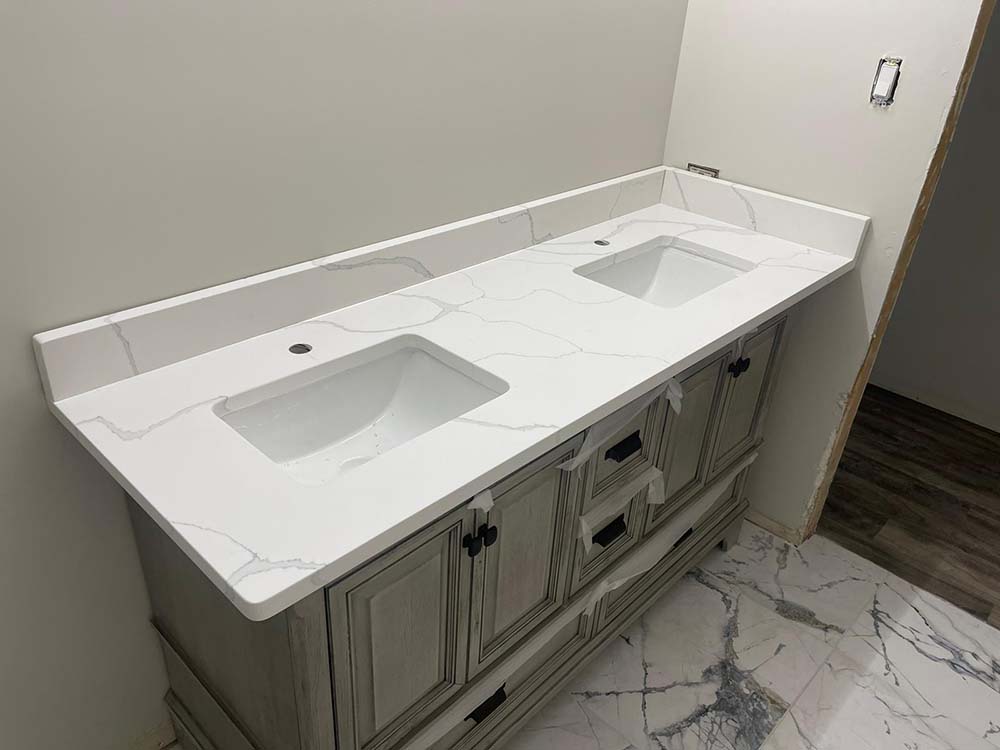
Small vanities
Standard vanity sizes can sometimes work well with prefab pieces.
Budget-driven renovations
If the primary goal is keeping material and fabrication costs low, prefab may be worth considering.
The key is that the dimensions and design need to cooperate with what is available.
When Does Custom Fabrication Make More Sense?
Custom countertops become more valuable as the project becomes more complex.
They are especially useful for:
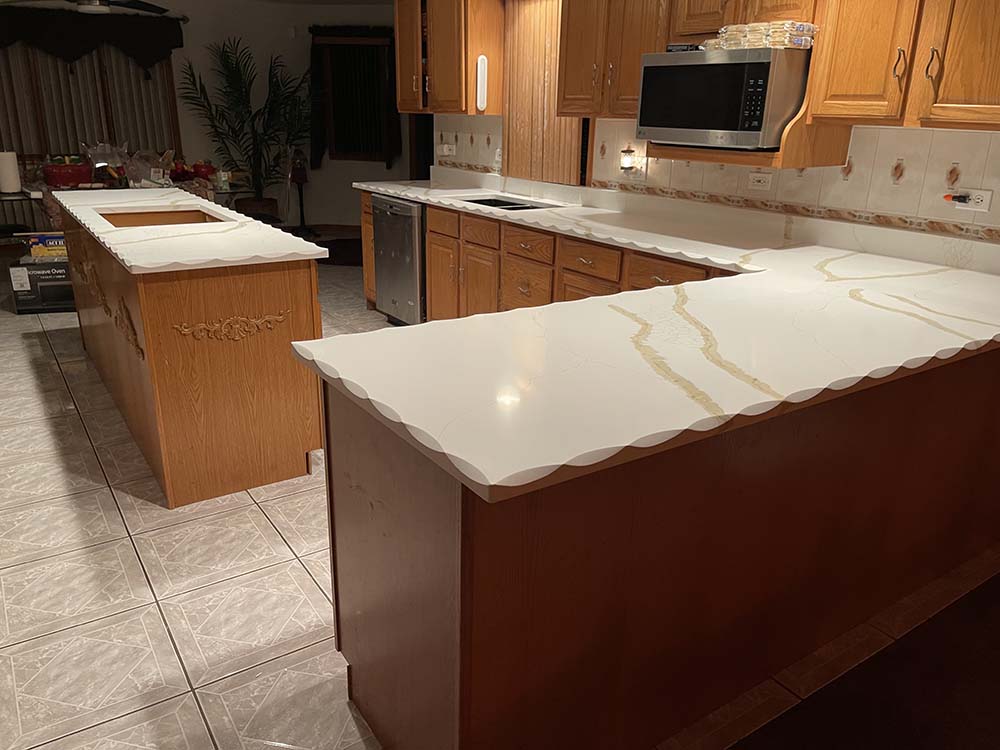
- Large kitchens
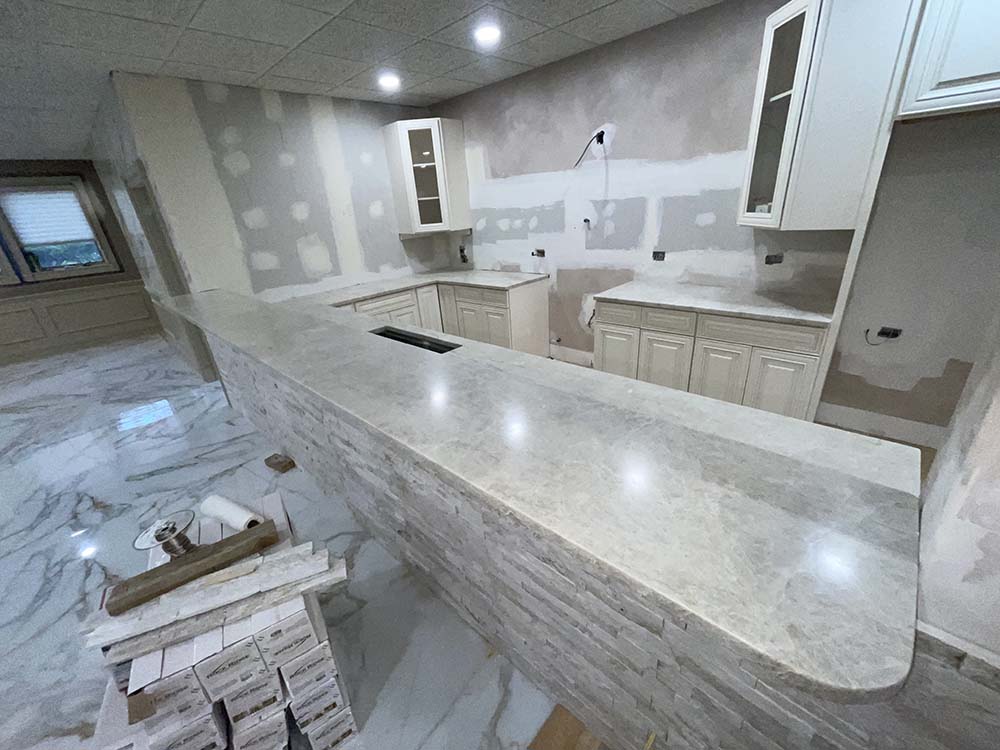
- L-shaped kitchens
- U-shaped kitchens
- Large islands
- Waterfall islands
- Custom cabinetry
- Farmhouse sinks
- Undermount sinks
- Cooktops
- Angled walls
- Multiple countertop sections
- Natural stone with strong veining
- Luxury kitchens
- Commercial counters
- Unusual overhangs
The more design decisions that affect the countertop, the more useful custom fabrication becomes.
Prefab vs. Custom for an L-Shaped Kitchen
An L-shaped kitchen creates a corner.
That may sound simple, but corners introduce additional measurements and seam decisions.
With prefab material, the installer must work with predetermined piece sizes.
That can limit where the pieces meet.
Custom fabrication allows the fabricator to consider:
- Exact wall angle
- Cabinet dimensions
- Corner shape
- Seam position
- Sink position
- Pattern direction
A custom template can be especially useful in older Chicagoland homes where walls are not perfectly square.
Prefab vs. Custom for a U-Shaped Kitchen
U-shaped kitchens add even more connection points.
There may be:
- Two corners
- Multiple seams
- Sink run
- Range opening
- Window
- Different cabinet depths
Standard pieces can still be used in certain situations, but the layout has to work around them.
Custom fabrication gives the fabricator more ability to plan the countertop as one complete project.
What About Large Kitchen Islands?
Large islands are one of the strongest reasons to consider custom fabrication.
Modern islands may include:
- Seating
- Sink
- Dishwasher
- Cooktop
- Waterfall edge
- Large overhang
- Multiple cabinets
They may also require a very large slab.
Jory’s kitchen countertop work specifically includes projects ranging from single islands to full kitchens, with slab layout and seam planning handled around the actual kitchen configuration.
With custom fabrication, the fabricator can evaluate the slab size before cutting and determine whether the island can be produced:
- In one piece
- With a seam
- With waterfall panels
- With reinforced overhangs
That level of planning is much harder when you begin with standard prefab pieces.
Can You Make a Waterfall Island With Prefab Countertops?
Sometimes, but custom fabrication is usually better suited to the design.
A waterfall island continues the countertop vertically down the side.
That means the horizontal countertop and vertical panel need to work visually together.
With strongly patterned quartz or natural stone, the fabricator may try to align the movement at the corner.
This is often called vein matching.
Custom slab layout gives much more control over where each piece is cut.
Prefab pieces may limit that ability because the finished dimensions and edges are already determined.
Can You Choose the Exact Slab With Custom Countertops?
Usually, yes.
That is one of the biggest advantages of custom natural-stone work.
You can often see the actual:
- Granite slab
- Marble slab
- Quartzite slab
before it is fabricated.
That matters because natural stone varies tremendously.
Two slabs sold under the same stone name can have different:
- Veins
- Color distribution
- Mineral deposits
- Movement
- Background tone
Jory allows customers to see full slabs before cutting, which is particularly important for natural stone.
Why Full Slab Selection Matters
A small stone sample tells you what the material can look like.
It does not necessarily tell you what your slab looks like.
For a small bathroom vanity, that may not matter as much.
For a large kitchen island, it can matter tremendously.
You may want to choose:
- The calmest section for the perimeter
- A dramatic vein for the island
- Matching movement at a seam
- A feature section behind the sink
Custom fabrication lets those decisions happen before the stone is cut.
Can You Choose the Exact Pattern With Prefab Quartz?
Your options are usually more limited.
Quartz is engineered, so the pattern is more repeatable than granite or quartzite.
But a prefabricated piece has already been cut into a specific form.
You are selecting from available pieces rather than deciding how an entire slab should be laid out for your kitchen.
That difference becomes more noticeable with dramatic marble-look quartz that contains large veins.
What About Seam Placement?
This is another major difference.
A seam is the joint where two countertop sections meet.
Many kitchens need at least one seam because of:
- Slab dimensions
- Kitchen layout
- Access
- Corner configuration
- Installation constraints
With custom fabrication, seam placement can be considered during the template and slab-layout process.
The fabricator can think about:
- Visibility
- Support
- Sink location
- Cooktop location
- Pattern movement
- Installation access
Jory specifically discusses seam placement and vein matching as part of custom kitchen work.
Prefab gives less flexibility because you are working with pieces that already exist in predetermined sizes.
Can Prefab Create More Seams?
It can.
Imagine a countertop run that is 120 inches long.
If the available prefab piece is shorter, you may need another section.
That creates a joint that might not have been necessary if the same project were cut from a sufficiently large custom slab.
This does not mean prefab always creates excessive seams.
But standard piece dimensions can influence where seams are required.
Can You Hide Countertop Seams?
You cannot make every seam completely invisible.
The goal is usually to make it:
- Tight
- Structurally appropriate
- Well positioned
- Visually coordinated
Patterned materials make this more challenging.
A seam running through dramatic quartzite or marble-look quartz can become very obvious if the patterns do not relate to each other.
Custom slab layout gives the fabricator more opportunity to plan around that.
How Do Sink Cutouts Differ?
This is important.
Custom fabrication allows the sink opening to be cut specifically for the sink selected for the project.
That matters for:
- Undermount sinks
- Farmhouse sinks
- Bar sinks
- Prep sinks
- Large single-bowl sinks
- Double-bowl sinks
Sink models vary significantly.
Even two sinks that appear to have the same overall dimensions can require different cutouts.
With custom work, the fabricator can create the opening based on the actual sink specifications.
Can You Use an Undermount Sink With Prefab Countertops?
Often, yes, but the countertop still needs to be modified correctly for the sink.
That work should not be treated as a generic cut.
The opening needs to consider:
- Sink dimensions
- Corner radius
- Reveal
- Faucet placement
- Stone around the opening
The more specialized the sink layout becomes, the more valuable precise fabrication becomes.
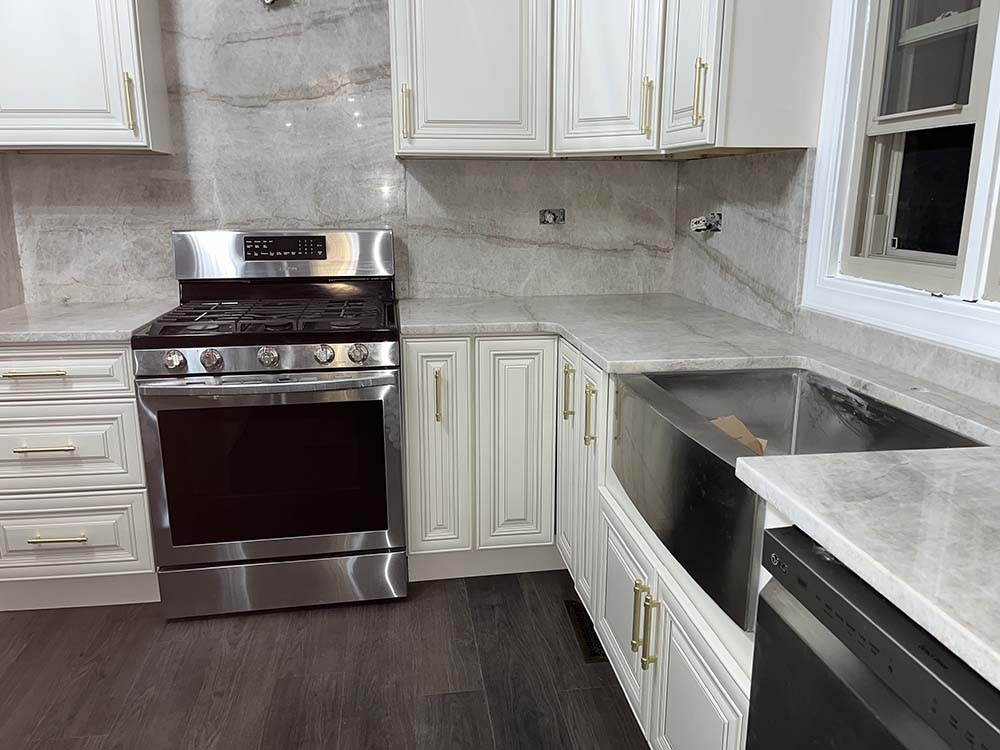
What About a Farmhouse Sink?
Farmhouse or apron-front sinks require more coordination with the cabinets and countertops.
The sink usually needs to be properly positioned and supported before final countertop work.
The fabricator then creates the countertop around the installed or finalized sink configuration.
Because the front of the sink is exposed and the stone may terminate around it, fit is especially important.
Custom templating is generally the safer approach.
What About Cooktop Cutouts?
Cooktops are another reason countertop fabrication cannot simply be treated as cutting a rectangular surface.
The fabricator needs the appliance specifications.
Different cooktops require different:
- Opening dimensions
- Corner shapes
- Clearances
If you have a cooktop instead of a freestanding range, custom fabrication gives the fabricator the exact dimensions needed for that appliance.
Edge Options: Prefab vs. Custom
Prefab countertops usually come with a certain edge already finished.
That may be perfectly acceptable if you like it.
Common prefab profiles tend to be simple because they need to work for many projects.
Custom fabrication gives you more flexibility.
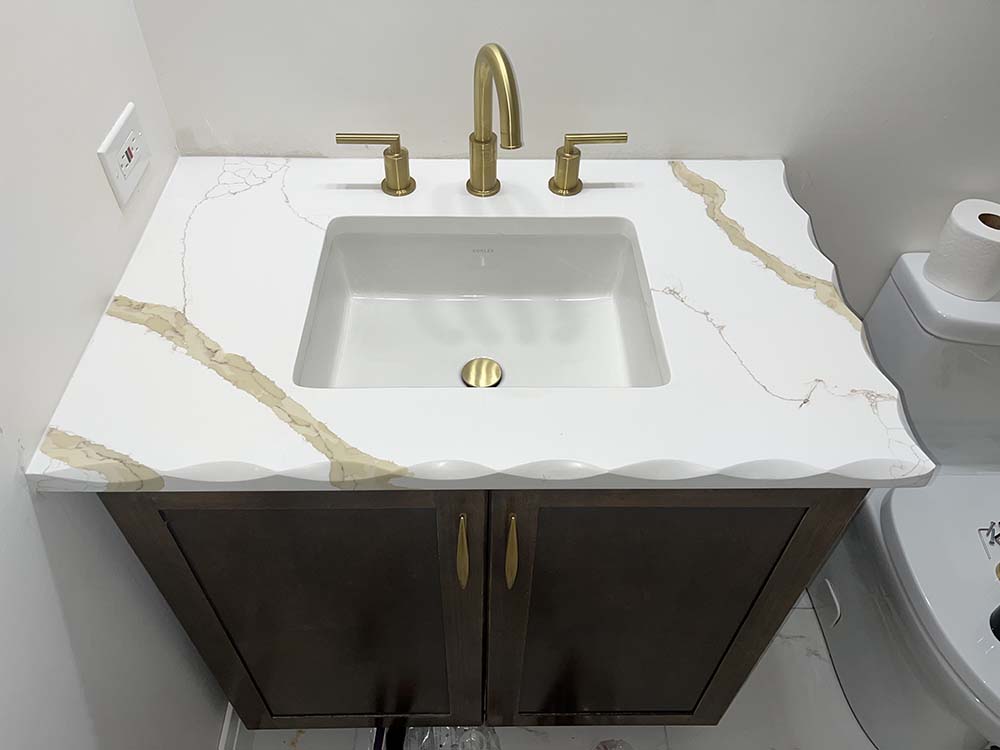
Depending on material and thickness, homeowners may consider profiles such as:
- Eased
- Beveled
- Bullnose
- Half bullnose
- Ogee
- Other decorative profiles
The edge may seem like a small detail.
But on a large island, it runs around one of the most visible features in the kitchen.
Does Custom Fabrication Let You Choose Countertop Thickness?
It gives you more control over the overall material specification.
Stone and quartz products may be available in different thicknesses depending on the material.
Thickness can affect:
- Appearance
- Edge options
- Support requirements
- Weight
- Overall style
Your fabricator can help determine what is appropriate for the specific material and project.
What Happens When Walls Are Not Straight?
This is where custom templating becomes extremely valuable.
A wall may look straight but actually move inward or outward slightly.
If you place a perfectly straight standard countertop against it, you may end up with inconsistent gaps.
Custom templating records the actual conditions.
The fabricated countertop can then be shaped accordingly.
The backsplash may hide small wall variation, but good fabrication begins with knowing what the wall actually does.
Are Older Chicago Homes a Good Candidate for Custom Countertops?
Often, yes.
Older homes can have:
- Uneven walls
- Settled floors
- Altered cabinetry
- Nonstandard dimensions
- Narrow access
- Unusual corners
None of those automatically create a problem.
They simply make accurate measurement more important.
A custom countertop can be fabricated around what actually exists rather than what the kitchen theoretically should measure.
Prefab vs. Custom for Chicago Condos
Condos can introduce a different type of complexity.
The kitchen itself may be straightforward, but the project may involve:
- Elevators
- Loading areas
- Building schedules
- Certificate-of-insurance requirements
- Limited access
- Narrow hallways
Large custom pieces have to be planned not only to fit the cabinets but also to reach the kitchen safely.
Sometimes a seam exists because of installation access rather than slab size alone.
That is another reason the fabricator should evaluate the entire project before the slab is cut.
Which Option Is Better for Quartz?
Both can work.
Prefab quartz may make sense when:
- Layout is simple
- Budget is a major factor
- Available color works with the design
- Standard dimensions fit well
Custom quartz countertops make more sense when:
- Kitchen is large
- Island is oversized
- Specific veining matters
- Custom edge is wanted
- Sink/cooktop layout is complex
- Seam placement matters
The fact that quartz is engineered does not mean every quartz countertop project should be designed the same way.
Which Option Is Better for Granite?
Custom fabrication is especially valuable with granite because granite is natural stone.
The slab itself is part of the design.
Different areas can contain:
- Larger crystals
- Different movement
- Color variation
- Natural markings
With granite countertops, seeing the entire slab and deciding where pieces should come from can make a significant visual difference.
Prefab granite can still work in simple applications, but you have less control over how the natural pattern appears in the finished room.
Which Option Is Better for Quartzite?
For most major kitchen projects using quartzite, custom fabrication has significant advantages.
Quartzite is chosen partly because of its natural appearance.
Many varieties have:
- Broad movement
- Long veins
- Color changes
- Unique sections within each slab
With quartzite countertops, careful slab layout helps the fabricator decide where the most important parts should appear.
That is especially useful for:
- Large islands
- Waterfalls
- Full-height backsplash
- Multiple seams
Which Option Is Better for Marble?
Marble is also highly dependent on the actual slab.
Two pieces of the same marble can look very different.
Custom fabrication lets the fabricator work around:
- Major veins
- Natural variation
- Fissures
- Pattern direction
- Visible seams
If the goal is a feature marble kitchen, slab selection and layout become part of the design rather than simply choosing a material name.
Is Custom Fabrication Always More Expensive?
Usually it costs more than the simplest prefab solution because there is more project-specific work.
Custom fabrication can include:
- Templating
- Slab layout
- Cutting
- Edge profiling
- Sink cutouts
- Cooktop cutouts
- Polishing
- Seam preparation
- Specialized finishing
But it is important to compare what you are actually receiving.
A lower-priced product that requires significant modification or creates additional seams may not be as large of a savings as it first appears.
The final decision should consider both price and project requirements.
What Are You Paying for With Custom Countertops?
You are not only paying for the stone.
You are paying for the process that turns the slab into something designed for your kitchen.
That includes expertise in:
- Measurement
- Material handling
- Slab layout
- Cutting
- Polishing
- Edge finishing
- Cutouts
- Seam planning
- Installation
The raw slab does not arrive from the supplier shaped like your kitchen.
Fabrication is what creates the finished countertop.
Can Custom Fabrication Reduce Material Waste?
Sometimes.
Good slab layout is partly about using material efficiently.
The fabricator considers how pieces fit together on the slab.
For example, the slab might need to produce:
- Island
- Sink run
- Range run
- Small counter
- Backsplash
- Waterfall panel
Moving one section may allow another piece to fit.
At the same time, appearance matters.
The most material-efficient layout is not always the best-looking layout.
An experienced fabricator balances:
- Yield
- Vein direction
- Seam location
- Structural considerations
- Finished appearance
Does Custom Fabrication Mean There Will Be No Seams?
No.
Custom does not mean seamless.
A project can still require seams because of:
- Slab size
- Layout
- Access
- Structural concerns
- Installation limitations
The advantage is that the seams can be planned as part of the project rather than dictated only by standard countertop piece sizes.
What About Full-Height Backsplash?
Custom fabrication is generally much better suited for full-height slab backsplash.
That is because the backsplash panels need to coordinate with the countertops.
The fabricator may consider:
- Vein direction
- Outlet cutouts
- Range hood
- Window
- Wall height
- Number of slabs
If you are deciding between different backsplash options, see our guide to 4-inch, tile and full-height stone backsplashes.
How Does Templating Work With Custom Countertops?
Templating takes place after the kitchen is ready for final measurements.
The cabinets generally need to be:
- Installed
- Secured
- Level
- In final position
The sink and cooktop selections should also be finalized.
The template records the real layout so the slab can be fabricated accordingly.
Our guide to what comes first in a kitchen remodel explains how countertop templating fits between cabinet installation and final countertop installation.
How Do You Know Whether Prefab Will Fit Your Kitchen?
Before ordering anything, compare the available pieces with the actual kitchen.
Ask:
- How long is each countertop run?
- How deep are the cabinets?
- Are there corners?
- Where will seams go?
- Is there an island?
- How large is the island?
- What sink are you using?
- Is there a cooktop?
- Are the walls straight?
- What edge comes with the piece?
- Can the piece safely reach the kitchen?
If the answers start getting complicated, custom fabrication may make more sense.
Prefab May Be Enough If…
Prefab may be a smart choice if:
- The project is small
- The layout is straight
- Standard dimensions fit
- You like the available edge
- Pattern placement is not important
- Budget matters more than customization
- You are comfortable with available colors
There is nothing wrong with choosing the simpler solution when the project itself is simple.
Custom Is Usually Worth Considering If…
Custom fabrication becomes more valuable if:
- You have a large island
- Your kitchen has multiple corners
- Walls are uneven
- You want waterfall ends
- You want specific seam placement
- You chose strongly veined stone
- You want a special edge profile
- You have an undermount or farmhouse sink
- You have a cooktop cutout
- You want a full-height backsplash
- You care where the veins appear
- Your cabinets are custom
- You want the countertop fitted precisely to the room
Questions to Ask Before Buying a Prefab Countertop
Before choosing prefab only because the initial price is lower, ask the supplier or installer:
- What are the exact dimensions?
- Which edges are already finished?
- Can the piece be modified?
- Where will the seams be?
- Is sink cutting included?
- Is cooktop cutting included?
- What happens if my wall is not straight?
- Is installation included?
- Is delivery included?
- Can additional matching pieces be purchased?
- What happens if the piece breaks during modification?
- Is backsplash included?
- What warranty applies?
This helps you compare prefab with a complete custom quote rather than comparing two numbers that include different things.
Questions to Ask a Custom Countertop Fabricator
If you are considering custom work, ask:
- Do you template the actual kitchen?
- Where is the slab fabricated?
- Can I see my slab before cutting?
- Who determines seam locations?
- Can you help with slab layout?
- Are sink cutouts included?
- Are faucet holes included?
- What edge profiles are available?
- Do you fabricate waterfall panels?
- Can you fabricate full-height backsplash?
- Who performs installation?
- What happens if there is a field issue?
Al Jory Marble templates, cuts, edges and polishes custom countertops through its own fabrication process in Crestwood rather than simply ordering finished pieces from another shop.
Prefab vs. Custom Countertops: Final Comparison
If you want the simplest explanation:
Prefab countertops make the most sense when the room is simple and the available countertop pieces already fit what you need.
Custom countertops make the most sense when you want the countertop designed around the actual kitchen rather than adapting the kitchen to standard pieces.
Prefab can provide:
- Lower initial cost
- Faster decisions
- Simple standard options
Custom fabrication provides:
- Precise fit
- More edge choices
- Better control over seams
- Better control over slab layout
- Custom sink and cooktop cutouts
- More flexibility for islands
- More flexibility for unusual walls
- Better planning for natural stone
The best choice depends on how complicated your project is and how much control you want over the finished result.
Frequently Asked Questions About Prefab vs. Custom Countertops
What does prefab countertop mean?
A prefabricated countertop is manufactured in predetermined sizes and often comes with a finished edge before the installer measures your specific room.
What is a custom fabricated countertop?
A custom countertop is measured and fabricated specifically for the actual kitchen, bathroom or commercial space.
Are prefab countertops cheaper?
They are often less expensive initially because the dimensions and finishing are standardized. Final installed cost depends on required cutting, seams, sink work, delivery and installation.
Are prefab countertops bad quality?
Not necessarily. A prefab countertop can use a quality surface material. The primary limitation is usually customization and dimensional flexibility.
Can prefab countertops be cut?
Many can be modified, but the amount of modification depends on the material, existing edge and project.
Can prefab countertops be used with an undermount sink?
Often, yes, if the material can be properly fabricated for the selected sink.
Can prefab countertops be used for kitchen islands?
Yes, if the available dimensions work for the island. Large or custom islands are often better suited to slab fabrication.
Can prefab countertops have seams?
Yes. In fact, standard piece dimensions may sometimes require additional seams compared with custom slab fabrication.
Is custom quartz better than prefab quartz?
The quartz itself is not necessarily better. Custom fabrication provides more flexibility in fit, seam placement, edges, cutouts and layout.
Is custom granite worth it?
It can be particularly valuable because granite is natural stone. Custom slab selection and layout allow you to control how the unique pattern appears in the kitchen.
Do custom countertops fit better?
They are fabricated from measurements or templates of the actual finished space, allowing the fabricator to account for real cabinet and wall conditions.
Do custom countertops still have seams?
Sometimes. Seam requirements depend on slab dimensions, kitchen layout, access and other installation considerations.
Can I select the exact slab with custom countertops?
For natural stone, homeowners can often select the actual slab before fabrication. This lets you see the true colors and movement before cutting.
What is the biggest advantage of custom countertop fabrication?
The biggest advantage is control. The countertop is fabricated around the actual space, sink, appliances, edges, slab pattern and design instead of being limited to standard countertop pieces.
Custom Countertop Fabrication in Chicagoland
The countertop material is only one part of the finished result.
How that material is measured, laid out, cut, edged and installed can make just as much difference.
Al Jory Marble provides custom countertop fabrication for homeowners, contractors, builders and businesses throughout Chicago and the surrounding suburbs.
We template the actual project, cut the slab in our Crestwood fabrication shop, prepare sink and cooktop openings, finish the edges and install the finished countertops.
If you are planning a kitchen, explore our kitchen countertop options or visit Jory Marble Granite Quartz INC in Crestwood, Illinois to see countertop materials and discuss your project.

Serving Chicago & Surrounding Areas
Get Your Free Kitchen Countertop Estimate
Fill out the form and our team will get back to you in next 24 hours.