
Written by the Al Jory Marble team. We fabricate and install in our own shop at 4711 135th St in Crestwood, IL, serving Chicago and the suburbs. See our site at aljorymarble.com.
Seams are the number one thing homeowners are unhappy about after a countertop install, and almost every one of those situations could have been prevented by a five minute conversation before the saw ran.
So let us have that conversation now.
First, the Uncomfortable Truth
Every seam is visible if you look for it. In every material, from every fabricator, at every price point.
Anyone who promises you an invisible seam is setting you up to be disappointed. What a good fabricator delivers is a seam that is tight, flat, color matched, and placed somewhere it does not fight with the room. What you should not accept is a seam with a visible gap, a lip you can feel with your hand, adhesive that is obviously the wrong color, or a pattern that stops dead and restarts somewhere else.
The difference between those two outcomes is layout planning and shop work. Both happen before install day.
Why Seams Exist at All
Three reasons, in order of how often they apply.
- Slabs are only so big. Stone arrives as a finite sheet. Natural stone slabs commonly run somewhere around nine to ten feet long, and engineered quartz is often produced in larger jumbo sizes. If your run of counter is longer than the slab, you get a seam. There is no way around physics.
- The stone has to get into your house. A ten foot piece of granite has to make it through your door, around your corner, up your stairwell, or into your elevator. In a Chicago bungalow with a tight turn at the top of the basement stairs, or in a high rise with a freight elevator that is shorter than the slab, access can force a seam that slab size alone would not have required. We cover this specifically in our post on Chicago condo and high rise countertop replacement.
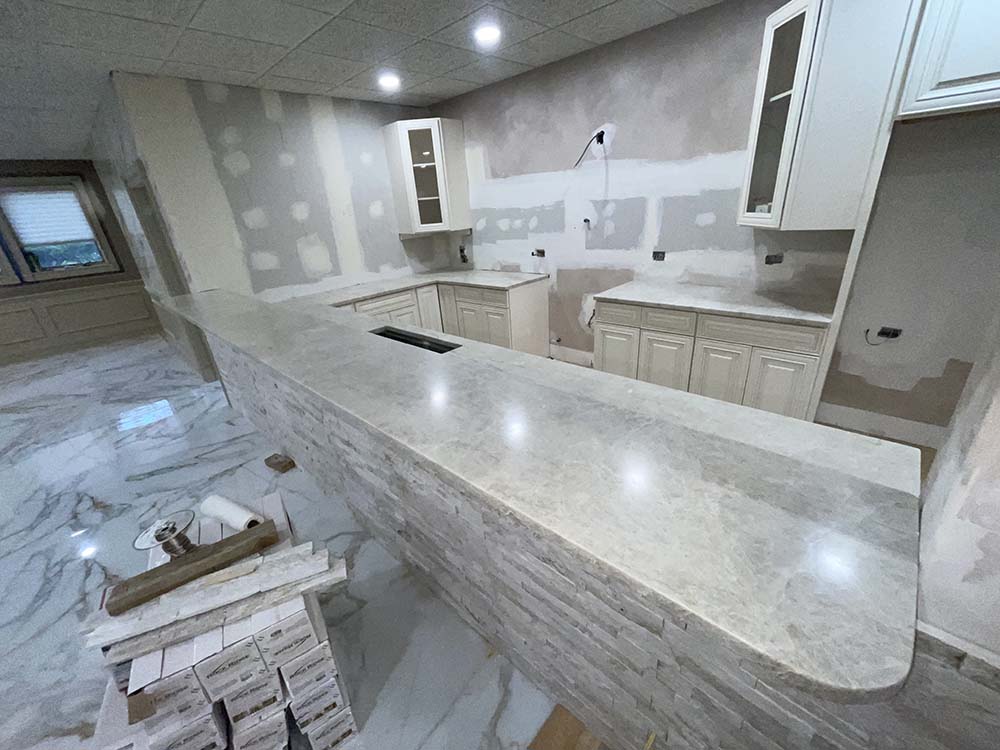
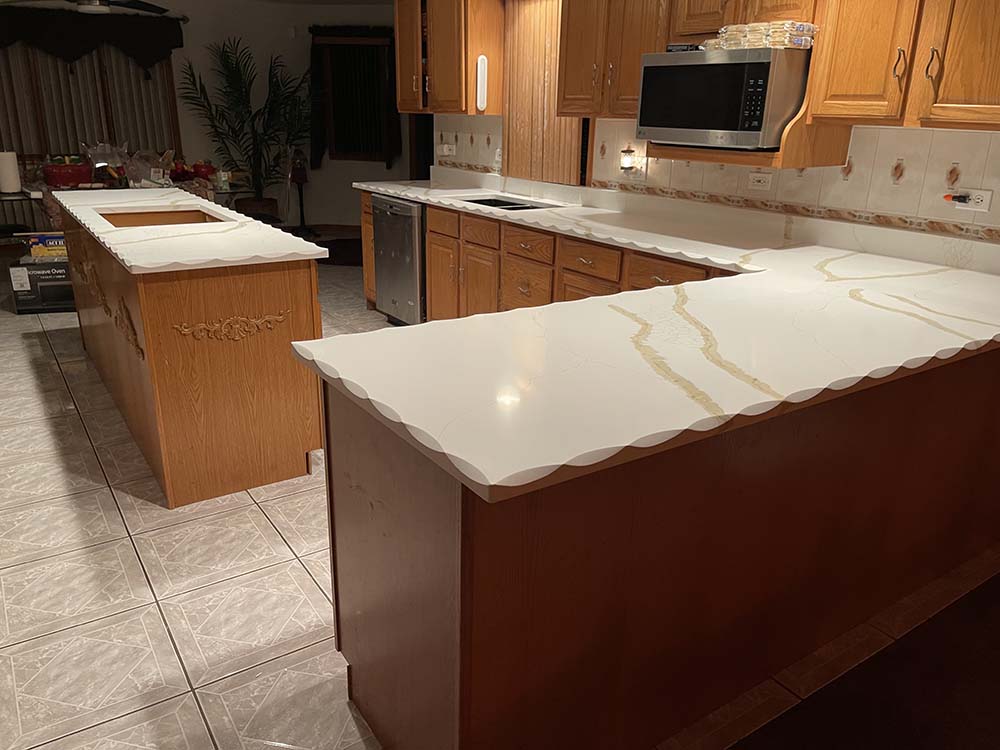
- Layout geometry. L shaped and U shaped kitchens usually need a seam at or near the corner, because cutting a full L out of one slab wastes an enormous amount of material and leaves a fragile corner.
Where Seams Should Go
This is where craft comes in. A good seam plan considers all of the following at once.
Away from the visual center of the room. If there is a spot everyone’s eye lands on when they walk in, the seam does not go there.
Not over a dishwasher opening. There is no cabinet underneath a dishwasher, which means no support. A seam over that span is a weak point, and it is one of the more common mistakes we see when we come out to look at somebody else’s work.
Somewhere with support underneath. Seams need a solid cabinet or a support structure beneath them.
Short runs over long ones. A seam in a two foot section of counter is less noticeable than one splitting a ten foot island.
At natural breaks. A corner, a change in direction, or the edge of a cooktop is a more forgiving place than the middle of a clear run.
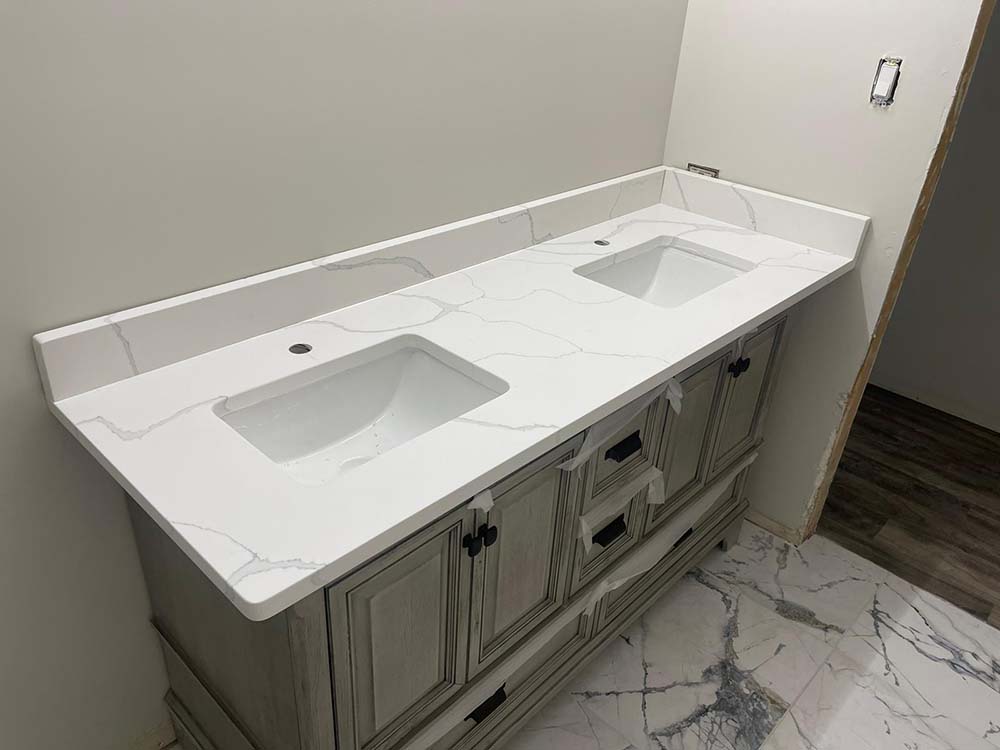
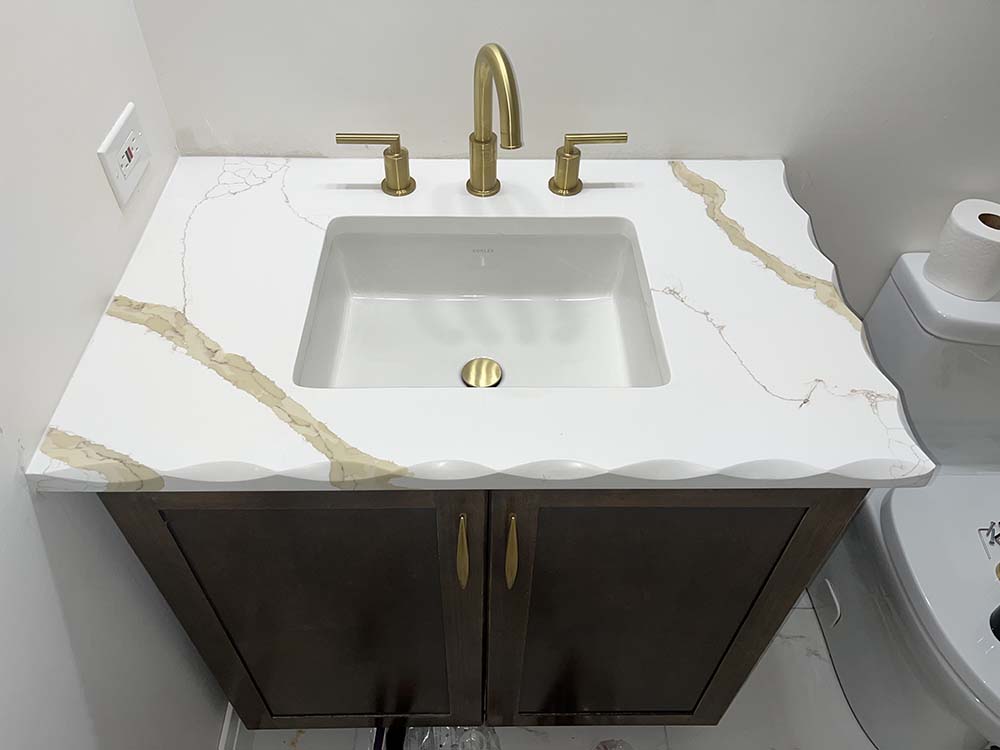
Balanced with the pattern. With natural stone, we look at where the veining wants to go and try to place the seam where the pattern flows through it rather than colliding.
Sink cutouts are a judgment call. Fabricators genuinely differ here. Running a seam through a sink cutout means the seam is partly hidden by the sink, but it leaves a narrow, fragile strip of stone across the front of the sink. Some shops do it, some avoid it. Neither position is wrong. What matters is that your fabricator has a reason and tells you what it is. We will tell you which way we are going on your job and why.
Seams in Different Materials
Quartz seams the most predictably. Because it is engineered, color and pattern are consistent slab to slab, so a quartz seam is generally the least noticeable. Veined quartz patterns are the exception, since the printed veining has to be matched across the joint.
Granite has heavy natural movement, which cuts both ways. Busy granite can hide a seam remarkably well because your eye is already tracking motion across the surface. Granite with large scale directional veining is harder, because a mismatch is obvious.
Quartzite behaves like granite for seaming purposes, with the added consideration that dramatic quartzite patterns often want to be book matched, which is a design decision made at layout.
Marble demands the most planning, because marble veining is usually the whole reason you bought it. Where the vein crosses the seam is a decision, not an accident. We go into more depth on the material in our post on marble countertops in Chicago.
What a Good Seam Looks Like Up Close
Here is what to inspect at your final walkthrough:
- The joint should be a thin line, not a gap.
- Run your hand across it. You should not feel a lip or a step between the two pieces.
- Color matched. Seam adhesive is tinted to the stone. A good match reads as a line, not as a stripe of contrasting color.
- No adhesive smeared onto the polished surface.
- Level and supported. No flex or movement when pressure is applied.
If something is off, say so during the walkthrough, not three weeks later. We walk every finished job with the homeowner before we leave for exactly this reason.
The Layout Conversation Is the Whole Job
Here is the part that separates a fabricator from a reseller.
Before we cut, we lay your pieces out on the actual slab. That is when we decide where the veining runs across your island, which end of the slab feeds the long perimeter run, and where the seams land. On natural stone, this decision determines what your kitchen looks like for the next twenty years, and it happens in our shop in Crestwood on a specific piece of stone with your name on it.
A company that resells slabs and ships them to a third party shop cannot have this conversation with you in any meaningful way, because the people making the layout decision have never seen your kitchen and you will never speak to them.
We template your space ourselves, cut and finish the slab in our own facility, and our own crew sets it. One team, start to finish. Our custom fabrication page covers the process, and our post on how long countertop installation takes covers where layout fits in the schedule.
Questions Worth Asking Any Fabricator
Before you sign anything, ask:
- How many seams will my job have, and where? You should get a specific answer, not a shrug.
- Can you show me the layout on the slab before you cut? We can.
- Will there be a seam over the dishwasher? The answer should be no.
- How will the veining be handled across the seam?
- Who is actually cutting my stone? If the answer is another company, ask who you call when something is wrong.
See Your Slab Before It Is Cut
The best way to avoid a seam surprise is to stand in front of the actual piece of stone with the person who is going to cut it.
We stock marble, quartz, granite, and quartzite at our Crestwood showroom and yard, so you can walk the racks, see full slabs end to end, and talk through layout before anything is committed. Bring your cabinet door and a floor sample. If a visit is difficult, we bring samples to your home and measure there.
We fabricate and install across Chicago, Oak Lawn, Orland Park, Tinley Park, Joliet, Bolingbrook, and the rest of Chicagoland, on kitchen countertops, bathroom vanity tops, and commercial countertops. Replacing existing tops? See countertop replacement and our guide to replacing countertops without replacing cabinets.
Talk Layout With the Shop That Cuts It
Visit the showroom at 4711 135th St, Crestwood IL 60418, Monday through Saturday, 9:00 a.m. to 6:00 p.m. Call (708) 362-7674 or request a free estimate. Free measurement, free written estimate, and a straight answer about exactly where your seams will be.


Serving Chicago & Surrounding Areas
Get Your Free Kitchen Countertop Estimate
Fill out the form and our team will get back to you in next 24 hours.