

Written by the Al Jory Marble team, fabricators and installers based in Crestwood, Illinois.
Almost every homeowner asks the same question at some point in the process: will I be able to see the seam. It is a fair question and the honest answer is that it depends almost entirely on decisions made before the stone is cut, not on the skill of the person setting it.
Seam placement is one of the more interesting parts of this trade because it is genuinely a judgment call. There is rarely one correct answer. There are tradeoffs, and the job is to pick the least bad one for your specific kitchen.
Why seams exist at all
Slabs come in finite sizes. A typical slab runs somewhere in the range of nine to ten feet long and five to five and a half feet wide, though this varies by material and by lot. Any countertop run longer than the slab needs at least one seam. That is simple arithmetic.
But length is only one of three reasons. The second is access. A slab that fits your kitchen on paper may not physically get into your kitchen, and a piece that cannot turn the corner at the top of a staircase has to become two pieces that can. The third is yield. Cutting an L shaped counter from a single piece wastes an enormous amount of the slab, so a seam at the corner may be the difference between one slab and two, which is a meaningful cost difference for you.
Occasionally none of these apply. A modest galley kitchen or a single island can often be done seamlessly. Whether yours can is one of the things we determine during the template visit.
The rules we follow when placing a seam
Put it where you do not look
Sight lines matter more than distance. A seam three feet from where you stand at the sink is less noticeable than one ten feet away that sits directly in the line of view when you walk into the room. We think about where people actually enter the kitchen and where they stand, and we push seams out of those paths.
Use the cutouts
A seam running through or beside a sink or cooktop cutout is partially hidden by the fixture itself. This is a legitimate technique and a common one, but it has limits. A seam should never run unsupported across the middle of a large cutout, because that is precisely where the stone is weakest. There is a difference between using a cutout to conceal a seam and using a cutout as an excuse to put a seam somewhere structurally poor.
Break at a natural transition
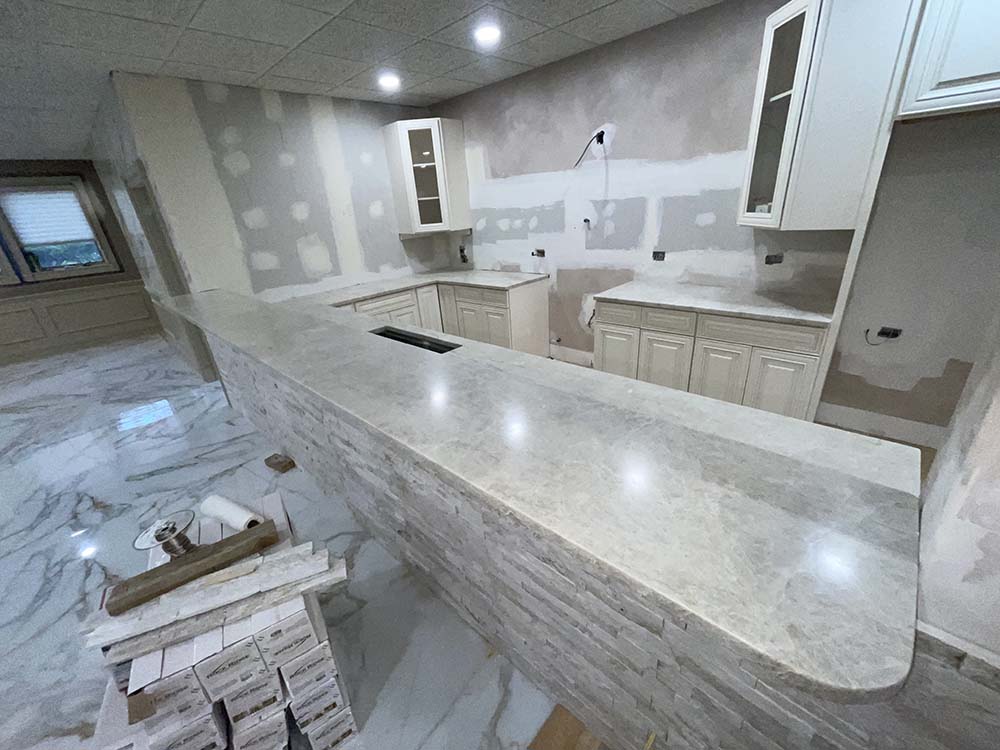
Inside corners, changes in counter depth, and the junction between an island and a perimeter run are all places where the eye already expects a line. A seam at a transition reads as intentional. A seam in the middle of a long uninterrupted run reads as a compromise, even when the workmanship is identical.
Support comes first
Every seam needs solid support under both sides. If the cabinet layout does not provide it, we add it. This is not negotiable and it is one of the places where a rushed job shows up two years later as a hairline crack.
How the material changes the answer
The stone you choose affects how visible a seam will be, and this is worth knowing before you pick.
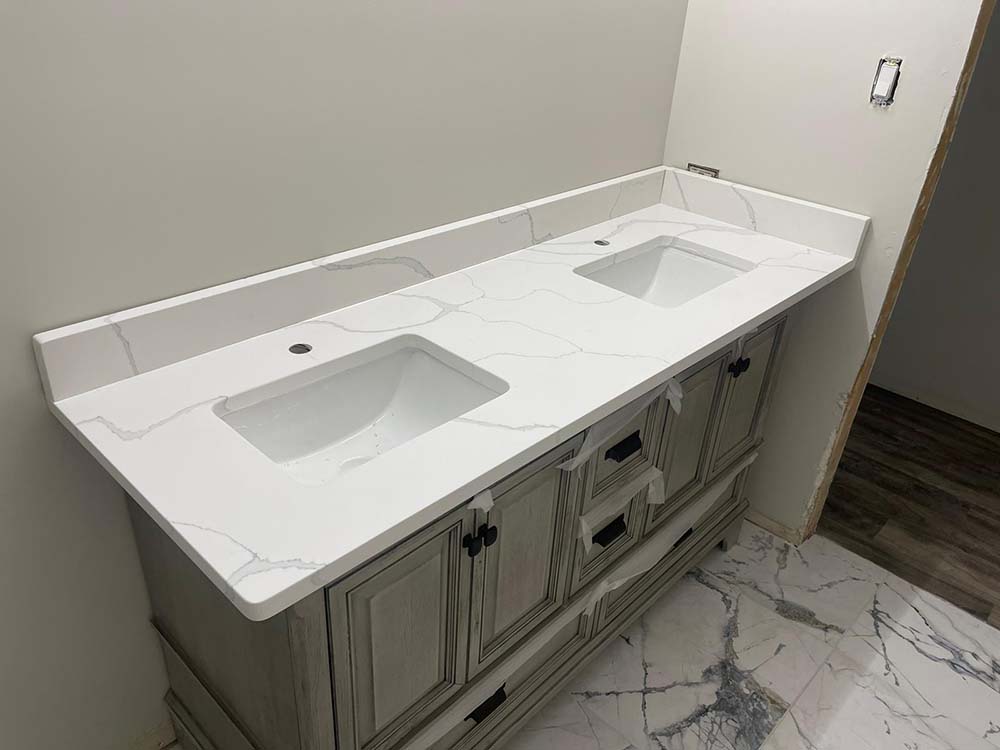
Quartz is engineered, which means color and pattern are consistent from one piece to the next. On a solid or lightly patterned quartz, a well executed seam can be genuinely difficult to find. On a heavily veined quartz that imitates marble, the pattern has a direction, and matching that direction across a seam takes deliberate layout work.
Granite varies. A busy, heavily patterned granite hides a seam extremely well because the eye has nowhere to settle. A quiet, uniform granite shows a seam more readily because any interruption stands out against consistency.
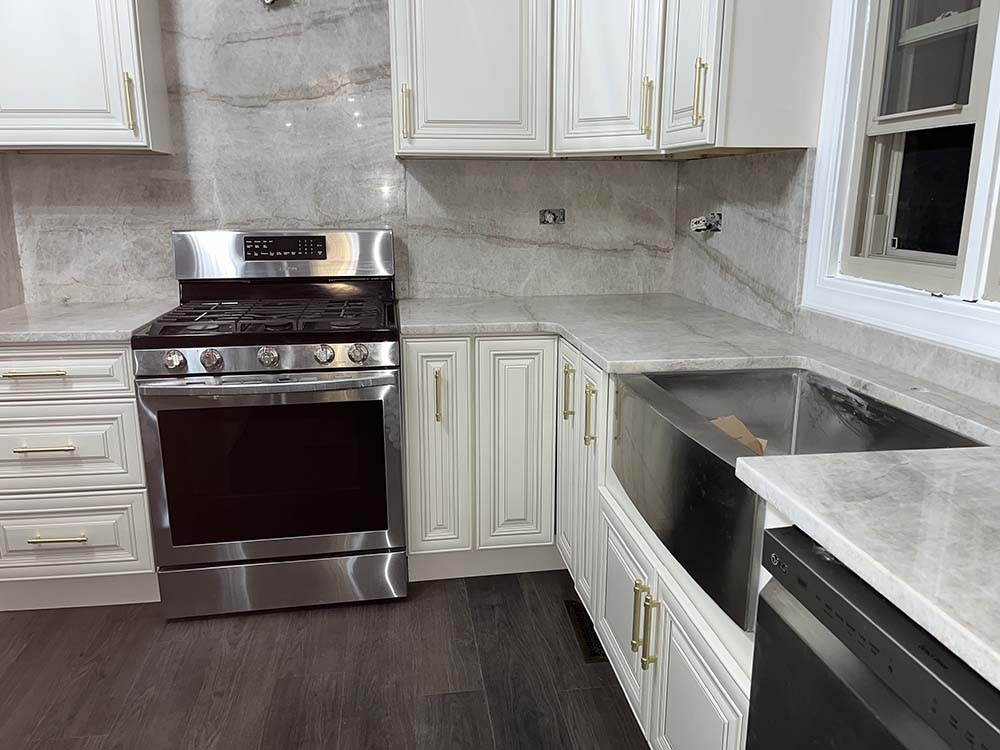
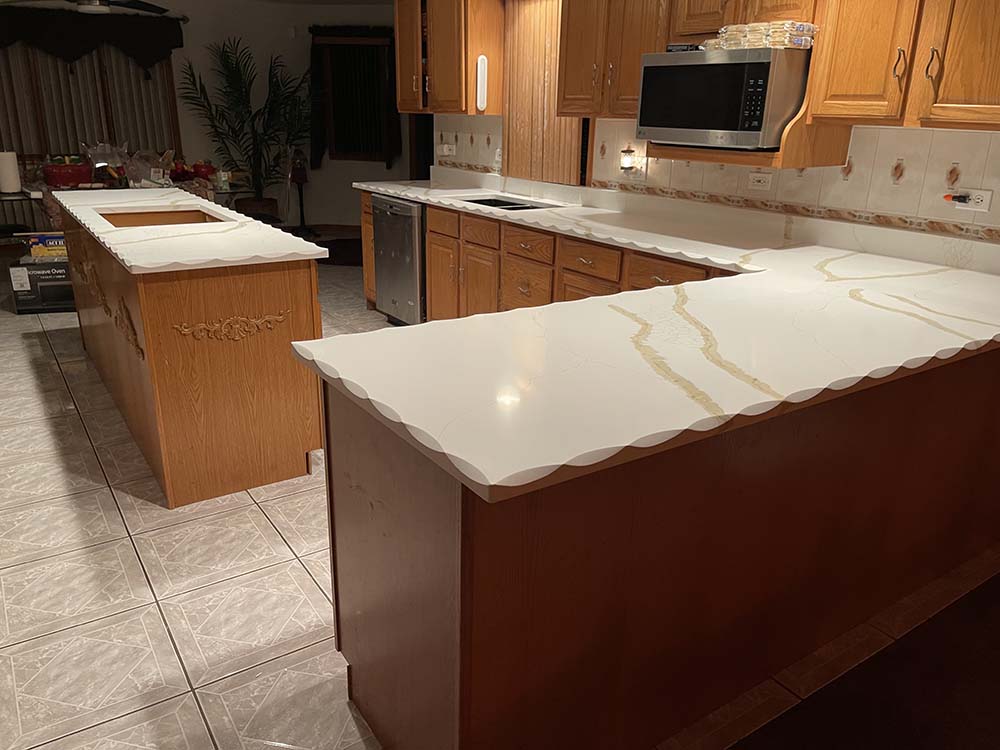
Quartzite and marble have directional veining that runs through the slab. This is where layout matters most. A seam that interrupts a vein mid-stroke is visible even when the joint itself is tight. A seam placed where the veining naturally breaks can nearly disappear. The same principle applies to dramatic marble looks like Calacatta, where the veining is the entire point of the material.
Book matching and vein matching
On higher end projects there is a technique worth knowing about. Consecutive slabs cut from the same block can be opened like the pages of a book, so the veining on one mirrors the veining on the other. Set side by side, the pattern reflects across the seam and the joint becomes a design feature rather than something to hide.
This requires selecting both slabs at the same time and planning the layout before anything is cut. It is not something that can be added later. If you are considering it, raise it early. It is a technique we use regularly on larger Naperville and Downers Grove projects where the island is the visual center of the main floor.
What a good seam actually looks like
A well made seam is tight enough that you cannot catch a fingernail in it, level enough that you cannot feel a lip when you run your hand across, and color matched enough in the joint that it does not read as a dark line. The adhesive gets tinted to the stone rather than left generic.
You will still be able to find it if you go looking. Anyone who promises an invisible seam in natural stone is overselling. What you should expect is a seam that does not draw attention on its own, that you stop noticing within a week of living with the kitchen, and that guests never mention.
What makes a seam go wrong
In our experience the failures come from a small number of causes, and almost all of them happen before installation day.
- The layout was never planned. Pieces were cut for yield and the seam fell wherever the math put it.
- Veining direction was ignored, so the pattern runs one way on one side and another way on the other.
- Support was assumed rather than verified, and the joint moved over time.
- The template did not account for a wall that was out of square, so one side of the seam had to be forced.
- The fabricator and the installer were different companies, and the reasoning behind the layout never made it across.
That last one is the reason we keep fabrication and installation under one roof. The person who decided where the seam goes is on site when it gets set.
Questions worth asking your fabricator
- How many seams will my kitchen have, and where exactly.
- Can I see the layout drawing before you cut.
- Will you match the veining direction across the seam.
- What supports the seam underneath.
- Is the joint adhesive going to be color matched to my stone.
A fabricator who cannot answer these before cutting has not planned the layout yet. That is worth knowing early.
Talk it through before you buy
Seam placement is one of those details that costs nothing to plan and a great deal to fix. If you are choosing stone for a kitchen countertop project anywhere in Chicagoland, from Aurora to Bolingbrook, bring it up at the showroom while you are standing in front of the slab. Call (708) 362-7674 and we will walk your layout with you.





Serving Chicago & Surrounding Areas
Get Your Free Kitchen Countertop Estimate
Fill out the form and our team will get back to you in next 24 hours.