
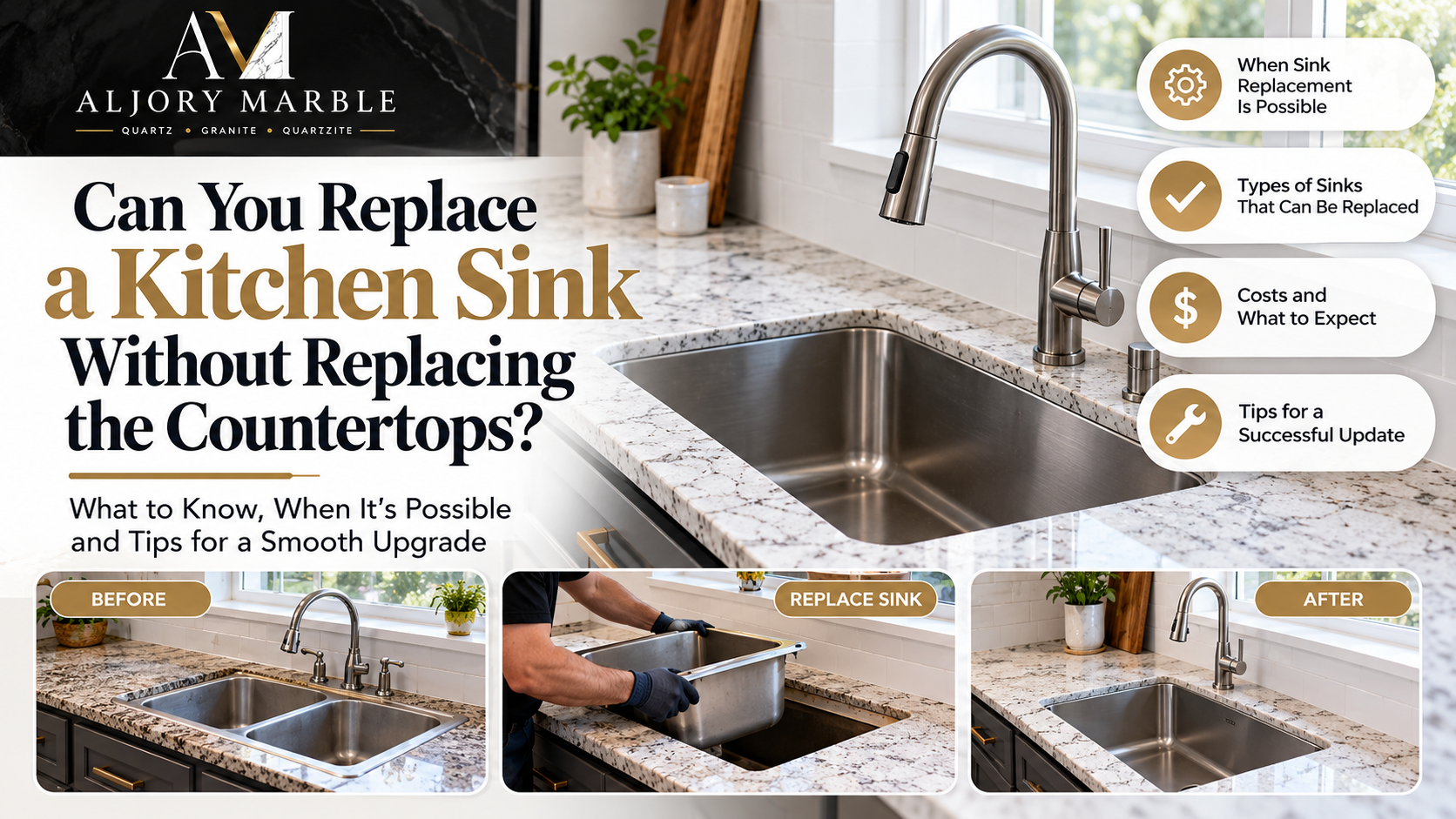
Your kitchen countertops are still in good condition.
The sink is not.
Maybe it is scratched, stained, too small, leaking, or simply outdated.
So do you really need to replace the entire countertop just to install a different sink?
Often, no.
A kitchen sink can sometimes be replaced while keeping the existing quartz, granite, marble or quartzite countertop.
But whether the project is simple or complicated depends heavily on the existing countertop opening and the new sink you want to install.
If the replacement sink fits the existing cutout, the project may be relatively straightforward.
If the new sink requires a larger opening, the stone may sometimes be modified on site by an experienced fabricator.
If the new sink requires a smaller opening, however, the project becomes much more difficult because stone that has already been removed cannot simply be added back.
Other factors also matter:
- Current sink style
- New sink style
- Stone material
- Existing cutout shape
- Faucet holes
- Cabinet width
- Sink-base condition
- Plumbing location
- Stone remaining around the opening
- Whether the countertop already has cracks
At Al Jory Marble, we fabricate, modify and replace stone countertops throughout Chicagoland. Here is what homeowners should understand before buying a new sink for an existing stone countertop.
Quick Answer: Can You Change the Sink and Keep the Countertops?
Usually, yes—if the new sink works with the existing countertop opening.
Here is the simplest way to think about it:
| New Sink Situation | Usually Possible? |
|---|---|
| Same sink model or dimensions | Usually yes |
| New sink fits existing opening | Usually yes |
| New undermount sink is slightly larger | Sometimes, if stone can safely be cut |
| New sink is smaller than current opening | Usually difficult |
| Drop-in sink larger than old opening | Sometimes |
| Drop-in sink smaller than old opening | Often problematic |
| Undermount to larger undermount | Sometimes |
| Undermount to farmhouse sink | Major modification may be required |
| Farmhouse sink to different farmhouse sink | Depends on cabinets and stone |
| Damaged stone around sink | May require repair or replacement |
The biggest mistake is buying the new sink before confirming that it works with the existing stone.
Why the Countertop Opening Matters So Much
Stone countertops are fabricated around the sink.
During the original countertop fabrication, the fabricator cuts an opening based on the exact sink dimensions.
That opening becomes permanent.
The countertop may also be:
- Polished around an undermount opening
- Drilled for faucet holes
- Reinforced near the sink
- Shaped around the cabinet
- Finished according to the sink reveal
When you change the sink later, the new sink has to work with what has already been cut.
Unlike wood or laminate, stone cannot simply be filled back in if the opening is too large.
The Easiest Sink Replacement: Same Size and Shape
The easiest situation is replacing the existing sink with:
- The same model
- A newer version with identical dimensions
- Another sink made for the same cutout
If the opening does not need to change, the stone countertop may remain untouched.
The installer can focus on:
- Removing the old sink
- Cleaning the mounting area
- Installing the new sink
- Sealing it correctly
- Reconnecting plumbing
Even here, exact dimensions should still be checked.
Do not assume two sinks labeled “33-inch” use exactly the same countertop opening.
Sink Size and Cutout Size Are Not the Same Thing
This is an important distinction.
A sink may be advertised as:
30 inches
or:
33 inches
but that number usually describes the overall sink dimensions.
The countertop cutout may be different.
Two 33-inch sinks can have different:
- Bowl sizes
- Rim widths
- Corner radiuses
- Mounting systems
- Cutout dimensions
That is why the new sink’s specification sheet matters more than the name on the box.
Can You Make an Existing Sink Opening Bigger?
Sometimes.
Stone fabricators can sometimes enlarge an existing opening in:
- Granite
- Quartz
- Quartzite
- Marble
But it is not automatically safe.
The fabricator needs to evaluate:
- How much stone must be removed
- Distance to the front edge
- Distance to the backsplash
- Faucet holes
- Seams
- Existing cracks
- Material thickness
- Stone type
- Cabinet opening underneath
Removing a small amount of stone may be possible.
Removing several inches can create an entirely different structural situation.
Why Cutting Stone Inside an Existing Kitchen Is Different
When a countertop is originally fabricated, much of the cutting is done in a fabrication shop.
The slab can be:
- Properly supported
- Measured precisely
- Cut with specialized equipment
- Polished before installation
Modifying an installed countertop is different.
The stone is already:
- Attached to cabinets
- Surrounded by backsplash
- Near finished walls
- Near plumbing
- Inside the home
There is also dust and vibration to control.
This is why an existing stone opening should be modified by someone experienced with countertop fabrication.
Can Quartz Be Cut for a Larger Sink?
Sometimes.
Quartz can be modified, but the fabricator needs to inspect the existing layout first.
A larger sink opening removes more material.
That matters especially along the narrow strip of countertop in front of the sink.
The remaining stone has to be strong enough for the finished installation.
The location of nearby seams and faucet holes also matters.
If you already have quartz countertops, do not order a larger sink based only on cabinet width.
Have the countertop opening evaluated first.
Can Granite Be Cut for a Larger Sink?
Often, yes, depending on the existing granite and cutout.
Granite is natural stone.
The fabricator may need to evaluate:
- Natural fissures
- Existing cracks
- Vein or grain structure
- Distance from edges
- Stone remaining around the sink
A cut that is safe in one granite installation may be risky in another.
That is why there is no universal answer such as:
“Every granite sink opening can be enlarged by two inches.”
The actual countertop needs to be inspected.
Can Quartzite Be Modified for a New Sink?
Possibly.
Quartzite is extremely hard natural stone, which makes it durable but also demanding to fabricate.
Cutting or polishing an installed quartzite countertop requires the right tools and experience.
The fabricator also needs to consider the stone’s natural structure.
If you have quartzite countertops, confirm the new sink before attempting any modification.
Can Marble Be Modified?
Yes in some situations, but marble requires careful handling.
Marble is softer than granite and quartzite.
That does not make the project automatically easier.
The countertop may already contain:
- Veins
- Natural fissures
- Etching
- Small chips
The fabricator needs to evaluate whether modifying the opening creates an acceptable risk.
Can You Make a Sink Opening Smaller?
This is much harder.
If your existing countertop has a large opening and the new sink requires a smaller opening, you now have missing stone around the sink.
You cannot simply shrink the hole.
Possible solutions may include:
- Choosing a different sink
- Using a top-mount sink that covers the opening
- Custom stone modification in unusual circumstances
- Replacing the countertop section
- Replacing the countertops
Usually, choosing a sink that works with the existing opening is more practical.
Why a Drop-In Sink Can Sometimes Solve a Cutout Problem
A drop-in sink has a visible rim that sits on top of the countertop.
That rim covers the edge of the cutout.
This gives the installer more tolerance than an undermount sink.
For example, if an old undermount opening is difficult to match exactly, a properly sized drop-in sink may sometimes cover the existing opening.
But the sink still needs to fit:
- The cabinet
- The countertop
- The plumbing
It is not a guaranteed solution.
Can You Replace an Undermount Sink Without Replacing the Countertop?
Yes.
This is very common.
The old undermount sink is detached from below the stone and removed.
The installer then cleans the underside of the countertop and installs the replacement sink.
The easiest situation is when the replacement sink matches the existing cutout closely.
The project becomes more complicated when the new sink has a different:
- Shape
- Radius
- Bowl configuration
- Reveal
What Is a Sink Reveal?
With an undermount sink, the relationship between the countertop edge and the sink opening is called the reveal.
There are several approaches.
Positive Reveal
A small portion of the sink rim is visible inside the opening.
Zero Reveal
The countertop edge aligns closely with the sink wall.
Negative Reveal
The countertop slightly overlaps the sink opening.
Your existing countertop has already been fabricated for one specific opening.
Changing sink dimensions can change how the reveal looks.
Can You Change From a Double-Bowl to a Single-Bowl Sink?
Often, yes.
But the new single-bowl sink still needs to fit the existing opening.
Many homeowners replace older double-bowl sinks with larger single-bowl workstation sinks.
This can be an excellent upgrade because it provides more uninterrupted space for:
- Large pans
- Baking sheets
- Dutch ovens
- Cutting boards
But “same outside width” does not guarantee that the stone cutout is compatible.
Always compare the technical drawings.
Can You Change From Single-Bowl to Double-Bowl?
Yes, if the sink works with the existing opening.
Because the divider is inside the sink itself, the countertop does not necessarily care whether the bowl is single or double.
What matters is the outside shape of the sink beneath the countertop.
Can You Replace a Drop-In Sink With an Undermount Sink?
This is much more complicated.
A drop-in sink covers the rough countertop opening with its rim.
Because that cutout was never intended to remain visible, the stone edge may not be:
- Smooth
- Polished
- Even
- Properly shaped for an undermount sink
To convert to undermount, the opening may need to be:
- Recut
- Reshaped
- Polished
The project is possible in some situations.
But it is not simply a matter of removing the old sink and gluing a new one underneath.
Can You Change From Undermount to Drop-In?
Often, yes, if the drop-in sink is large enough to cover the existing opening.
The sink rim hides the cut edge.
This can occasionally be a useful solution when the existing stone opening does not work with the preferred undermount replacement.
But measure carefully.
The sink still has to fit inside the base cabinet.
Can You Change to a Farmhouse Sink Without Replacing Countertops?
Sometimes—but this is a much larger project.
A farmhouse or apron-front sink extends through the front of the sink cabinet.
Converting from a normal undermount sink may require:
- Cutting the cabinet front
- Changing cabinet doors
- Adding sink support
- Modifying stone
- Enlarging the countertop opening
The farmhouse sink also needs structural support.
It should not simply hang from the countertop.
Why Farmhouse Sink Conversions Get Complicated
The countertop is only one part of the problem.
You also need to consider the sink base cabinet.
A standard cabinet may have:
- False drawer front
- Full-height doors
- Center stile
A farmhouse sink requires room for the front apron.
That may require significant cabinet modification.
Sometimes the countertop can be preserved.
Sometimes replacing that section or the entire countertop becomes more practical.
Can You Install a Workstation Sink in an Existing Countertop?
Possibly.
Workstation sinks have become popular because they can hold accessories such as:
- Cutting boards
- Colanders
- Drying racks
But they tend to be large.
Before ordering one, confirm:
- Outside dimensions
- Cutout dimensions
- Cabinet width
- Front-to-back clearance
- Faucet location
The extra width can become a problem if too little stone remains around the opening.
Does the Sink Cabinet Determine the Largest Sink You Can Use?
Yes.
The sink has to physically fit inside the cabinet.
A 33-inch sink does not necessarily fit a 33-inch cabinet.
The cabinet needs room for:
- Sink body
- Mounting hardware
- Supports
- Plumbing
Manufacturers typically specify the minimum base-cabinet width for each sink.
Check this before purchasing.
Can You Put a 33-Inch Sink in a 30-Inch Cabinet?
Usually not with a conventional installation.
The sink body may simply be too wide.
There are specialty installations and cabinet modifications, but a homeowner should not assume a sink will fit because the dimensions sound close.
Follow the sink manufacturer’s minimum cabinet requirement.
Does a Larger Sink Need More Countertop Support?
Potentially.
A larger opening leaves less countertop material around it.
The narrowest area is often the stone strip between:
the sink opening and the front countertop edge.
That area needs enough material to remain structurally sound.
This is why simply making the hole larger is not always possible.
What Happens to the Faucet Holes?
Changing the sink can affect faucet positioning.
Your existing countertop may have holes for:
- Faucet
- Soap dispenser
- Filtered-water faucet
- Air switch
- Sprayer
A new sink may position the bowl differently.
You need to confirm that the faucet still has enough:
- Clearance
- Reach
- Space behind the bowl
Can Existing Faucet Holes Be Reused?
Often, yes.
If the new sink and faucet layout work with them.
The biggest concern is whether the new sink bowl comes too close to an existing hole underneath the countertop.
You need room for:
- Faucet hardware
- Supply lines
- Tightening nuts
Can New Faucet Holes Be Drilled in Existing Stone?
Often, yes.
A fabricator can sometimes drill additional holes in an installed stone countertop.
But the location needs to be evaluated.
The new hole should not be too close to:
- Existing holes
- Sink cutout
- Countertop edge
- Seam
This is another decision to make before buying the faucet.
Can Old Faucet Holes Be Filled?
They can sometimes be plugged, but they usually will not disappear completely.
A filled hole may still be visible.
Another option is using the existing hole for:
- Soap dispenser
- Filtered-water faucet
- Air switch
If appearance matters, plan carefully before changing the faucet configuration.
Should You Replace the Faucet When Replacing the Sink?
Not necessarily.
But it can be a convenient time.
The old sink is being removed and plumbing will already be disconnected.
Replacing the faucet at the same time may make sense if it is:
- Leaking
- Corroded
- Too short for the new bowl
- Visibly outdated
- Difficult to use
What About the Garbage Disposal?
The disposal can often be transferred to the new sink if:
- It remains in good condition
- The new sink uses the appropriate drain opening
- The plumbing layout still works
If the disposal is old, replacing it during the sink project can prevent having to disconnect everything again soon afterward.
Will Plumbing Need to Change?
Possibly.
Changing:
- Sink depth
- Bowl location
- Drain location
can affect the drain piping underneath.
A deeper sink may lower the drain outlet.
That can create problems if the wall drain is already very low.
This is something homeowners often overlook.
Can a Sink Be Too Deep for Existing Plumbing?
Yes.
Imagine replacing a shallow sink with a very deep workstation sink.
The sink drain may now sit several inches lower.
Add a garbage disposal underneath and the outlet becomes lower again.
If the wall drain is too high relative to the disposal outlet, proper drainage may become difficult.
Check plumbing before ordering an unusually deep sink.
Does Sink Depth Affect Storage?
Yes.
A deeper bowl extends farther into the cabinet.
You may lose space for:
- Trash pullout
- Cleaning supplies
- Water filtration
- Disposal
- Storage drawers
A huge sink can be useful above the counter while creating a very crowded cabinet below it.
Can You Replace the Sink Without Removing the Countertop?
Usually, yes.
That is the goal in most sink-only replacement projects.
The sink is removed from below or above depending on its mounting style.
The countertop stays attached to the cabinets.
If the stone opening needs modification, cutting may happen while the countertop remains installed.
Does the Backsplash Have to Come Out?
Usually not for a straightforward sink replacement.
The backsplash is generally unaffected.
However, changes to faucet placement can become complicated if there is very limited space between:
- Sink
- Faucet
- Backsplash
A tall backsplash or window sill can also affect faucet clearance.
What If the Sink Is Under a Window?
Measure carefully.
The new faucet may be taller than the existing one.
Check whether it interferes with:
- Window
- Sill
- Casement handle
- Shutters
This is especially important with tall pull-down faucets.
What If the Countertop Is Already Cracked Near the Sink?
Stop before making the opening larger.
The sink area is already one of the most structurally sensitive sections of a countertop because so much material has been removed.
An existing crack may indicate:
- Stress
- Poor support
- Cabinet movement
- Previous impact
Additional cutting could make the problem worse.
The stone should be inspected first.
What If the Countertop Has a Seam Near the Sink?
That also requires evaluation.
A seam is not automatically a problem.
But enlarging a cutout close to a seam changes the amount of stone supporting that area.
The fabricator needs to consider:
- Seam location
- New cutout
- Remaining material
- Cabinet support
before approving the change.
Can a Chipped Sink Edge Be Repaired During the Project?
Sometimes.
Small chips around stone sink openings can often be repaired with color-matched material.
Whether the repair will be noticeable depends on:
- Material
- Chip size
- Location
- Pattern
If the new sink slightly changes the opening, some damaged areas may also be removed during modification.
When Is Sink Replacement a Good Reason to Replace the Countertops Too?
Sometimes the sink project reveals that the countertops are near the end of their useful life.
Replacement may make more sense when:
- Countertop is badly cracked
- Multiple seams are failing
- Stone is heavily damaged
- Existing cutout is much too large
- You want a drastically different sink
- Countertop style is already being changed
- Cabinets are being remodeled
- Existing layout no longer works
In that situation, forcing a sink to work with the old countertop may create unnecessary compromises.
Do You Have to Replace All Countertops?
Not always.
In some layouts, a countertop section may be independent.
But matching an existing material can be difficult.
Natural stone is especially challenging because every slab is unique.
Even engineered quartz colors can change between manufacturing batches or become discontinued.
If one section must be replaced, the fabricator should determine whether the new piece can realistically coordinate with the rest.
Can You Match Existing Granite?
Sometimes, but exact matches are difficult.
Granite is natural.
Even slabs sold under the same name can have different:
- Colors
- Crystals
- Veins
- Movement
If the existing stone was installed years ago, finding a visually identical slab may be impossible.
Can You Match Existing Quartz?
Potentially.
Quartz patterns are more consistent than natural stone.
But manufacturers can:
- Discontinue colors
- Update formulas
- Change patterning
And manufacturing lots can have subtle differences.
Bring the fabricator the manufacturer and color information if you have it.
Should You Buy the Sink Before Calling a Countertop Fabricator?
Not necessarily.
This is one of the few projects where calling first may save you money.
Before ordering the sink, provide:
- Current sink model if known
- Current opening measurements
- Photo from above
- Photo underneath
- Cabinet width
- Desired replacement sink
The fabricator can tell you whether the idea appears realistic before you commit to a sink that may not fit.
How to Measure the Existing Sink
Start with basic measurements.
Measure:
- Sink width
- Sink front-to-back depth
- Bowl depth
- Cabinet width
- Visible countertop opening
But remember:
Homeowner measurements are useful for planning, not final fabrication.
It can be difficult to measure an undermount cutout accurately because part of the sink rim is hidden below the stone.
Find the Existing Sink Model if Possible
This is even better than measuring.
Check:
- Underside label
- Manufacturer stamp
- Original invoice
- Remodeling records
If you can identify the exact sink model, the manufacturer may still provide the technical drawing.
That tells the fabricator exactly what opening the sink was designed for.
Compare Technical Drawings, Not Product Photos
Two sinks can look almost identical online and require different cuts.
Use the manufacturer’s:
- Specification sheet
- Cutout template
- Installation guide
This information matters much more than the product photo.
What Should a Fabricator Check?
Before modifying the countertop, the fabricator may evaluate:
- Existing cutout
- New sink template
- Stone type
- Countertop thickness
- Front rail width
- Back rail width
- Faucet holes
- Seams
- Cracks
- Cabinet width
- Support
- Plumbing access
This is why sink changes involving stone are not just plumbing projects.
The plumber handles the connections.
The stone fabricator determines what can safely happen to the countertop.
Plumber vs. Countertop Fabricator: Who Does What?
A typical project may involve both.
Countertop Fabricator
Handles:
- Stone evaluation
- Cutout modification
- Stone cutting
- Edge polishing
- Faucet-hole drilling
- Stone repairs
Plumber
Handles:
- Water supply
- Drain
- Garbage disposal
- Dishwasher plumbing
- Faucet connections
The order should be coordinated so the sink can be installed correctly.
Can a Handyman Cut Granite for a Sink?
Stone fabrication requires specialized tools and experience.
Cutting an installed countertop carries risks including:
- Chipping
- Cracking
- Dust
- Incorrect cutout
- Poor polishing
Saving money on the cut is not helpful if the entire countertop cracks.
Use someone who works with the specific material.
What Happens if the Stone Cracks During Modification?
This is one of the reasons fabricators need to evaluate risk beforehand.
Existing stone can contain:
- Hidden stress
- Natural fissures
- Weak areas
- Previous damage
Modification is not always risk-free.
The homeowner should understand whether the proposed sink change is reasonable before work starts.
Best Sink Replacement Scenario
The ideal project looks like this:
Existing sink: 30-inch undermount single bowl
New sink: Same outside dimensions and compatible corner radius
Cabinet: Good condition
Countertop: No cracks
Faucet: Existing holes still work
In this situation, there may be very little stone work required.
More Complicated Scenario
Now imagine:
Existing sink: 30-inch double-bowl undermount
New sink: 36-inch workstation sink
Countertop: Quartz
Sink cabinet: 33 inches wide
This is probably not a simple countertop modification.
The new sink may not even fit the cabinet.
The project needs to be reconsidered before any cutting occurs.
Another Complicated Scenario
Existing sink: Large farmhouse sink
New sink: Smaller undermount sink
The existing countertop and cabinet opening may already be too large.
You cannot simply put back the missing stone and cabinet face.
Countertop and cabinet replacement may be more practical.
Should You Replace the Sink During a Countertop Replacement?
If you are already replacing the countertops, that is usually the easiest time to change the sink.
The new countertop can be fabricated around the exact new sink.
You can choose:
- Different size
- Different shape
- Single bowl
- Double bowl
- Farmhouse
- Workstation
without being limited by the old stone opening.
This is why homeowners using our countertop replacement service should decide on the sink before final fabrication.
Which Sink Is Best for Stone Countertops?
There is no universal winner.
Undermount
Best for a clean appearance and easy countertop cleanup.
Drop-In
Practical and easier to adapt in certain replacement situations.
Farmhouse
Creates a distinctive look but requires more cabinet planning.
Workstation
Excellent for homeowners who want built-in accessories and large single-bowl space.
Our existing guide to undermount, farmhouse and drop-in sinks goes deeper into choosing the sink style itself.
Sink Replacement Checklist
Before buying a new sink for existing stone countertops, confirm:
- Existing countertop material
- Existing sink style
- Existing opening dimensions
- New sink dimensions
- New sink cutout requirements
- Minimum cabinet width
- Countertop condition
- Distance from cutout to front edge
- Faucet-hole locations
- Plumbing height
- Garbage disposal clearance
- Backsplash clearance
- Window clearance
- Whether cutting is required
A few measurements before purchasing can prevent a much bigger problem afterward.
Frequently Asked Questions About Replacing a Sink With Existing Countertops
Can I replace my kitchen sink without replacing granite countertops?
Often, yes. The easiest replacement uses a sink that fits the existing granite opening. A larger sink may require professional stone modification.
Can I replace a sink without replacing quartz countertops?
Yes, if the new sink works with the existing opening or the quartz can be safely modified.
Can you cut an existing quartz countertop for a bigger sink?
Sometimes. A fabricator should evaluate how much stone needs to be removed and how much will remain around the opening.
Can granite be cut while already installed?
Yes in some situations. Installed granite can be modified using specialized equipment, but the risk and layout should be assessed first.
Can you make an existing sink hole smaller?
This is much more difficult because the missing countertop material cannot simply be replaced. A different sink or countertop replacement may be necessary.
Can I install a bigger sink in my existing countertop?
Possibly, if there is enough countertop and cabinet space to enlarge the opening safely.
Can I replace a double sink with a single sink?
Yes, as long as the new sink dimensions work with the existing countertop opening.
Can I replace a drop-in sink with an undermount sink?
Sometimes, but the existing cutout may need to be recut and polished because a drop-in opening was not originally designed to remain visible.
Can I replace an undermount sink with a drop-in sink?
Often, if the drop-in sink rim is large enough to properly cover the existing opening.
Can I convert to a farmhouse sink without replacing countertops?
Sometimes, but farmhouse conversions can require major stone and cabinet modifications.
Can I add a workstation sink to an existing quartz countertop?
Possibly, but many workstation sinks are large. Confirm the cabinet size and stone cutout requirements first.
Do I need a countertop fabricator or a plumber?
You may need both. A fabricator handles stone modification, while a plumber handles water, drains, faucet and disposal connections.
Can a plumber enlarge a granite sink opening?
Stone modification should generally be handled by an experienced stone fabricator rather than treated as ordinary plumbing work.
Will I need a new faucet?
Not necessarily. But confirm that the existing faucet holes and faucet reach work with the new sink.
Can new faucet holes be drilled in existing granite or quartz?
Often, yes, provided the proposed location is structurally appropriate.
Can I keep my existing garbage disposal?
Usually, if it is compatible with the new sink and remains in good condition.
Can a deeper sink cause plumbing problems?
Yes. A deeper sink lowers the drain and may interfere with the existing wall drain or garbage disposal configuration.
Should I buy the sink before having the countertop inspected?
It is safer to confirm the proposed sink dimensions with a fabricator first, especially if the new sink is larger or a different style.
Changing Your Sink Without Replacing Good Countertops
A worn-out sink does not automatically mean your stone countertops have to go.
If the quartz, granite, marble or quartzite is still in good condition, there may be several ways to install a new sink while preserving the existing surface.
The key is choosing the sink around the stone that already exists.
If the opening needs to be enlarged, faucet holes need to move or the sink style is changing completely, have the countertop evaluated before ordering materials.
Al Jory Marble provides custom countertop fabrication, countertop modification and countertop replacement throughout Chicago and the surrounding suburbs.
If your existing countertop cannot safely accommodate the sink you want, we can also help determine whether modifying the opening or fabricating a new countertop makes more sense.
Visit Jory Marble Granite Quartz INC, 4711 W 135th St, Crestwood, IL 60418 to discuss the existing stone and the sink you would like to install.


Serving Chicago & Surrounding Areas
Get Your Free Kitchen Countertop Estimate
Fill out the form and our team will get back to you in next 24 hours.