
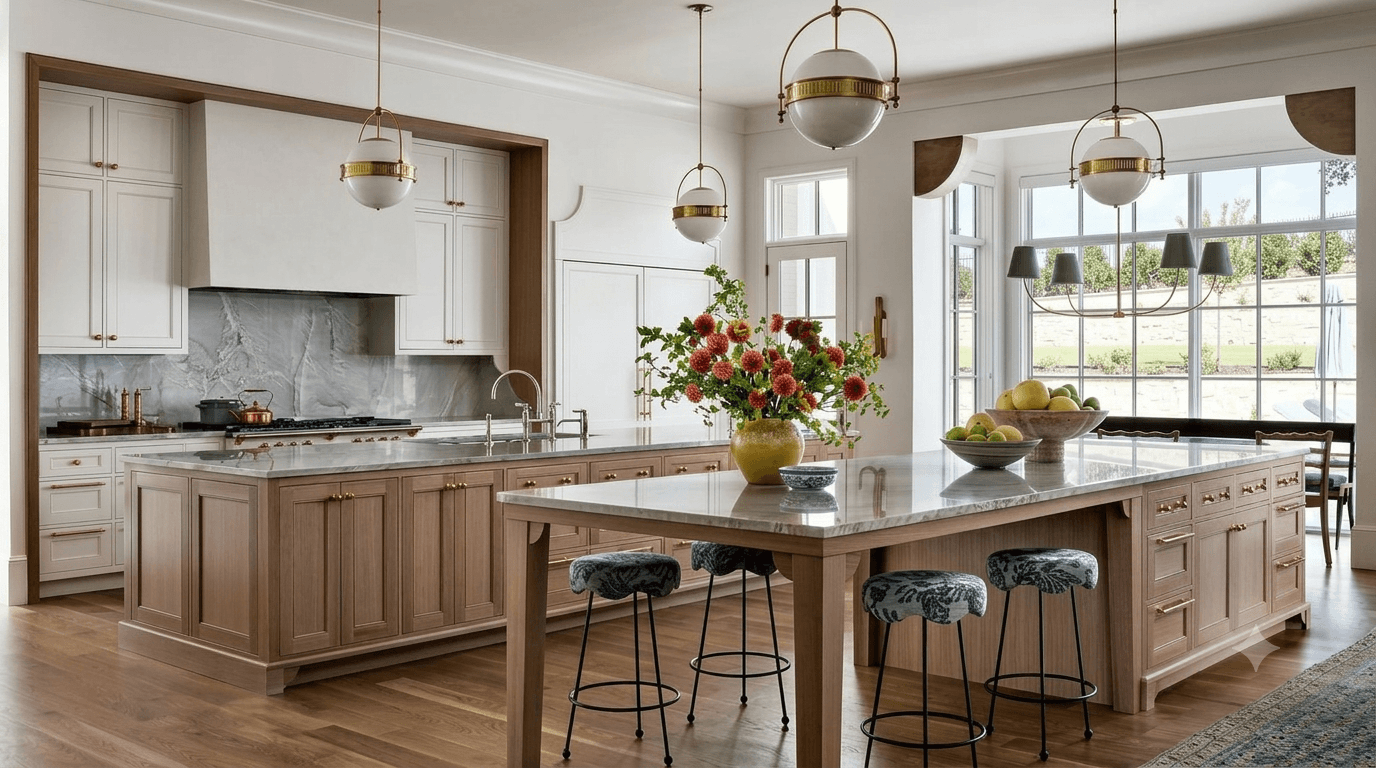
Written by the Al Jory Marble team, fabricators and installers based in Crestwood, Illinois.
Most countertop advice is written from the showroom, describing how materials perform in theory. We get a different view. We go back into kitchens years after we worked on them, usually because somebody is remodeling again or a neighbor asked for a referral, and we see what a decade of real cooking does to stone.
Here is the honest version, material by material.
Granite after ten years
Granite ages better than almost anything, and the failures we see are maintenance failures rather than material failures.
The surface itself holds up. It does not scratch in normal use, it takes a hot pan without marking, and the polish stays. Ten year old granite in a kitchen that gets used every night generally looks close to how it looked on day one.
What we do see is staining around the sink and behind the cooktop in kitchens where the sealer was never renewed. Granite is porous to varying degrees, and different granites vary considerably in how absorbent they are. A dark dense granite may go years without needing much attention. A lighter, more open one absorbs oil and will show it.
The good news is that this is fixable. A poultice will usually pull an oil stain out even years later, and resealing takes an afternoon. The homeowners who never have a problem are the ones who reseal roughly annually and wipe up oil rather than letting it sit.
The other thing we see occasionally is a chip at an edge, almost always at a corner near a high traffic path or beside the dishwasher where something heavy got swung into it. Small chips can be filled. This is a workmanship-adjacent issue as much as a material one, since a well eased edge is far less chip prone than a sharp one.
Quartz after ten years
Quartz is the most predictable material over time, which is its whole argument. No sealing, nothing soaks in, and the surface looks the same after a decade of spills.
There are two things we do see. The first is heat damage. Quartz contains resin, and resin does not like sustained high heat. A pan straight off a burner set down on quartz can leave a mark that does not come out. Most people learn this once. If you cook heavily and habitually set hot pans down without thinking, this is a real consideration and it is the one place granite genuinely outperforms quartz.
The second is that some white quartz can develop a very slight warming of tone over many years in areas with strong direct sunlight. This is subtle, it does not happen in every kitchen, and it is far less pronounced than what people fear. In a kitchen with a large south facing window it is worth knowing about.
Otherwise, ten year old quartz looks like new quartz. For a busy household that does not want to think about maintenance, that consistency is worth a great deal.
Quartzite after ten years
Quartzite holds up extremely well, and in our experience it is the material homeowners are happiest with a decade on, particularly the ones who wanted a marble look but cook seriously.
It resists scratching better than granite and it does not etch the way marble does. It is porous and does benefit from sealing, so the same staining considerations apply, though generally to a lesser degree than with an open granite.
The one caveat worth knowing is that material sold as quartzite varies in what it actually is. Some stone marketed as quartzite is closer to a marble in behavior and will etch. This is one more argument for buying from someone who handles the material daily and can tell you what you are actually looking at.
Marble after ten years
Marble is the material where the ten year picture diverges most sharply between households, and the difference is expectations rather than the stone.
Marble etches. Lemon juice, wine, vinegar, tomato, and many common cleaners will dull the polish where they sit, leaving a matte spot. This is not staining and it is not damage in the structural sense. It is a chemical reaction with the surface, and it is permanent unless the area is refinished.
Marble also develops a patina. Over years of use the whole surface softens slightly and the individual etch marks blend into a general character rather than reading as isolated spots. In a period home, alongside original millwork, that aged surface often looks correct in a way a pristine surface would not.
So the ten year outcome depends entirely on what the homeowner wanted. The ones who understood they were buying a material that changes are usually delighted. The ones who expected it to stay looking new are unhappy within eighteen months. We try hard to have this conversation honestly at the point of sale, including with dramatic marbles like Calacatta, because the material is genuinely beautiful and genuinely demanding.
If you love the marble look and do not want the maintenance, quartzite is usually the answer, and a good veined quartz is a reasonable second option.
What fails that is not the stone
Going back into older kitchens, the problems we find are frequently not the material at all.
- Seams that opened slightly because the support underneath was inadequate from the start.
- Caulk at the backsplash junction that dried out and pulled away, which is normal and is a fifteen minute fix.
- Undermount sinks where the mounting hardware loosened over the years, usually after a heavy cast iron sink was installed with support sized for something lighter.
- Cracks originating at a cutout corner that was cut too sharp, which is a fabrication decision made a decade earlier.
- Overhangs that sagged because they were installed without proper brackets.
Every one of these traces back to a decision made during fabrication or installation rather than to the stone. Which is the argument for caring who does the work, not just which material you pick.
How to get twenty years instead of ten
- Reseal natural stone roughly annually. Test it by dripping water on the surface near the sink and seeing whether it beads or darkens.
- Use a trivet on quartz. Always.
- Wipe up oil, wine, and citrus rather than letting them sit, particularly on lighter stone.
- Use pH neutral cleaner. Skip anything acidic or abrasive.
- Use a cutting board, less because the stone will scratch and more because your knives will not survive the encounter.
- Recaulk the backsplash joint when it starts to separate rather than waiting.
What we would tell a friend
If you cook constantly and do not want to think about your counters, quartz. If you cook seriously and want natural stone, granite or quartzite. If you want marble, buy it because you love how it will age, not in spite of it.
And whatever you choose, pay attention to who is fabricating and installing it, because the things that go wrong at year eight were usually decided in week one.
We have been putting countertops into Chicagoland kitchens for years, in Chicago, Orland Park, Joliet, Bolingbrook, and beyond, and we still get called back into a lot of them. Come talk it through at the yard. Call (708) 362-7674.



Serving Chicago & Surrounding Areas
Get Your Free Kitchen Countertop Estimate
Fill out the form and our team will get back to you in next 24 hours.