
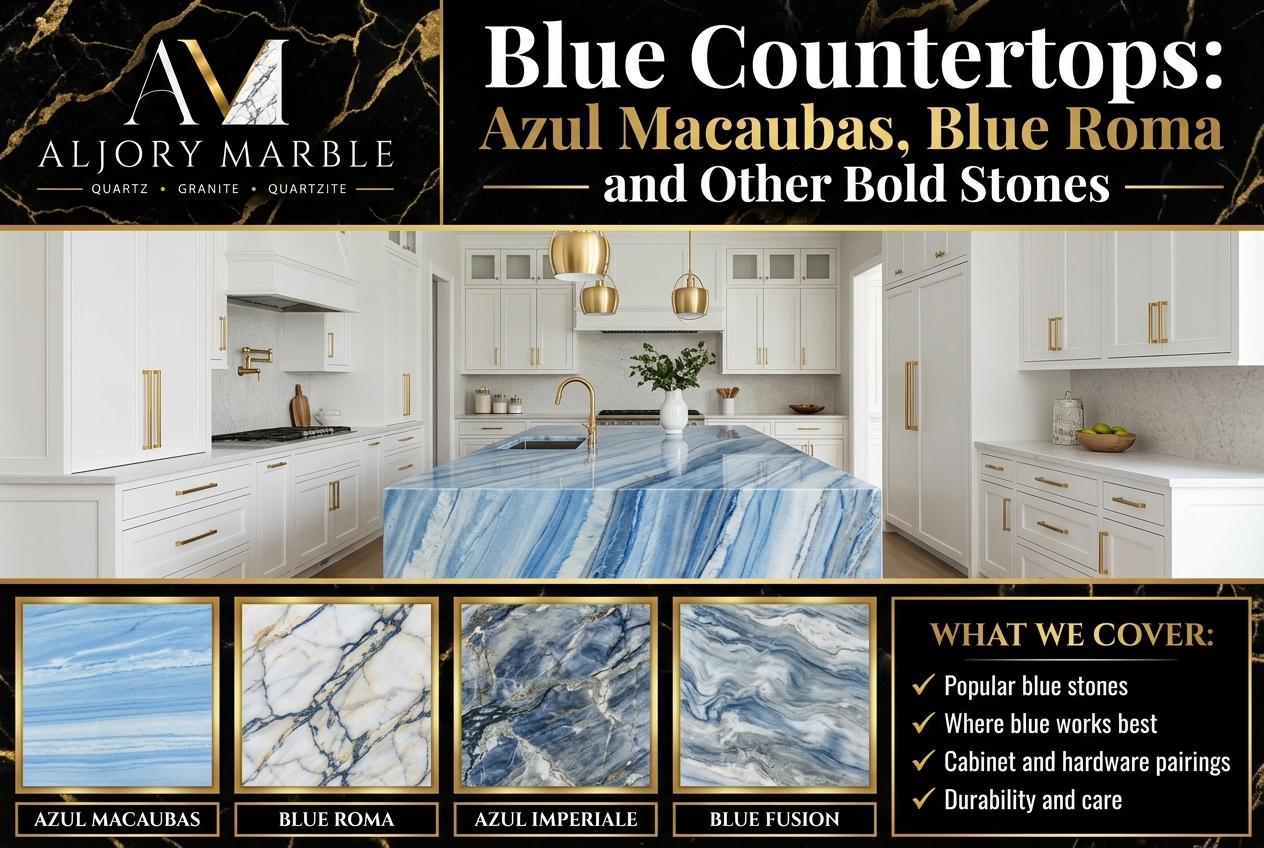
Blue countertops turn a kitchen island or vanity into the first thing people notice. Blue is rare in natural stone, so the slabs that have it stand out. This guide covers the most popular blue stones, including Azul Macaubas, Blue Roma, Azul Imperiale, Blue Fusion, and Blue Pearl. You will learn how each one looks, how it holds up, and how to design a room around it.
Quick answer: For the brightest, rarest blue, choose Azul Macaubas. For blue with warm copper and gold veins, choose Blue Roma. For a lower-key blue with white and gold lines, look at Azul Imperiale. For a painterly mix of blue, gray, and rust, choose Blue Fusion. For a dark stone with a blue shimmer, look at Blue Pearl granite.
Why Blue Stone Is So Rare
Most natural stone comes in white, gray, beige, brown, or black. True blue needs special minerals. In Azul Macaubas, for example, the blue comes from a mineral called dumortierite. Stones like this come from only a few places in the world, which is why blue slabs are often limited and priced higher than common granite.
Most of the blue stones in this guide are quartzite from Brazil. Quartzite is a natural stone made mostly of quartz. It is very hard, handles heat well, and does not etch from lemon juice or vinegar the way marble does. Learn more on our quartzite countertops page.
Blue Countertops at a Glance
| Stone | Type | Colors | Pattern | Best for |
|---|---|---|---|---|
| Azul Macaubas | Quartzite, Brazil | Sky blue to deep blue, white | Linear bands, wave-like | Statement islands, feature walls |
| Blue Roma | Quartzite, Brazil | Powder blue to blue-gray, copper, gold, burnt orange | Bold, crossing veins | Islands, vanities, bars |
| Azul Imperiale | Sold as quartzite, Brazil | Blue, navy, white, gold | Linear veins | Islands, waterfalls, backsplashes |
| Blue Fusion | Quartzite, Brazil | Steel blue, charcoal, rust, beige | Swirling, painterly | Islands, feature walls |
| Blue Pearl | Granite, Norway | Dark blue-gray with blue shimmer | Large crystals that flash blue | Bars, vanities, accent tops |
Azul Macaubas: The Rare Sky Blue Quartzite
Azul Macaubas is the best known blue stone in the world. It comes from the Bahia region of Brazil. Its color runs from soft sky blue to deep blue, often with white bands and sometimes beige or gold touches. The blue comes from dumortierite, a rare mineral mixed into the quartz.
Why people pick it:
- The brightest, most true blue in natural stone
- It is a hard quartzite, so it handles daily use, heat, and acids well
- Every slab is one of a kind
- It makes a stunning island, waterfall, or full height backsplash
What to know before you buy:
- It is rare and priced at the high end. Many homeowners use it on an island only and pair it with a quieter stone on the perimeter.
- Color and pattern change a lot between slabs. Choose your exact slab in person.
- Like most quartzite, it should be sealed.
Best for: A showpiece island, a waterfall end, a bar top, or a feature wall.
Blue Roma: Blue Gray With Copper Veins
Blue Roma is a quartzite from Brazil with a powder blue to blue-gray base. Bold veins of copper, gold, and burnt orange cross the surface. The warm veins against the cool blue base give it an artistic, high-contrast look. You may also see it sold as Blue Deep.
Why people pick it:
- Cool blue and warm copper in the same stone
- Hard and durable for kitchen use
- Works well with brass and gold fixtures
- A leathered finish brings out the texture of the veins
What to know before you buy:
- The pattern is bold. It looks best with simple cabinets and a quiet backsplash.
- Some slabs lean more gray, some more blue. See the full slab before it is cut.
Best for: Kitchen islands, bathroom vanities, home bars, and fireplace surrounds.
Azul Imperiale: Blue With White and Gold Lines
Azul Imperiale is sold by major suppliers as a quartzite from Brazil. It has blue and navy tones with white and gold veins that run in long, linear lines. It is a good choice if you want blue with more movement than Azul Macaubas, or a softer look than Blue Roma.
Why people pick it:
- Strong linear pattern that looks great on a waterfall or full height backsplash
- Blue, white, and gold tones that pair well with white cabinets
- A natural stone with a lot of movement
What to know before you buy:
- Not every source classifies this stone the same way. Some describe it as a marble. Before you buy, test a sample for etching (see the testing section below).
- Plan the vein layout so the lines flow across seams and edges.
Best for: Waterfall islands, full height backsplashes, and modern kitchens.
Blue Fusion: A Painterly Mix of Blue, Gray, and Rust
Blue Fusion, also sold as Fusion or Fusion Blue, is a quartzite from Brazil. It mixes steel blue, charcoal gray, rust orange, and creamy beige in swirling patterns that look almost like an oil painting. No two slabs are alike.
Why people pick it:
- One of the most colorful natural stones you can buy
- The busy pattern hides crumbs, fingerprints, and small marks
- Hard quartzite that holds up to daily cooking
What to know before you buy:
- The colors vary a lot. Some slabs are mostly blue, others lean rust and gray.
- With this much color, keep cabinets, flooring, and backsplash simple.
Best for: A statement island, a feature wall, or a wet bar.
Blue Pearl: Dark Granite With a Blue Shimmer
Blue Pearl is a dark granite from Norway. It is filled with large crystals that flash blue and silver as you move around it. It is a good pick if you want a hint of blue in a darker, more classic stone. Do not confuse it with Black Pearl, a black granite from India with silver flecks. See our guide to black countertops.
Why people pick it:
- A darker blue look that feels classic, not loud
- The shimmer changes with the light
- Granite durability and heat resistance
Best for: Home bars, vanities, kitchen perimeters, and commercial counters. Browse more on our granite countertops page.
Is It Really Quartzite? How to Test Blue Stone
In the stone trade, names and labels are not always exact. The same stone may be sold as quartzite by one supplier and as marble or dolomite by another. This matters because true quartzite does not etch, while marble and dolomite can etch from lemon juice, vinegar, and wine.
Two simple tests help:
- Glass test. Try to scratch a piece of glass with an edge of the stone sample. True quartzite is harder than glass and will scratch it. Marble will not.
- Etch test. Put a few drops of lemon juice or vinegar on a sample for a few minutes, then wipe it off. If you see a dull mark, the stone has calcite in it and will etch in your kitchen.
Ask your fabricator to help you test before you commit to a slab. Read more in our quartzite countertops guide.
Where Blue Countertops Work Best
Blue stone is bold, so many homeowners use it where it can shine:
- Kitchen islands. The most popular choice. A blue island with a white or neutral perimeter keeps the room balanced. See our kitchen island countertop guide.
- Waterfall edges. Wrapping the stone down the side shows off the pattern. Read about waterfall islands.
- Full height backsplashes. A slab behind the range turns the wall into art. See our full height stone backsplash guide.
- Bathroom vanities. A small top is a lower cost way to use a rare stone. See our bathroom vanity tops.
- Home bars. Blue Fusion and Blue Pearl are great for bars. Read our wet bar countertops guide.
- Fireplaces. A blue surround makes a strong focal point. See our stone fireplace surround guide.
Designing a Kitchen Around Blue Countertops
Blue countertops work best when the stone leads and the rest of the room supports it.
- Cabinets: White and soft cream cabinets let the blue pop. Warm wood adds balance to cool blue. Navy cabinets with a blue stone can feel heavy unless the stone has a lot of white.
- Hardware and fixtures: Brass and gold pick up the gold and copper veins in Blue Roma and Azul Imperiale. Polished nickel suits cooler stones like Azul Macaubas.
- Backsplash: Keep it simple, or use the same stone. A busy tile will fight the slab.
- Perimeter: If the blue stone is on the island, a quiet white quartz or quartzite on the perimeter keeps the look clean and controls cost. See our quartz countertops page.
- Lighting: Blue looks different in daylight and warm light. Look at your slab in both if you can.
For more pairing ideas, read how to match stone with cabinets.
Plan the Vein Layout Before the Cut
Blue stones have a lot of movement, so where you cut matters. On an island or waterfall, a good fabricator lays out the pattern before cutting so the veins flow across seams and down the sides. Some homeowners choose bookmatched slabs, where two slabs open like a book and mirror each other.
Read vein matching and bookmatching explained and countertop slab selection, templating, and cutting explained.
How to Care for Blue Quartzite and Granite
- Wipe daily with warm water and a mild, pH-neutral soap.
- Dry with a soft cloth to prevent water spots.
- Seal as your fabricator recommends. If water soaks in and darkens the stone, it is time to reseal.
- Wipe up oil quickly. Quartzite resists acids but can still absorb oil if the sealer wears.
- Use trivets and cutting boards to protect the finish over time.
See our countertop care guide for more.
What Blue Stone Costs
Blue stone usually costs more than common granite because it is rare and comes from a few quarries. Azul Macaubas is among the most expensive. What you pay depends on:
- The stone and the slab you choose
- How many slabs your project needs
- Square footage and island size
- Finish and edge profile. See our edge profiles guide
- Extras like a waterfall end or full height backsplash
To save, use the blue stone on the island or vanity only. For real price ranges, see our countertop cost guide.
See Blue Slabs in Our Crestwood Showroom
Blue stone has to be seen in person. A photo or small sample cannot show how the color moves across a full slab. Visit our showroom and slab yard at 4711 135th St, Crestwood, IL 60418, Monday to Saturday, 9 am to 6 pm. Exotic slabs come and go, so call ahead to ask what is in stock.
We template, cut, and finish every slab in our own shop, and our own crew installs it. Get a free estimate or call (708) 362-7674.
Frequently Asked Questions About Blue Countertops
What is the most popular blue countertop stone?
Azul Macaubas is the best known blue countertop stone. It is a rare quartzite from Brazil with sky blue to deep blue color. Blue Roma, Azul Imperiale, and Blue Fusion are other popular blue stones.
Why is blue quartzite so expensive?
Blue is rare in natural stone. Stones like Azul Macaubas get their color from uncommon minerals and come from only a few quarries, so supply is limited and prices are higher.
Is Azul Macaubas quartzite durable for a kitchen?
Yes. Azul Macaubas is a hard quartzite that handles heat and daily use well and resists etching from acids. Like most natural stone, it should be sealed.
What colors are in Blue Roma quartzite?
Blue Roma has a powder blue to blue-gray base with bold veins of copper, gold, and burnt orange. The warm veins against the cool blue give it a high-contrast look.
How can I tell if a blue stone is real quartzite?
Try a glass scratch test and an etch test on a sample. True quartzite scratches glass and does not etch from lemon juice or vinegar. Ask your fabricator to help you test before you buy.
What cabinets go with blue countertops?
White and cream cabinets let blue stone stand out. Warm wood cabinets balance cool blue tones. Brass or gold hardware pairs well with stones that have gold or copper veins.
Can I use blue stone on just the island?
Yes. Many homeowners use blue stone on the island and a quiet white quartz or quartzite on the perimeter. This keeps the room balanced and helps control cost.
Where can I see blue countertop slabs near Chicago?
Visit the Al Jory Marble showroom and slab yard at 4711 135th St, Crestwood, IL 60418, Monday to Saturday, 9 am to 6 pm. Exotic slabs change often, so call ahead to check stock.


Serving Chicago & Surrounding Areas
Get Your Free Kitchen Countertop Estimate
Fill out the form and our team will get back to you in next 24 hours.