
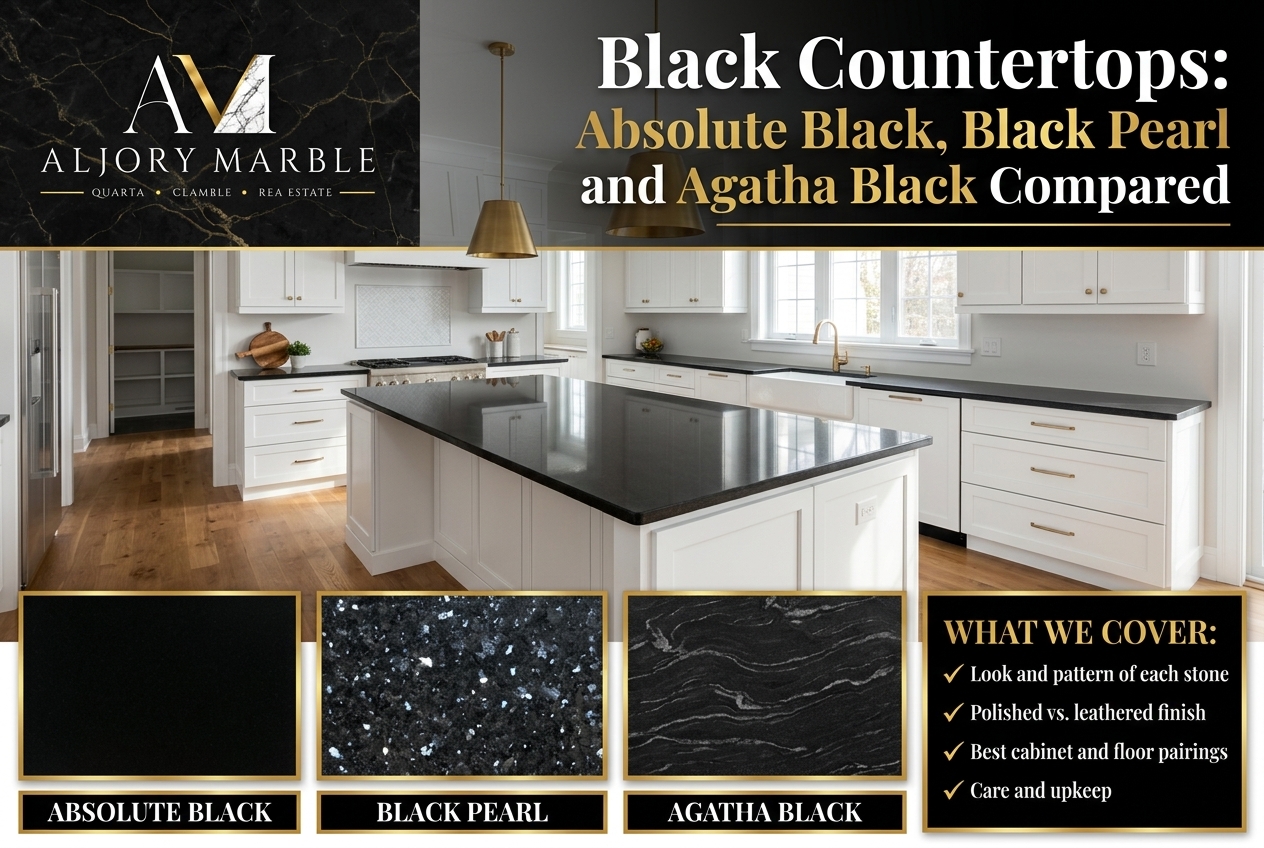
Black countertops give a kitchen a bold, finished look that works with almost any cabinet color. But not all black stone looks or behaves the same. Absolute Black is solid and sleek. Black Pearl has a silver shimmer. Agatha Black has white veins that move across the slab. This guide compares all three so you can pick the right one for your home.
Quick answer: Choose Absolute Black for a clean, solid black look. Choose Black Pearl if you want sparkle that hides crumbs and smudges better. Choose Agatha Black if you want the drama of veining without the upkeep of marble. All three are natural granite, handle heat well, and hold up to daily cooking.
Black Countertops at a Glance
| Absolute Black | Black Pearl | Agatha Black | |
|---|---|---|---|
| Look | Solid, uniform black | Black with silver and gray flecks | Black with light gray and white wavy veins |
| Pattern | Almost none | Fine speckle, some shimmer | Flowing veins with movement |
| Shows fingerprints | Most, when polished | Less | Less |
| Hides crumbs | Least | Well | Well |
| Style | Modern, minimal | Classic or modern | Dramatic, high design |
| Best finish options | Polished, honed, leathered | Polished, leathered | Polished |
Why Homeowners Choose Black Countertops
Black stone has been a kitchen favorite for years, and for good reason.
- It goes with everything. White, wood, green, gray, and navy cabinets all work with black.
- It grounds a bright kitchen. In an all-white room, a black island adds contrast and weight.
- It handles heat. Granite is formed by heat, so hot pans are not a worry the way they are with quartz.
- It hides stains. Coffee, wine, and oil stains are hard to see on a dark surface.
There are trade-offs too. Polished black stone shows fingerprints, water spots, and dust more than lighter stone. We cover how to manage that in the finish section below.
Absolute Black: The Solid Black Look
Absolute Black is the deepest, most uniform black you can get in natural stone. Up close you may see a very fine grain, but from a few feet away it reads as solid black. Most Absolute Black is quarried in India. It is sold in the trade as granite, but it is a very dense stone, which is why it takes such a deep shine.
Why people pick it:
- Clean, modern look with no busy pattern
- Very dense, so it resists stains well
- Slab to slab, the color is very consistent, which helps on large kitchens with seams
- Works in polished, honed, and leathered finishes
What to know before you buy:
- Polished Absolute Black shows fingerprints and water spots more than any other black stone. There is no pattern to hide them.
- Some black stone on the market is lighter gray stone that has been dyed or treated to look darker. That color can fade over time. See the section on dyed stone below.
Best for: Modern kitchens, white shaker kitchens that need contrast, bar tops, and anyone who wants a quiet, solid surface.
Black Pearl: Black With a Silver Shimmer
Black Pearl is a black granite filled with silver and gray mineral flecks. Under light, those flecks give the stone a soft shimmer. Most Black Pearl is quarried in India. The pattern is fairly consistent, but some slabs have larger crystals than others, so it is worth seeing a few slabs before you choose.
Why people pick it:
- The speckle hides crumbs, smudges, and water spots better than solid black
- It still reads as black from across the room
- The shimmer adds interest without a bold pattern
- It comes in large slabs, which helps on long runs and islands
What to know before you buy:
- Crystal size and shimmer change from slab to slab. Pick your actual slab, not a small sample. Read why two slabs of the same granite never look the same.
- Like most granite, it should be sealed to keep it stain resistant.
- Do not confuse it with Blue Pearl, a different stone from Norway with a blue shimmer.
Best for: Busy family kitchens, rental properties, wet bars, and anyone who wants black without daily wiping.
Agatha Black: Black With White Veins
Agatha Black is a granite from Brazil with a dark black base and light gray and white wavy veins. The veins add movement, so it looks closer to a dramatic marble than a typical granite. It is a natural stone, so no two slabs are the same.
Why people pick it:
- The marble look in black, with the toughness of granite
- The veins make a strong statement on an island or waterfall
- The pattern helps hide everyday smudges
- It handles heat and daily cooking the way granite does
What to know before you buy:
- Vein layout matters. On an island or waterfall, plan how the veins line up across seams and edges. See vein matching and bookmatching explained and our guide to waterfall islands.
- Because every slab is different, see the full slab before it is cut.
Best for: Statement islands, waterfall edges, full height backsplashes, fireplaces, and powder rooms.
Polished, Honed, or Leathered: Picking a Finish for Black Countertops
The finish you choose changes how black countertops look and how much wiping they need. Read our full guide to polished vs. honed vs. leathered countertops.
| Finish | Look | Fingerprints and water spots | Good to know |
|---|---|---|---|
| Polished | Deep, glossy, mirror-like | Shows them most | Most slabs arrive polished, so it is usually the standard option |
| Honed | Flat, matte, soft black | Shows less shine but can show oily marks | Can look more charcoal than jet black; may need sealing more often |
| Leathered | Textured, soft sheen | Hides them best | Keeps a rich black color with a touch of texture |
In the Chicago area, hard water can leave mineral spots on dark stone, especially near the sink. A leathered finish or a quick dry with a soft cloth helps. Read how Chicago’s hard water affects your countertops.
Watch Out for Dyed Black Granite
True black granite should not fade. But some stone sold as black is gray stone that has been dyed or treated with oils to look darker. Over time, that color can fade, often near the sink or where you clean the most.
A simple test helps. Wipe a hidden spot of the slab with a clean white cloth and a little acetone. If black color comes off on the cloth, the stone has been dyed. Ask your fabricator to do this test before the slab is cut. Buying from a shop where you can see and check the full slab makes this easy.
What Pairs Well With Black Countertops
Black is one of the easiest countertop colors to design around. A few pairings that work well:
- White cabinets: Classic, high contrast. Absolute Black gives the sharpest look.
- Warm wood cabinets: Black stone with oak or walnut feels warm and modern.
- Sage, olive, or forest green cabinets: Black adds depth without fighting the color.
- Navy or gray cabinets: Agatha Black or Black Pearl adds texture so the room does not feel flat.
- Hardware: Brass and gold pop against black. Matte black hardware gives a quiet, modern look.
- Backsplash: A white or light backsplash keeps the room bright. A full height backsplash in the same stone makes a bold statement. See our full height stone backsplash guide.
For more ideas, read how to match stone with cabinets.
Where Black Stone Works Beyond the Kitchen
Black granite is not just for kitchens. It also works well in:
- Bathroom vanities. Black looks sharp with white sinks and brass faucets. See our bathroom vanity tops.
- Wet bars and home bars. Black Pearl and Agatha Black hide spills well. Read our wet bar countertops guide.
- Fireplace surrounds. Agatha Black makes a strong focal point. See our stone fireplace surround guide.
- Commercial spaces. Restaurants, coffee shops, and offices use black granite for its durability. See our commercial countertops.
- Outdoor kitchens. Granite holds up outdoors, but dark stone gets hot in direct sun. Read outdoor kitchen countertops in Chicago weather.
Other Black Stones to Consider
If none of the three feels right, there are other black options:
- Black Galaxy: Black granite with gold flecks that sparkle like stars.
- Andes Black: A black quartzite for those who want natural stone with a different pattern.
- Black quartz: Engineered stone that never needs sealing. See our quartz countertops.
You can browse more options on our granite countertops page.
How to Care for Black Granite
Black granite is low maintenance if you follow a few simple habits:
- Wipe daily with warm water and a mild, pH-neutral soap.
- Dry with a soft microfiber cloth to stop water spots and streaks.
- Skip vinegar, bleach, and harsh cleaners. They can wear down the sealer.
- Seal as your fabricator recommends. To check, drop a little water on the stone. If it soaks in and darkens the spot, it is time to reseal.
- Use a cutting board. Granite is hard enough to dull your knives.
Our countertop care guide covers each stone in more detail.
What Black Countertops Cost
The price of black countertops depends on more than the stone name. The main factors are:
- The slab you choose and how many slabs your kitchen needs
- Square footage, including the island
- Finish, since honed or leathered work can cost more than standard polished
- Edge profile. See our edge profiles guide
- Cutouts for the sink and cooktop, plus extras like a waterfall end
For real price ranges, see our countertop cost guide. Every estimate from Al Jory Marble is free and in writing.
See Black Slabs in Our Crestwood Showroom
Black stone looks different under showroom lights, daylight, and your kitchen lighting. The best way to choose is to see the full slab. Visit our showroom and slab yard at 4711 135th St, Crestwood, IL 60418, Monday to Saturday, 9 am to 6 pm. Bring a cabinet door and a floor sample to hold against the stone. If you cannot make it in, we can bring samples to your home.
We template, cut, and finish every slab in our own shop, and our own crew installs it. Get a free estimate or call (708) 362-7674.
Frequently Asked Questions About Black Countertops
Which black granite is best for a kitchen?
It depends on the look you want. Absolute Black is best for a solid, modern look. Black Pearl hides crumbs and smudges better. Agatha Black adds white veins for a bold, marble-like look with granite durability.
Do black countertops show fingerprints?
Polished black countertops show fingerprints and water spots more than lighter stone. Absolute Black shows them the most because it has no pattern. A leathered finish or a speckled stone like Black Pearl hides them better.
Is Absolute Black real granite?
Absolute Black is a natural stone sold in the trade as granite. It is very dense, which helps it resist stains and take a deep polish. Some black stone on the market is dyed, so ask for an acetone test before the slab is cut.
How can I tell if black granite is dyed?
Wipe a hidden spot with a clean white cloth and a little acetone. If black color comes off on the cloth, the stone has been dyed and the color may fade over time.
What is the difference between Black Pearl and Absolute Black?
Absolute Black is solid black with almost no pattern. Black Pearl is black with silver and gray flecks that give it a soft shimmer and help hide smudges.
Does Agatha Black granite need sealing?
Like most natural granite, Agatha Black should be sealed to keep it stain resistant. Your fabricator can tell you how often based on the slab and finish.
What cabinet colors go with black countertops?
Black works with white, wood, green, gray, and navy cabinets. White cabinets give the most contrast. Warm wood gives a modern, warm look.
Where can I see black granite slabs near Chicago?
Visit the Al Jory Marble showroom and slab yard at 4711 135th St, Crestwood, IL 60418, Monday to Saturday, 9 am to 6 pm. We can also bring samples to your home.



Serving Chicago & Surrounding Areas
Get Your Free Kitchen Countertop Estimate
Fill out the form and our team will get back to you in next 24 hours.