
Written by the Al Jory Marble team. We fabricate and install in our own shop at 4711 135th St in Crestwood, Illinois.
The Short Answer
There is no single best countertop material. There is a best material for how you cook, how much upkeep you will actually do, and what you want the kitchen to look like in ten years.
Here is the honest version, before the detail:
- Pick quartz if you want a surface that never needs sealing and looks the same in year ten as it did on day one.
- Pick Calacatta if you want white stone with bold veining. Calacatta is a look, not a material, so you then choose whether you want it in quartz, marble, or quartzite.
- Pick marble if you want real Italian stone and you accept that it will etch and soften into a patina.
- Pick granite if you want the toughest natural stone for the money and you like heavy movement and color.
- Pick Taj Mahal quartzite if you want the marble look but you cook hard and do not want to worry about lemon juice.
The rest of this guide explains why, with 2026 pricing, a durability comparison, and the questions we get asked most often in our Crestwood showroom.
The Five Surfaces at a Glance
Before we go deep, here is the whole decision on one screen. Costs are published 2026 industry ranges for fully installed countertops in the United States, including material, fabrication, and installation. Your real number depends on the slab you pick, your square footage, edge profile, and cutouts.
| Surface | What it is | Typical installed range, 2026 | Sealing | Best for |
|---|---|---|---|---|
| Quartz | Engineered stone, ground quartz bound with resin | $50 to $150 per sq ft | Never | Busy family kitchens, rentals, anyone who wants zero upkeep |
| Calacatta | A pattern, available in quartz, marble, or quartzite | $90 to $200 per sq ft depending on material | Depends on the material | Statement islands and bright white kitchens |
| Marble | Natural stone, quarried, soft and porous | $65 to $250 per sq ft | Regularly | Vanities, baking stations, buyers who want genuine marble |
| Granite | Natural stone, quarried, hard igneous rock | $40 to $175 per sq ft | Roughly once a year | Heavy use kitchens, outdoor kitchens, value seekers |
| Taj Mahal quartzite | Natural stone from Brazil, harder than granite | $100 to $160 per sq ft | Every 12 to 18 months | Serious cooks who want the marble look without the risk |
You can see full slabs of all five at our countertop showroom in Crestwood. A two inch sample chip cannot show you how veining moves across nine feet of stone.
What Countertops Actually Cost in 2026
Countertop pricing confuses people because fabricators quote it two different ways. Some quote material only. Some quote a single installed number. When you compare two estimates, make sure you are comparing the same thing.
Across the industry in 2026, material is usually 40 to 50 percent of the final price. Fabrication and installation make up the rest. That covers templating, cutting on the saw, polishing the edge, cutouts for your sink and cooktop, delivery, and the install crew.
| Material | Material only, per sq ft | Installed, per sq ft | Typical 40 sq ft kitchen |
|---|---|---|---|
| Entry level quartz | $30 to $50 | $50 to $85 | $2,000 to $3,400 |
| Mid grade quartz | $45 to $75 | $75 to $120 | $3,000 to $4,800 |
| Premium quartz, including Calacatta patterns | $70 to $110 | $110 to $200 | $4,400 to $8,000 |
| Granite, common colors | $25 to $50 | $40 to $100 | $1,600 to $4,000 |
| Granite, exotic slabs | $60 to $110 | $95 to $175 | $3,800 to $7,000 |
| Carrara marble | $40 to $80 | $65 to $160 | $2,600 to $6,400 |
| Calacatta and Statuario marble | $75 to $140 | $120 to $250 | $4,800 to $10,000 |
| Taj Mahal quartzite | $60 to $100 | $100 to $160 | $4,000 to $6,400 |
Two notes on that table. First, published Chicago market data for 2026 puts most quartz kitchens between $85 and $120 per square foot installed, which sits in the mid grade band. Second, add ons move the number more than people expect. A waterfall island edge, a full height slab backsplash, an undermount sink cutout, or tearing out an old top all add cost. Our countertop cost guide breaks those line items down.
The only number that matters in the end is a written estimate against your actual measurements. Call (708) 362-7674 or request a free estimate and we will measure at no charge.
Quartz: The Default Choice, and Usually the Right One
Quartz is engineered. Ground natural quartz is mixed with pigment and resin and pressed into slabs. That manufacturing process is the whole story, good and bad.
Why people choose quartz
It is nonporous. Nothing soaks in, so it never needs sealing, ever. Red wine, olive oil, turmeric, and coffee all wipe off. It does not etch, so lemon juice and vinegar sitting on the counter overnight do nothing.
The pattern is consistent from slab to slab. If you approve a sample, that is what shows up in your kitchen. On a big project across an island and two perimeter runs, that predictability is worth a lot. Natural stone cannot promise it.
It is also the most popular slab material in America and has been for years. In the 2026 Houzz Kitchen Trends Study, engineered quartz was the top slab choice among remodeling homeowners at 39 percent.
Where quartz falls short
Heat. The resin that binds quartz can scorch or discolor under a hot pan straight off the burner. Use a trivet. Granite and quartzite do not care about heat the same way.
Sunlight. Resin can yellow with heavy ultraviolet exposure, which is why quartz is not recommended for outdoor kitchens or a counter under a south facing window with no shade.
Depth. Up close, engineered stone does not have the translucency of quarried marble. From six feet away nobody can tell. Standing over the island with your hand on it, some people can.
See what we stock on our quartz countertops page, or read the full quartz countertops guide.
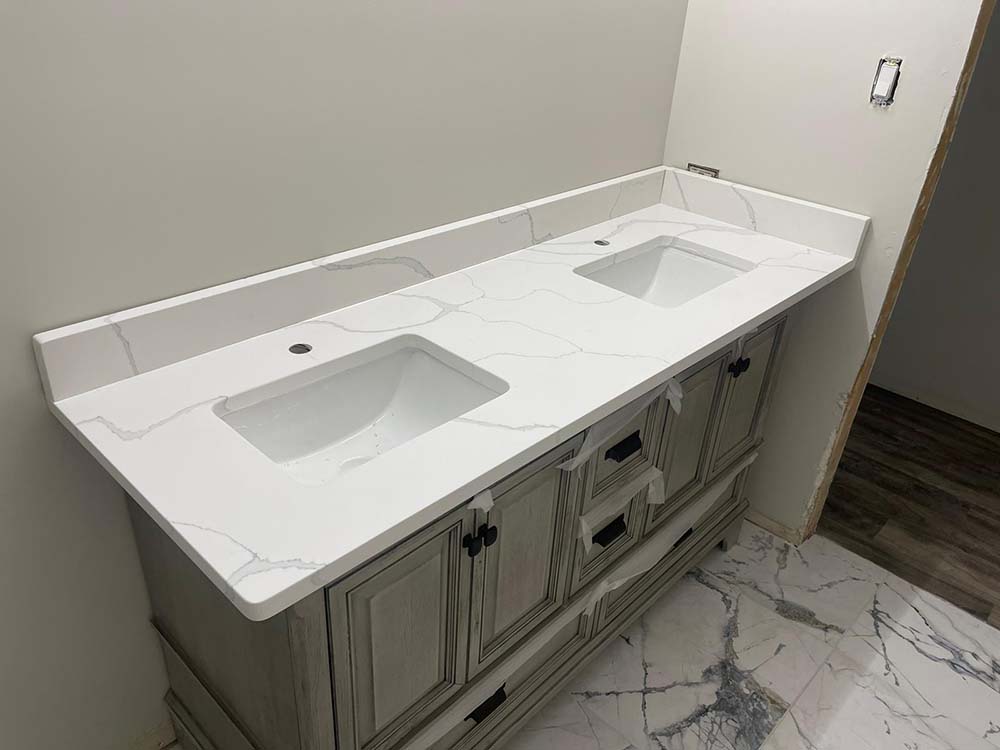
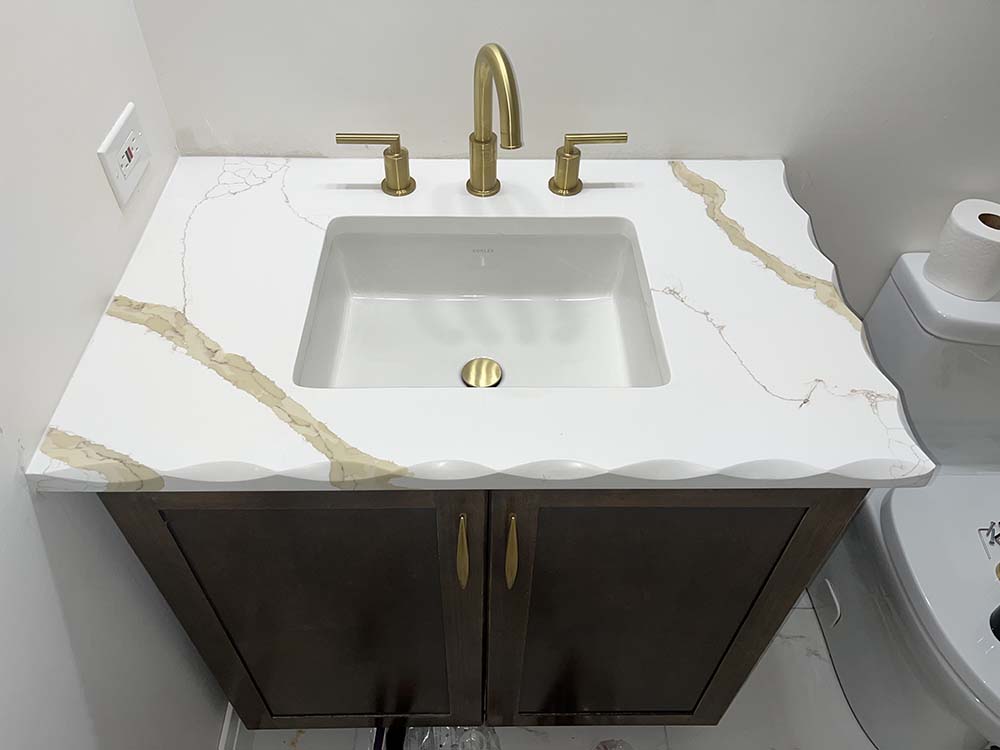
Calacatta: A Look, Not a Material
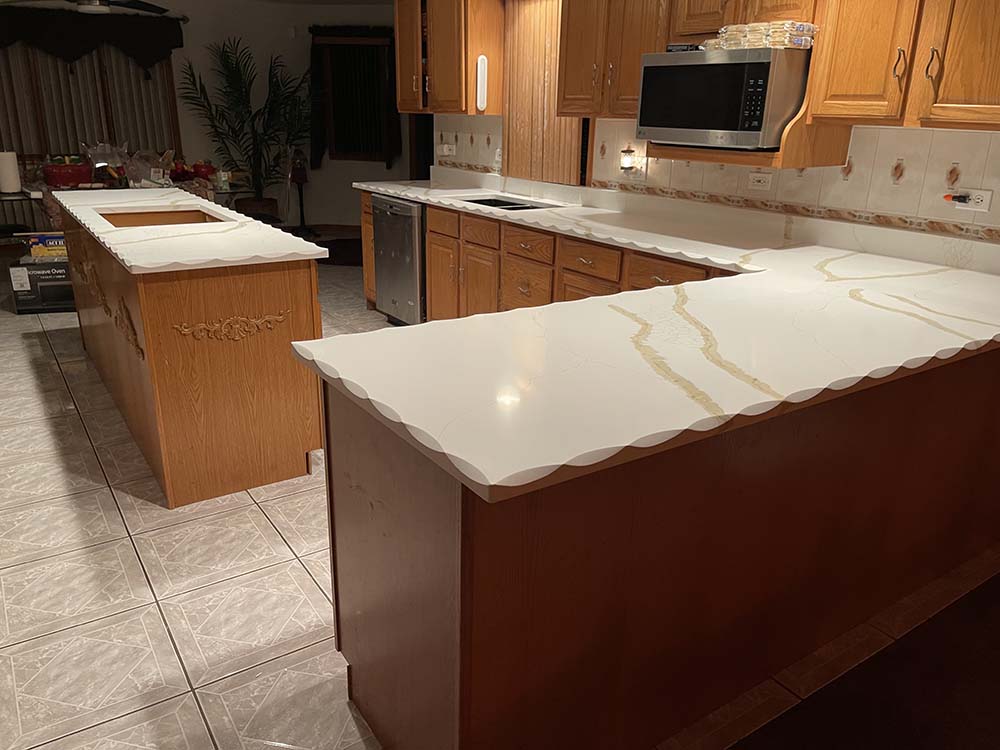
This trips up more homeowners than anything else on the list. Calacatta is not a material category the way quartz or granite is. It is a pattern: a bright white field with bold, widely spaced veining, often with warm gold or taupe running through it.
You can buy that pattern three different ways, and they behave completely differently in a kitchen.
| Calacatta quartz | Calacatta marble | Calacatta quartzite | |
|---|---|---|---|
| What it is | Engineered, manufactured | Natural, quarried in Italy | Natural, quarried in Brazil |
| Sealing | Never | Regularly | Periodically |
| Etches from acid | No | Yes, in seconds | Highly resistant |
| Heat tolerance | Use a trivet | Good | Excellent |
| Slab to slab consistency | Consistent | Every slab unique | Every slab unique |
| Relative cost | Moderate to high | Highest | High |
Most of the Calacatta we sell is quartz, and for most kitchens that is the right call. You get the look with none of the anxiety. If you specifically want quarried Italian marble, we stock that too. For the natural stone version with real durability, look at Calacatta Macaubas or Calacatta Montreal, which are quartzites.
Our Calacatta countertops page shows what is in the yard, and the complete guide to Calacatta marble and quartz goes deeper on the differences.
Marble: Beautiful, Honest About Its Flaws
Nothing else looks like marble. The veining runs through the depth of the stone rather than sitting on the surface, and it has a translucency every engineered surface is trying to copy.
Marble is also soft and porous. On the Mohs hardness scale it sits at 3 to 4, compared to 6 to 7 for granite and quartz. That is not a small gap. It means marble scratches more easily and it etches when acid touches it.
Etching is not staining
These are two different problems and people mix them up constantly.
Etching is a chemical reaction. Lemon, wine, vinegar, or tomato dulls the polish and leaves a matte mark. It happens in seconds. Sealer does not prevent it. Any fabricator who tells you a sealer stops etching is overselling.
Staining is something soaking in and darkening the stone, usually oil, over hours. Sealer does help with that.
What makes marble work in a kitchen
Two things. Finish and expectation.
A honed finish has no polish for an acid to dull, so etching is far less visible. We recommend honed marble in kitchens more often than polished. Leathered finishes hide even more.
Expectation is the other half. Marble will change. The people who love their marble ten years in are the ones who wanted a surface that records a life. The people who expected it to look new forever are unhappy inside eighteen months. We would rather have that conversation before you buy.
Marble also stays cooler than the room, which is why pastry chefs roll dough on it. Even in a mostly quartz kitchen, a single marble baking section is a smart compromise.
Browse marble countertops, including Carrara, Calacatta, and Statuario, or read where marble works and where it does not.
Granite: The Value Pick That Still Wins on Toughness
Granite got typecast as the countertop of the early 2000s, and a lot of homeowners wrote it off with the speckled brown slabs of that era. That is a mistake. Granite today comes in enormous variety, from near solid black to slabs with sweeping movement that read closer to marble.
Why granite still makes sense
It is genuinely hard, sitting at 6 to 6.5 on the Mohs scale. It handles heat better than anything except quartzite, so a hot pan straight off the stove will not hurt it. It is ultraviolet stable, which makes it one of the few good options for an outdoor kitchen or a grill island.
It is also the widest price range on this list. Common colors are the most affordable natural stone we sell. Exotic slabs from rare blocks push past premium quartz. That range means granite fits almost any budget.
What to watch for
Granite is porous and needs sealing, generally about once a year depending on the stone and how hard the kitchen gets used. The test is simple. Drip water near the sink. If it beads, you are fine. If it darkens the stone, it is time to reseal.
The other thing to know is that no two slabs match. Two slabs of the same named granite can look meaningfully different, which is why we ask you to approve your actual slab rather than a sample. We wrote about why two slabs of the same granite never look the same if you want the geology behind it.
See what we carry on the granite countertops page, or read the granite countertops guide.
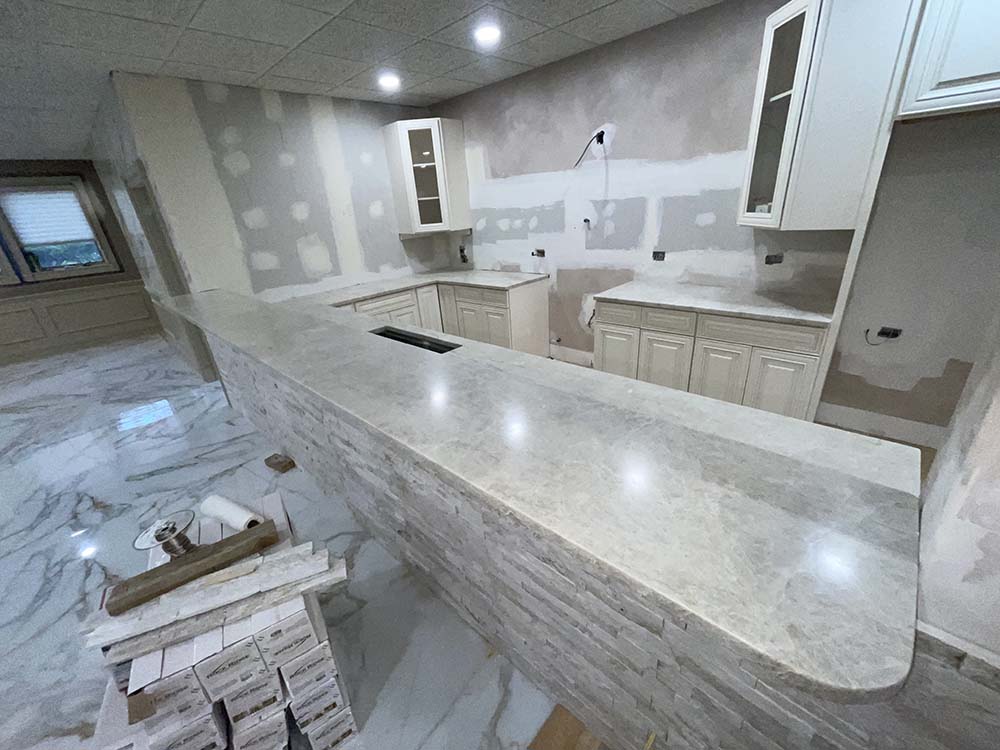
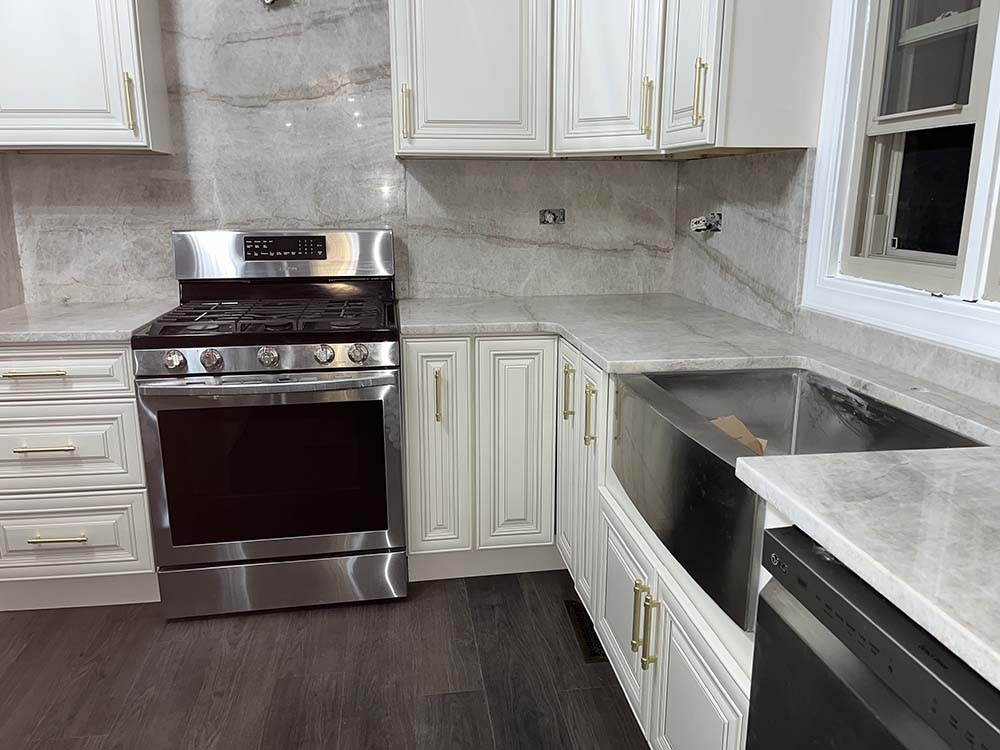
Taj Mahal Quartzite: The Marble Look That Survives a Real Kitchen
Taj Mahal is a quartzite quarried in Ceara, Brazil. It has a creamy, warm white background with soft gold and gray veining. Across a room it reads like marble. In use it behaves nothing like marble.
Quartzite starts as sandstone and gets compressed and heated until the grains fuse into a dense, interlocked crystal. That process makes it harder than granite, around 7 on the Mohs scale. It resists scratching, it does not etch from lemon or wine, and it takes heat without complaint.
The catch
It is porous, so it does need sealing. Most fabricators recommend every 12 to 18 months. Marketing that calls quartzite maintenance free is not accurate.
There is also a labeling problem worth knowing about. Some dolomitic marble gets sold as soft quartzite. It looks similar and costs less, but it etches like marble. Ask your fabricator to confirm what you are buying, and be skeptical of a quartzite priced well below the market.
Taj Mahal is not cheap. Published 2026 pricing puts it at $100 to $160 per square foot installed, with premium slabs and complex vein matching pushing higher. What you get for that is the only material on this list that gives you real natural stone, a marble look, and granite level durability at the same time.
Explore quartzite countertops, or read our complete Taj Mahal quartzite guide.
Head to Head: How They Actually Perform
| Property | Quartz | Calacatta quartz | Marble | Granite | Taj Mahal quartzite |
|---|---|---|---|---|---|
| Natural stone | No | No | Yes | Yes | Yes |
| Hardness, Mohs | 6 to 7 | 6 to 7 | 3 to 4 | 6 to 6.5 | 7 |
| Scratch resistance | Good | Good | Poor | Very good | Excellent |
| Heat resistance | Fair, use a trivet | Fair, use a trivet | Good | Excellent | Excellent |
| Stain resistance | Excellent | Excellent | Poor | Good when sealed | Good when sealed |
| Etch resistance | Excellent | Excellent | Poor | Very good | Excellent |
| Ultraviolet stability | Poor | Poor | Good | Excellent | Excellent |
| Outdoor use | No | No | Limited | Yes | Yes |
| Sealing schedule | Never | Never | Often | About yearly | Every 12 to 18 months |
| Repairable | Chips can be filled | Chips can be filled | Etches can be polished out | Chips can be filled | Chips can be filled |
| How it looks in ten years | The same | The same | Patinated, softened | Nearly the same | Nearly the same |
Choosing By How You Actually Live
Specifications only get you so far. Here is how we steer people in the showroom.
You have kids and you cook every night
Quartz. Full stop. Nothing gets ruined, nothing needs sealing, and nobody has to police what gets set down on the counter. If you want it to look like natural stone, pick a warm white quartz with soft veining.
You cook seriously and you want real stone
Taj Mahal quartzite, or another quartzite in the same family. You get the natural material, the heat tolerance for pans straight off the burner, and no anxiety about a lemon rolling off the cutting board.
You want the most kitchen for the money
Granite in a common color. It is the least expensive natural stone we fabricate, it is hard, and the variety is far better than its reputation suggests. Ask about remnants for a small kitchen or a vanity. Our post on countertop remnants explains how that works.
You want marble and you know what you are signing up for
Marble, honed. Put it where it will be happiest. A bathroom vanity top sees water rather than lemon juice, so marble is an easy win there. A fireplace surround, a butler pantry, or a baking station all give you the material without daily acid exposure.
You are remodeling to sell
Neutral colors in durable materials hold up best for resale. Warm white or light neutral quartz is the safest, broadest choice. Avoid anything strongly trend driven, because a bold slab appeals to fewer buyers.
It is an outdoor kitchen or a grill island
Granite or quartzite. Quartz resin is not ultraviolet stable and will discolor outdoors.
It is a restaurant, cafe, or office
Quartz for anything food facing, because the nonporous surface is easy to keep sanitary and consistent across long runs. Granite or quartzite where heat is a factor. We handle restaurant countertops, coffee shop countertops, and office countertops across Chicagoland.
What Is Trending in 2026
Three shifts are worth knowing about, because they affect what you will find in showrooms right now.
Warm neutrals replaced cool grays. At the 2026 Kitchen and Bath Industry Show, warm neutrals led the countertop releases: creamy off white backgrounds with veining in taupe, beige, sand, chocolate, and soft gold. Stark cool white is on the way down. Warm white with subtle veining is now the most requested look overall.
The island got louder while the perimeter got quieter. A calm surface on the perimeter runs with a dramatic Calacatta or Statuario style slab on the island is one of the most requested layouts we template.
Honed and matte finishes gained ground. Polished is still the default, but honed and leathered finishes are increasingly asked for. They read softer, they hide fingerprints better, and on marble a honed finish is genuinely the practical choice.
Taj Mahal quartzite fits all three trends at once, which is a large part of why demand for it keeps climbing.
A Few Things That Matter More in Chicago
Local conditions change the math a little.
Hard water. Much of Chicagoland has hard water, and mineral deposits leave spots that homeowners often mistake for stains or a failed sealer. Polished surfaces show it more than honed. We covered what actually removes them in our post on Chicago hard water and countertops.
Older housing stock. Bungalows, two flats, and older frame homes rarely have perfectly square walls or level cabinet runs. That is normal, and it is exactly what templating is for. Our guide to countertops for a Chicago bungalow covers the specifics.
Getting the slab into the building. Condos, walk ups, and high rises come with elevator reservations, certificates of insurance, and stairwell turns that a nine foot slab may not make. Worth planning early. See condo and high rise countertop replacement.
Winter. Installation runs year round here. Cold slabs need to acclimate before they are set, which is a scheduling detail rather than a problem. More in winter countertop installation in Chicago.
How the Project Runs
Whichever material you choose, the process is the same at our shop.
- Free consultation. We walk your kitchen or bath, talk through layout, edge profiles, sink cutouts, finish, and budget, then give you a written estimate at no charge.
- Slab selection. You pick your actual slab in our Crestwood yard, or we bring samples to your home.
- Templating. We capture exact dimensions, wall variation, and appliance clearances, then plan the vein layout so the pattern flows across your island and perimeter instead of stopping at a seam.
- Fabrication. Cut, edged, and polished in our own shop. Nothing is subcontracted.
- Installation. We set and seam the tops, dress the cutouts, apply the initial sealer where the material needs it, clean up, and walk the finished job with you.
Most kitchens run one to three weeks from template to install. More detail in our countertop installation timeline and the full kitchen countertop installation guide.
Frequently Asked Questions
What is the best countertop material overall?
For most kitchens, quartz. It is nonporous, it never needs sealing, it does not etch or stain, and the pattern is consistent from slab to slab. It is the most popular slab material in America for those reasons. The exceptions are outdoor kitchens, where quartz resin is not ultraviolet stable, and homes where the owner specifically wants natural stone.
Is Calacatta a type of marble or a type of quartz?
It is neither. Calacatta is a pattern, a bright white field with bold veining that often has gold or taupe warmth. You can buy that pattern in engineered quartz, in quarried Italian marble, or in natural quartzite. They look similar and behave very differently, so the material matters more than the name.
Is Taj Mahal quartzite better than marble?
For a working kitchen, usually yes. Taj Mahal gives you a similar warm white look with soft veining, but it is around 7 on the Mohs hardness scale compared to 3 to 4 for marble. It resists scratching and it does not etch from lemon or wine. Choose marble when you specifically want marble and the way it ages, not as a compromise.
Which countertop material is cheapest?
Among the five compared here, granite in a common color is the least expensive, starting around $40 per square foot installed in 2026. Entry level quartz is close behind. Remnant slabs are cheaper still for small kitchens and vanities, since you are using material left over from a larger job.
Does quartzite really need sealing?
Yes. Quartzite is porous natural stone, and most fabricators recommend resealing every 12 to 18 months. Marketing that describes quartzite as maintenance free is not accurate. Sealing is a short job and it protects against staining.
Can I put a hot pan on my countertop?
On granite and quartzite, yes. On marble, generally yes, though thermal shock is still a risk. On quartz, no. The resin that binds engineered quartz can scorch or discolor, so use a trivet.
What is the difference between etching and staining?
Etching is a chemical reaction where acid dulls the polish and leaves a matte mark, and it happens in seconds with lemon juice, wine, vinegar, or tomato. Staining is something soaking into the stone and darkening it, usually oil, and it happens over hours. Sealing helps with staining. Sealing does not prevent etching.
Which countertop is best for resale value?
Neutral colors in durable materials. Warm whites, light neutrals, and grays in quartz, granite, or quartzite tend to appeal to the widest range of buyers. Bold or strongly trend driven slabs narrow your buyer pool, even when they look striking in your own kitchen.
Do I have to pick my exact slab?
With natural stone, yes. Veining varies enormously between slabs of the same name and even within a single slab, so a small sample tells you very little about what ends up in your kitchen. With engineered quartz it matters less, because the pattern is consistent by design.
How much does a full kitchen cost in 2026?
A typical 40 square foot kitchen runs roughly $2,000 to $3,400 in entry level quartz, $3,000 to $4,800 in mid grade quartz, $1,600 to $4,000 in common granite, $4,000 to $6,400 in Taj Mahal quartzite, and $4,800 to $10,000 in Calacatta or Statuario marble. Edge profiles, cutouts, tear out, and a slab backsplash all move those numbers.
What should I use to clean my countertops?
Warm water and a mild dish soap, or a cleaner labeled pH neutral and safe for natural stone. Never use vinegar, lemon, bleach, or a generic bathroom spray on natural stone, because most of them are acidic and will etch the surface. Quartz tolerates more, but harsh chemicals can still dull it over time.
Can you replace countertops without replacing the cabinets?
Yes, and it is one of the most common jobs we do. As long as the cabinet boxes are sound and level, new tops can go straight on. We cover the details in our post on replacing countertops without replacing your cabinets.
Come See Them Side by Side
Photographs flatten the differences between these five surfaces. Marble looks like quartz on a screen. Taj Mahal looks like Calacatta. The only way to decide is to stand in front of full slabs.
Visit our showroom and slab yard at 4711 135th St in Crestwood, Illinois. Bring a cabinet door and a piece of your flooring and hold them up against the stone. Somebody will walk the yard with you, talk through how you actually cook, and schedule a free measurement.
We fabricate and install across Chicagoland, including Naperville, Orland Park, Tinley Park, Oak Lawn, Schaumburg, and Aurora.
Get a free estimate or call (708) 362-7674. Free measurement, written estimate, no obligation.

Serving Chicago & Surrounding Areas
Get Your Free Kitchen Countertop Estimate
Fill out the form and our team will get back to you in next 24 hours.