
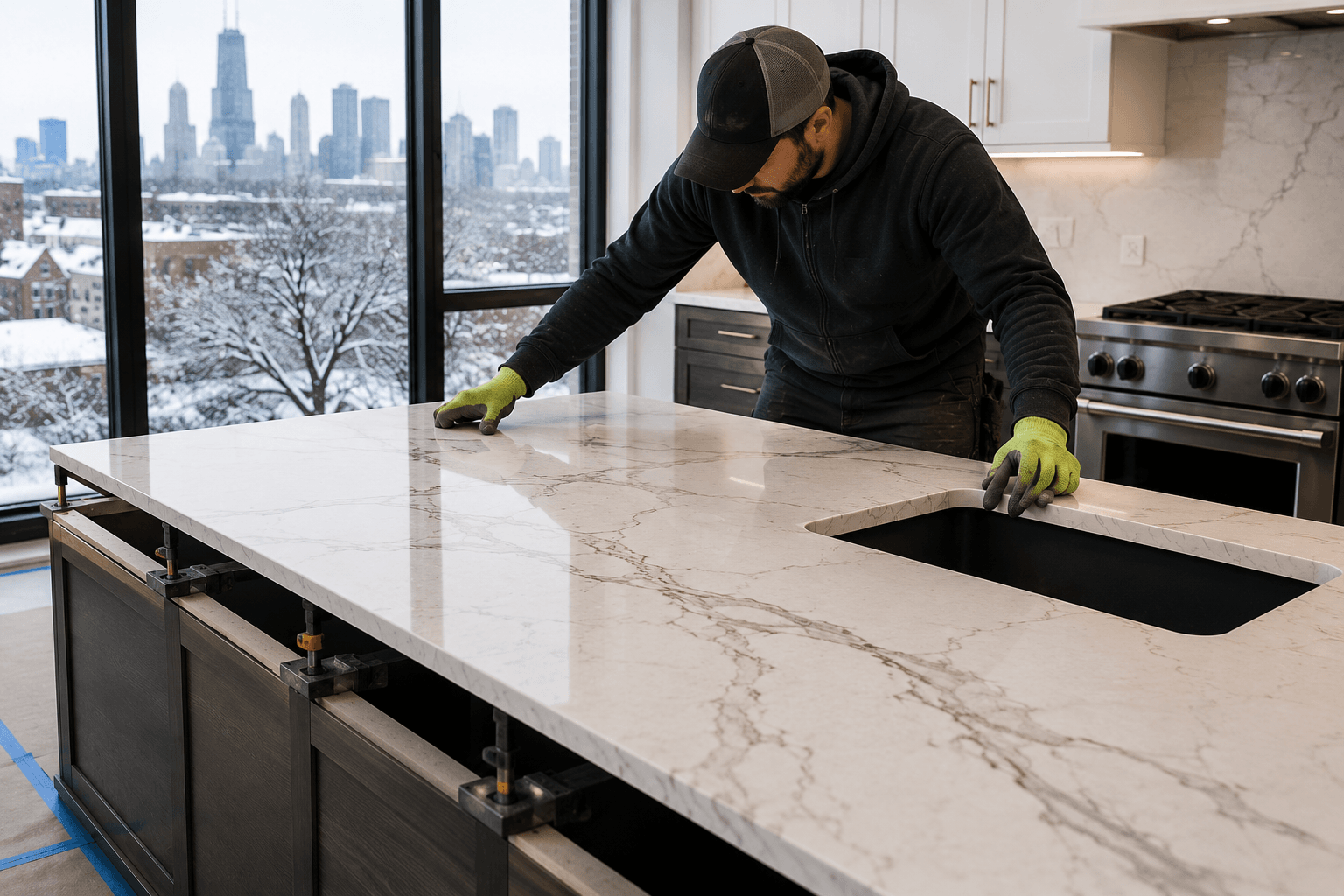
Homeowners ask us every November whether they should wait until spring. The short answer is no — we fabricate and install through the whole Chicago winter, and January is often one of the easier months to get on the schedule. But a few things genuinely change between July and February, and knowing them ahead of time makes install day go smoothly instead of becoming an improvised problem.
Stone comes into your house cold
A slab that’s been riding in a truck at 15 degrees is 15 degrees when it reaches your door. Bring that into a 70-degree kitchen and the surface pulls condensation the same way a cold glass does in August.
That matters for two reasons. Wet stone can’t be seamed or siliconed until it’s dry, and a slab that’s still contracting from cold will move slightly as it warms. Our crews handle this by letting pieces acclimate in the space before final setting rather than fighting it — usually a matter of staging the pieces and doing the disconnect and demo work while they come up to room temperature.
What we need from you is simple: have the heat on. A kitchen that’s been shut down at 50 degrees because the family is staying elsewhere during the remodel turns a half-day install into a two-visit job.
Silicone and epoxy cure slower
Every seam we make gets a color-matched epoxy. Every perimeter and sink joint gets silicone. Both are chemistry, and chemistry slows down in the cold.
At normal room temperature a seam sets up quickly and we can move on. In a cold room the same adhesive can take significantly longer, and rushing it produces a weaker joint. This is the single most common reason a winter install runs longer than the same job in June.
The practical consequences:
- Keep the space at normal living temperature the day before, the day of, and the day after.
- Expect us to be a little more conservative about when the sink can be reconnected.
- Don’t put weight on an island overhang or a seam until we tell you it’s cured.
None of this changes the finished result. It changes the clock. Our countertop installation timeline post covers the normal sequence; add a modest buffer to the install day itself in deep winter.
The path from the truck to your kitchen
This is where winter actually creates risk, and it has nothing to do with the stone.
Pieces of a fabricated countertop are heavy, awkward, and carried by hand. The route from the truck to your kitchen has to be safe for the crew and protected from the mess they’re tracking in. In January that route usually involves some combination of ice, snow, road salt, and a slush line just inside your door.
Here’s what helps enormously:
Clear and salt the walkway the morning of. Not the night before — overnight melt refreezes. A carried slab means a crew that can’t see their feet.
Hold a parking spot if you can. In city neighborhoods this is the difference between a 30-foot carry and a 200-foot carry in the cold. If your street uses winter parking restrictions, tell us in advance so we plan the approach. If you’re in a building, our post on getting a slab into a Chicago building covers the freight and elevator side.
Expect floor protection, and let us put it down. Salt is abrasive and it will scratch hardwood if it’s ground underfoot. We lay protection on the full route, not just the kitchen.
Keep pets somewhere else. Doors are propped open in winter installs more than you’d think.
Freight and slab availability shift
Most of the slabs in Chicago yards arrive by container, and the movement from port to distributor to local yard is slower in deep winter. Weather closures, holiday shutdowns at quarries and manufacturing plants, and reduced trucking capacity all compress into December through February.
For you, that means one thing: approve your slab earlier than you would in summer. If you fall in love with a specific piece of Calacatta and it needs to come from a distributor, the reorder window in January is longer than the one in June. Selecting from what’s physically in a local yard eliminates the problem entirely — and it’s the approach we recommend anyway, because two slabs of the same stone never look identical.
If you’re remodeling on a fixed date — a holiday, a listing, an event — build the extra lead time into your planning. Our post on when to order countertops during a remodel explains where this decision sits relative to your cabinets.
What doesn’t change
A lot, actually. Our fabrication shop is climate-controlled, so cutting, polishing, and seam prep are exactly the same in February as in August. Template accuracy is unaffected. Material quality is unaffected. The finished countertop in your kitchen is identical either way.
And templating is unaffected by weather too — it’s a digital measurement done indoors, and it takes about the same time year-round.
Why winter is often the better time to book
Remodeling demand in Chicagoland is seasonal, and it peaks in spring and early summer. That means winter usually brings:
- Shorter waits for a template appointment. In peak season, the gap between contract and template can stretch. In winter it typically doesn’t.
- More flexible install scheduling. Easier to get the day you want, easier to coordinate with your plumber and electrician, who are also less booked.
- A cabinet-to-countertop handoff that isn’t fighting a queue. If your cabinets land in January, your countertops can follow quickly instead of waiting behind a backlog.
Homeowners who are replacing tops without touching their cabinets often find winter the easiest possible window — the whole job is measured in days, and the kitchen is down for a short stretch when nobody’s entertaining anyway. Our post on replacing countertops without replacing cabinets covers what that project actually involves.
A short winter install-day checklist
- Heat on and holding normal temperature, day before through day after
- Walkway and steps cleared and salted the morning of
- Parking held or the approach route discussed with us in advance
- Sink, faucet and any appliances on site and ready
- Cabinets clear on top, and drawers under the sink emptied
- Pets secured away from the work route
- Plumber scheduled for the reconnect, with a little slack in the timing
Winter installs go fine. They go smoothly when the house is warm and the sidewalk isn’t a skating rink.
If you’re planning a project for the next few months, we’re happy to walk through the timing with you — request a quote or take a look at how our installation service works.






Serving Chicago & Surrounding Areas
Get Your Free Kitchen Countertop Estimate
Fill out the form and our team will get back to you in next 24 hours.